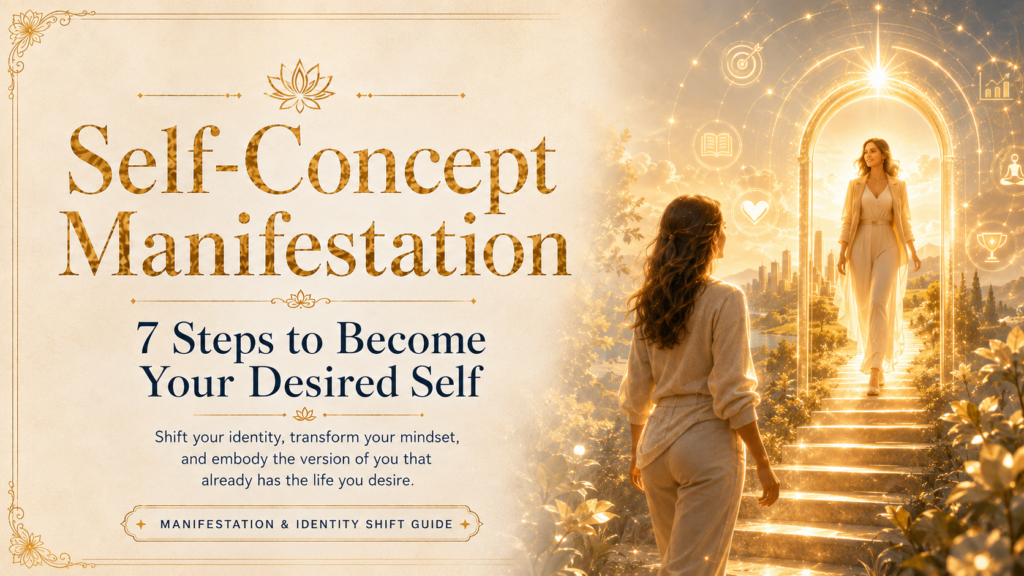
Introduction: What if the Goal Is Not to Chase a New Life, but to Become a New Version of You?
Most people begin manifestation with a list.
A better job. More money. A loving relationship. Confidence. Peace. A healthier body. A successful business. A bigger audience. A dream home. A life that finally feels like it matches the picture they carry in their mind.
Then they start collecting techniques. They write affirmations. They make vision boards. They try the 369 method. They listen to manifestation meditation before sleep. They visualise the desired outcome. They repeat “I am abundant” while checking the bank account. They say “I am loved” while anxiously watching whether someone replied. They search for how to manifest faster, how to make the Law of Attraction work, and what to do when manifestation is taking too long.
But underneath all of those techniques, one quieter question often remains untouched:
Who do you believe you are while you are doing all of this?
That question is the heart of self-concept manifestation.
Self-concept is the internal picture you carry of yourself: what kind of person you think you are, what you expect from life, what you believe you deserve, how capable you feel, what you tolerate, how you respond to setbacks, and what feels “normal” for someone like you.
You can desire abundance while identifying as someone who always struggles. You can visualise healthy love while secretly assuming people eventually leave. You can repeat success affirmations while believing you are the person who never follows through. You can say that you want peace while building an identity around pressure, urgency and overthinking.
This is why self-concept has become such a major topic in manifestation and Law of Assumption conversations in 2026. Current self-concept guides increasingly describe the practice as identity-level change: shifting the assumptions underneath your everyday decisions rather than simply repeating an outcome statement. That does not prove that identity magically rearranges external reality. It does point to something practical and powerful: identity affects attention, choices, confidence, boundaries, persistence and the opportunities you are prepared to act on.
The approach in this guide reflects the broader teaching style associated with Dr Amiett Kumar, the Amiett Kumar YouTube community and Readers Books Club: inner work becomes more useful when it leads to better awareness and better action. Meditation can quiet mental noise. Affirmation can help you rehearse a more supportive self-story. Visualisation can make a future behaviour feel more concrete. Spirituality can give meaning and perspective. Coaching can improve accountability. But the desired self must eventually show up in decisions.
This article will show you how to build that shift in seven clear steps.
What Is Self-Concept Manifestation?
Self-concept manifestation is the practice of deliberately changing the identity assumptions you repeatedly carry about yourself and your life.
In simple language, it asks you to stop beginning with:
“How do I get this thing?”
and begin with:
“Who would I be if this kind of life felt natural to me?”
Imagine two people who both want to start a business. The first person thinks, “I want to be successful, but I am terrible with money, I am not confident enough, and people like me do not build big businesses.” The second person thinks, “I am still learning, but I am becoming someone who makes clear decisions, learns from feedback, communicates value and handles money responsibly.”
They may have the same goal, but they are operating from different self-concepts. Those identities influence which opportunities they notice, how they interpret rejection, whether they ask for help, how quickly they recover from mistakes, and whether they behave consistently when motivation disappears.
Within the Law of Assumption tradition, self-concept is often connected to the idea that what you assume to be true about yourself becomes the lens through which you experience life. Followers commonly associate this teaching with Neville Goddard, whose spiritual philosophy emphasised imagination, assumption and living from the feeling of the desired state.
A grounded reading of this idea is useful even if you do not treat the Law of Assumption as a literal law of physics. Your internal assumptions can become self-reinforcing. If you believe you are socially awkward, you may enter conversations tense, speak less, read neutral reactions negatively and then use the awkward experience as proof that your original belief was correct. If you begin to see yourself as someone learning to connect confidently, you may make eye contact, stay present longer, recover from imperfect moments and gather new evidence.
That is identity shift manifestation in practical form: your self-story starts influencing your behaviour, and your behaviour starts giving your self-story new evidence.
Self-Concept Is Not the Same as Self-Esteem
These terms are often mixed together, but separating them makes the practice clearer.
Self-esteem is broadly about how positively or negatively you evaluate yourself.
Self-confidence is often more specific: how capable you feel in a particular situation.
Self-concept is wider. It includes the beliefs and descriptions that make up your picture of “me.” You may see yourself as creative, shy, spiritual, disciplined, unlucky, lovable, disorganised, ambitious, sensitive, bad with money, good under pressure, or someone who always has to struggle.
A person can have reasonable self-esteem and still carry an unhelpful self-concept in one area. You may genuinely like yourself and still believe, “I am terrible at relationships.” You may feel confident professionally and still think, “Money never stays with me.”
This is why manifestation self-concept work should be specific. “I love myself” may be valuable, but if your goal is career growth, you may also need to examine beliefs such as:
- I am not leadership material.
- I never speak confidently in important rooms.
- People like me are overlooked.
- I have to overwork to prove my worth.
- I cannot charge more for my work.
The desired self-concept might become:
- I prepare well and speak with clarity.
- I can learn leadership through practice.
- My work deserves to be communicated confidently.
- I can create value without constantly proving myself.
- I make thoughtful financial decisions.
Notice the difference. The new identity is positive, but it is also usable.
Why Self-Concept Matters in Manifestation
Many manifestation mistakes are not technique problems. They are identity contradictions.
Someone writes “I am financially abundant” every morning but spends the rest of the day avoiding bank statements because money feels frightening. Someone visualises a loving relationship but continues chasing emotionally unavailable people because inconsistency feels familiar. Someone says “I am successful” but procrastinates on the application, proposal or conversation that would create movement.
The conflict is not that the universe has rejected the affirmation. The conflict is that the practised identity and the desired identity are not yet aligned.
Psychology offers a more modest but useful parallel. Research on self-affirmation suggests that certain forms of affirming important values can reduce defensiveness and support small positive changes in intentions and behaviour. Research on mental simulation also finds that imagining future scenarios can influence later behaviour under some conditions. Neither area proves manifestation claims, but both support the idea that the way you mentally represent yourself and future action can matter.
At the same time, research also warns against forcing positive statements that feel wildly unbelievable. One well-known study found that repeating highly positive self-statements could make some people with low self-esteem feel worse. That is important for anyone using affirmations for self-concept. The best affirmation is not always the most dramatic sentence. It is the sentence you can repeat while building believable evidence.
Instead of:
“I am the most successful person in the world.”
try:
“I am becoming someone who follows through on important work.”
Instead of:
“Everyone loves me.”
try:
“I am learning to choose relationships where respect and consistency are mutual.”
Instead of:
“Money comes to me effortlessly every second.”
try:
“I am becoming more confident in earning, receiving, saving and managing money.”
Self-concept manifestation becomes stronger when the identity is aspirational enough to create movement and grounded enough to guide behaviour.
The 7 Steps to Become Your Desired Self
Step 1: Audit Your Current Self-Concept Without Judging It
You cannot deliberately change an identity you have never clearly observed.
Start by noticing the phrases you automatically use after disappointment, uncertainty or comparison. Those moments reveal self-concept faster than your morning affirmations do.
What do you say when someone rejects an idea?
“I knew nobody would take me seriously.”
What do you say when money becomes tight?
“This always happens to me.”
What do you say when a relationship feels uncertain?
“People always lose interest.”
What do you say when you miss one workout?
“I have no discipline.”
These are not harmless descriptions. Repeated often enough, they become identity instructions.
Create a Self-Concept Audit with five columns:
1. Area of life
2. Desired outcome
3. Current automatic belief
4. behaviour created by that belief
5. New identity assumption
Example:
Area: Career
Desired outcome: Promotion
Current belief: “I am invisible in important meetings.”
behaviour: Stay silent, overprepare, and avoid presenting ideas.
New identity: “I contribute clearly and learn to communicate my value.”
Do this for money, relationships, confidence, health and purpose.
The objective is not to attack the old self. That often creates shame, and shame makes identity change harder. The old self-concept usually formed for a reason. Perhaps it was learned from family messages, repeated experiences, school, relationships, social comparison or previous failures.
You do not need to blame the past. You need to stop treating the past as a permanent identity certificate.
A useful meditation prompt is:
“What do I repeatedly assume about myself when I am afraid?”
Sit quietly for five minutes and allow answers to emerge. Do not argue with them. Write them down. Awareness is the first movement of identity shift manifestation because what becomes visible can finally be questioned.
Step 2: Define Your Desired Self in behavioural Language
Many people define their desired self using only outcomes:
Rich. Married. Famous. Fit. Successful. Peaceful.
Those words describe results, but they do not tell you how to live today.
A useful desired self is defined by qualities, standards and repeatable behaviours.
If you want abundance, ask:
- How does my desired self manage money?
- What does this person learn?
- How does this person handle risk?
- What opportunities would this person apply for?
- What financial habits would feel normal?
If you want love, ask:
- What does my desired self tolerate and refuse?
- How does this person communicate needs?
- Does this person chase inconsistency or choose reciprocity?
- What boundaries protect peace?
If you want confidence, ask:
- How does this version of me enter a room?
- What happens after criticism?
- How does this person speak when uncertain?
- What skill would this person practise instead of pretending to know everything?
This approach makes self-concept manifestation actionable.
Create a one-page desired self profile. Complete these sentences:
- I am becoming someone who…
- I no longer need to prove…
- I protect my energy by…
- I handle setbacks by…
- I treat money by…
- I approach love by…
- I care for my body by…
- I create opportunities by…
- I speak to myself by…
- I make decisions from…
Keep the language personal. Do not copy a stranger’s Instagram identity. Your desired self should feel like a deeper version of you, not a costume built from comparison.
This is also where spirituality can provide a useful filter. Ask whether the identity you are building reflects your values. More money without integrity is not alignment. Confidence without empathy is not growth. Visibility without purpose can become another form of insecurity.
The desired self is not merely the person who “has more.” It is the person who can responsibly hold more.
Step 3: Use Self-Concept Affirmations That Your Mind Can Work With
Affirmation is one of the most searched manifestation practices because it is simple. You can repeat a sentence anywhere. But simple does not mean automatic.
Affirmations for self-concept work best when they are identity-based, emotionally tolerable and connected to evidence.
Compare these two statements:
Outcome-only: “I have ten crore rupees.”
Identity-based: “I am becoming financially capable, valuable, disciplined and open to better opportunities.”
The first may inspire someone. For another person, it may create an immediate internal argument. The second gives the mind behaviours to build.
Try three levels of affirmation.
Level 1: Bridge Affirmations
Use these when the desired identity still feels far away.
- I am open to seeing myself differently.
- I can learn a new way of responding.
- My past patterns do not have to define my next decision.
- I am building evidence that I can trust myself.
Level 2: Identity Affirmations
Use these when the new belief feels possible.
- I am someone who keeps promises to myself.
- I communicate with calm confidence.
- I choose reciprocal relationships.
- I make thoughtful money decisions.
- I deserve respect, and I also practise self-respect.
Level 3: Embodied Affirmations
These connect identity with action.
- Because I value my health, I move my body today.
- Because I am building financial confidence, I review my numbers instead of avoiding them.
- Because I respect my voice, I share one clear idea in the meeting.
- Because I choose healthy love, I do not chase mixed signals.
If you want to know how to change your self-concept, this last level is especially important. The affirmation stops being something you say and becomes a decision rule.
Do not repeat fifty statements until they become background noise. Choose three to five. Say them slowly after meditation, write them in a journal, or record them in your own voice. Then ask: What would make this statement more true today?
That question converts affirmation into identity evidence.
Step 4: Practise a Short Self-Concept Meditation
Meditation can create a useful gap between automatic thoughts and deliberate identity.
It does not erase the subconscious mind or place you in a scientifically proven “manifestation frequency”. What mindfulness practices can do is train attention and awareness, which may help you notice thoughts without immediately obeying them. This makes meditation a natural partner for self-concept work.
Here is a simple 10-minute self concept meditation.
Minute 0-2: Settle
Sit comfortably. Let your breathing become natural. Notice the body touching the chair or floor. Do not force the mind to become blank.
Minute 2-4: Observe the Old Story
Bring one current challenge to mind. Notice the sentence that appears automatically.
“I am behind.”
“I am not enough.”
“I always fail.”
Do not fight the sentence. Label it gently: old story.
Minute 4-6: Create Space
Ask:
“Is this a fact, or is this a familiar identity interpretation?”
Let the question remain open.
Minute 6-8: Rehearse the Desired Self
Visualise yourself handling one realistic scene as your desired self. If your goal is confidence, imagine entering tomorrow’s meeting, breathing steadily and speaking clearly. If your goal is love, imagine communicating a boundary calmly. If your goal is money, imagine reviewing finances without avoidance and making one intelligent decision.
Mental imagery research suggests that simulation can support later behaviour, which is one reason process visualisation may be more useful than merely imagining a trophy at the end.
Minute 8-10: Choose the Next Action
Repeat one identity affirmation and ask:
“What is one action this version of me would take today?”
End the meditation with that action written down.
The purpose of self concept meditation is not to escape reality. It is to meet reality from a more intentional identity.
Step 5: Visualise From the Identity, Not Only the Outcome
Visualisation for manifestation often becomes a movie of results: the bank balance, wedding, award, house, car or follower count.
There is nothing wrong with enjoying an outcome image. But if all your visualisation happens after the work has magically been completed, you are rehearsing celebration rather than capability.
Add process visualisation.
See yourself:
- opening the laptop when you do not feel motivated;
- walking into the gym on an ordinary day;
- responding calmly instead of sending the impulsive message;
- asking for the sale;
- recording the video even when it is imperfect;
- saying no to an opportunity that conflicts with your values;
- checking the budget without shame;
- submitting the application before you feel completely ready.
This is identity shift manifestation in motion.
Use first-person imagery whenever possible. Instead of watching yourself like a movie character, look through your own eyes. Hear what you would hear. Notice posture, breathing and environment. Keep scenes short and believable.
Then add one emotional question:
“What would feel normal to this version of me?”
For the current self, asking for a higher fee may feel terrifying. For the desired self, it may feel respectful and professional. For the current self, not checking a partner’s message every five minutes may feel impossible. For the desired self, emotional steadiness may feel normal.
The goal is not to manufacture excitement. Often the strongest sign of identity change is boring normality. A healthy habit stops feeling dramatic. A boundary stops feeling cruel. Saving money stops feeling restrictive. Confidence becomes quieter.
When you visualise, rehearse that normality.
Step 6: Create Identity Evidence Through Aligned Action
This is the step many manifestation conversations avoid because action feels less mystical than affirmation.
But action is where a self-concept becomes believable.
Suppose you repeat, “I am disciplined,” but every night you break the one promise you made to yourself. The old self-concept now has fresh evidence.
Instead, choose a tiny action you can actually complete. Ten minutes of reading. One follow-up email. A five-minute meditation. Saving a fixed amount. Going to sleep when planned. Posting the first video. Saying one honest sentence.
Each completed action becomes a vote for the identity.
This is especially useful if you are asking how to manifest faster. Faster does not always mean adding more rituals. Sometimes it means reducing contradiction.
You do not need seven manifestation techniques at once. You need one inner practice and one outer behaviour that agree with each other.
Use the Identity Evidence Rule:
Every day, create one piece of evidence for the person you say you are becoming.
If the identity is “I am financially responsible,” evidence might be tracking spending.
If the identity is “I am a creator,” evidence might be publishing.
If the identity is “I respect myself,” evidence might be ending a conversation that repeatedly crosses a boundary.
If the identity is “I am healthy,” evidence might be taking a walk, eating one balanced meal or scheduling appropriate care.
The action does not need to impress anyone. Its job is to reduce the gap between words and identity.
This is where coaching or a life coach can be useful. A coach cannot manifest for you. A responsible coach can help you clarify goals, identify contradictions, create accountability and review behaviour. If emotional difficulties are severe, persistent or connected to mental-health symptoms, qualified clinical support may be more appropriate than manifestation coaching.
Step 7: Repeat, Review and Release the Need for Constant Proof
The final step is consistency without obsession.
A common self-concept mistake is turning identity work into another performance test. You repeat affirmations for three days, then ask whether reality has changed. You meditate and immediately check for signs. You visualise the relationship and then inspect every notification. You say you trust abundance while refreshing the sales dashboard twenty times.
That constant monitoring keeps the old identity alive: the person who does not trust until external proof arrives.
Create a weekly review instead.
Ask:
- Which old identity story appeared most often this week?
- Where did I respond differently?
- What evidence did I create for the desired self?
- Which affirmation felt supportive?
- Which affirmation felt fake or pressuring?
- What boundary became clearer?
- What action did I avoid?
- What will I repeat next week?
Measure progress through behaviour and internal stability, not only through external outcomes.
Maybe the relationship has not arrived yet, but you stopped chasing inconsistency.
Maybe the income goal has not been reached yet, but you finally started negotiating, saving and building skills.
Maybe the audience has not doubled, but you post consistently without collapsing after one low-performing video.
Those are not “small” results. They are identity infrastructure.
Detachment does not mean you stop caring. It means the goal stops being the only proof that you are worthy.
Self-Concept Manifestation Examples
Money and Abundance
Old self-concept: “Money is always difficult for me.”
Desired self: “I am becoming financially calm, capable and proactive.”
Affirmation: “I can create value, receive fairly and manage money wisely.”
Visualisation: See yourself reviewing numbers calmly, discussing compensation confidently or completing an income-generating task.
Aligned action: Track spending, improve a skill, make an offer, apply for better opportunities or create a financial plan.
The Law of Attraction language might call this abundance alignment. A practical interpretation is that you are training attention and behaviour away from helplessness and toward capability.
Love and Relationships
Old self-concept: “I have to chase people to be chosen.”
Desired self: “I am someone who expects mutual effort and communicates honestly.”
Affirmation: “Healthy love feels reciprocal, respectful and safe.”
Visualisation: Imagine calmly expressing a need and remaining grounded regardless of the answer.
Aligned action: Stop rewarding inconsistency, strengthen friendships, communicate clearly and choose partners based on behaviour rather than fantasy.
Self-concept manifestation should never be used to justify controlling another person. You can work on your identity, standards and communication. Another person still has autonomy.
Career and Business
Old self-concept: “I am not ready to be seen.”
Desired self: “I am someone who learns publicly and communicates value.”
Affirmation: “My voice becomes stronger through use.”
Visualisation: See yourself presenting, pitching, recording, negotiating or leading one realistic moment.
Aligned action: Publish, apply, ask, follow up, improve the offer and request feedback.
For creators, podcasters and entrepreneurs, this is where manifestation moves from passive hope into creative participation.
Confidence and Self-Worth
Old self-concept: “I need everyone’s approval to feel secure.”
Desired self: “I can respect feedback without outsourcing my worth.”
Affirmation: “I listen, learn and still trust myself.”
Visualisation: Imagine receiving criticism without immediately spiralling.
Aligned action: Do one thing that matters without asking five people whether it is acceptable.
Confidence is not the absence of uncertainty. It is the ability to move while uncertainty exists.
21 Self-Concept Affirmations
Use the statements that feel supportive rather than forcing all of them.
1. I am learning to trust myself through consistent action.
2. My past does not have to become my permanent identity.
3. I choose thoughts that support clarity rather than panic.
4. I am becoming someone who follows through.
5. I can receive good opportunities without feeling guilty.
6. I communicate my needs with respect.
7. I choose relationships that choose me back.
8. I am capable of learning difficult things.
9. I can handle money with increasing confidence.
10. I allow success to feel safe and normal.
11. I do not need perfection to make progress.
12. I respect my body through practical care.
13. I am becoming more comfortable being visible.
14. My voice deserves to be used.
15. I can disappoint someone and still be a good person.
16. I release identities that were built only for survival.
17. I notice opportunities that match my values.
18. I take aligned action even when motivation is low.
19. I can change my patterns one decision at a time.
20. I am allowed to grow beyond the version people remember.
21. I am becoming a person I can rely on.
Self-Concept vs Law of Attraction vs Law of Assumption
These three ideas are often used interchangeably online, but they are not exactly the same.
The Law of Attraction is commonly explained as the belief that thoughts, feelings and energetic focus attract corresponding experiences.
The Law of Assumption is usually described as the idea that you experience life in accordance with what you consistently assume to be true, especially about yourself and your desired state.
Self-concept manifestation focuses specifically on the identity assumptions underneath those practices.
For someone following a spiritual interpretation, self-concept work may feel like aligning the inner state with the desired reality. For someone who prefers a psychological interpretation, the same exercises can be treated as identity rehearsal: changing self-talk, expectations, attention and behaviour.
You do not need to solve the metaphysics before using the practical parts.
Meditate so you can notice the story.
Use affirmation to rehearse a better one.
Use visualisation to make the behaviour concrete.
Use action to create evidence.
Use spirituality to remember that a meaningful life is larger than one outcome.
That combination is more sustainable than trying to “think correctly” every second of the day.
Why Self-Concept Affirmations Are Not Working
If you have been repeating affirmations for weeks and nothing feels different, check these common reasons.
1. The Statement Creates Immediate Rejection
If “I am a billionaire” produces a stronger internal voice shouting “No you are not,” use a bridge statement. Believable growth is better than dramatic internal conflict.
2. You Affirm for Five Minutes and Criticise Yourself for Fifteen Hours
The practice is not only the formal sentence. Notice everyday identity language: “I am stupid,” “I am always unlucky,” “I ruin everything.” These statements may be rehearsed more frequently than the affirmation.
3. There Is No Behavioural Evidence
An identity becomes stronger when action supports it. If you affirm confidence but avoid every situation where confidence could grow, the self-concept remains theoretical.
4. You Are Using Affirmation to Suppress Emotion
Self-concept work does not mean you must deny sadness, fear, anger or grief. Feelings are experiences, not identity failures.
5. You Are Chasing External Validation
If every affirmation is secretly asking, “Did they text me yet?” the practice remains outcome-dependent.
The solution is not more repetition. It is better alignment between sentence, emotion, behaviour and standard.
How to Manifest Faster Without Turning Manifestation Into Pressure
The phrase “how to manifest faster” attracts attention because waiting is uncomfortable. But urgency can become its own block.
A more useful question is:
“How can I reduce the distance between the person I say I want to become and the way I live today?”
You can often accelerate practical progress by:
- choosing one clear goal instead of ten conflicting desires;
- reducing techniques rather than collecting more;
- using one meditation consistently;
- selecting three identity affirmations;
- rehearsing process visualisation;
- taking one meaningful action daily;
- reviewing progress weekly instead of checking constantly;
- improving sleep, attention and emotional regulation;
- asking for feedback;
- learning skills the desired self actually needs.
This is less dramatic than waiting for a sign, but it is more empowering.
Common Manifestation Mistakes in Self-Concept Work
Mistake 1: Treating the Desired Self Like a Fake Personality
You are not trying to become artificial. Build from genuine values.
Mistake 2: Confusing Confidence With Certainty
Your desired self can still feel nervous. Identity change is not emotional perfection.
Mistake 3: Using “Everyone Is You Pushed Out” to Ignore Other People’s Autonomy
Spiritual interpretations should never become excuses for manipulation, stalking, coercion or refusing to accept another person’s boundaries.
Mistake 4: Making Self-Worth Depend on Manifestation Results
Your worth is not measured by whether a particular desire appears on schedule.
Mistake 5: Calling Every Setback a Manifestation Failure
Some goals require time, skills, resources, timing, cooperation and chance. A setback is information, not proof that your thoughts are defective.
Mistake 6: Ignoring Real-World Problems
Affirmations do not replace financial planning, medical care, relationship communication, job applications, legal advice or professional support where needed.
Mistake 7: Overloading the Subconscious With Constant Techniques
More methods can create more anxiety. Consistency is often more useful than intensity.
A 7-Day Self-Concept Manifestation Reset
Day 1: Identity Audit
Write the three beliefs that create the most friction in your current life. Identify where each belief came from and how it influences behaviour today.
Day 2: Desired Self Profile
Create one page describing the qualities, standards, habits and values of your desired self. Avoid focusing only on possessions.
Day 3: Affirmation Reset
Choose three affirmations: one bridge affirmation, one identity affirmation and one embodied affirmation. Repeat them after five minutes of meditation.
Day 4: Visualisation
Practise five minutes of process visualisation. Rehearse one scene that will actually occur in the next week.
Day 5: Identity Evidence
Do one action you have been avoiding that would create evidence for your new identity.
Day 6: Standards and Boundaries
Identify one thing your desired self would stop tolerating: from yourself or from others. Choose a respectful boundary or behaviour change.
Day 7: Review and Release
Review what changed internally. Do not ask only whether the external goal arrived. Ask whether your decisions, self-talk and emotional steadiness changed. Keep the two practices that felt most useful for the next 21 days.
Meditation, Spirituality and the Desired Self
Self-concept work can easily become another self-improvement project driven by the belief that the current self is unacceptable.
Meditation offers a different perspective.
Before you become the “better” self, you can practise sitting with the present self without judgment. That matters because sustainable transformation is easier when it comes from awareness rather than self-rejection.
In spirituality, identity is often treated as more fluid than the everyday personality suggests. You are not only your job title, relationship status, income, body image or follower count. Roles change. Achievements change. Emotions change. The observing awareness behind them gives you a wider place from which to choose.
This perspective can soften manifestation obsession.
You can desire growth without declaring war on today.
You can visualise abundance without treating current circumstances as shameful.
You can practise affirmation without pretending every moment is positive.
You can become more without believing you are nothing now.
That may be one of the healthiest expressions of self concept meditation: identity becomes intentional, but not rigid.
Dr Amiett Kumar, Coaching and Identity-Level Manifestation
The broader manifestation approach presented across Dr Amiett Kumar’s website repeatedly emphasizes meditation, affirmation, visualisation, subconscious beliefs, self-worth and aligned action. Recent site content also frames manifestation as an inner identity shift before an outer result.
That makes self-concept manifestation a natural pillar topic for the Amiett Kumar audience.
Readers who know Dr Amiett Kumar through YouTube, podcasts, manifestation programs or Readers Books Club may already be familiar with techniques such as manifestation meditation, affirmations, visualisation and Law of Attraction practices. Self-concept gives those techniques a unifying question:
“What identity am I training through this practice?”
A top manifestation coach or life coach can be useful when guidance stays grounded. Coaching can help you translate a desired identity into routines, standards and accountability. It can also help reveal contradictions: for example, wanting confidence while constantly avoiding exposure, or wanting financial growth without looking at financial behaviour.
But no coach should promise guaranteed control over external events or another person. The most empowering form of coaching returns agency to your choices.
Frequently Asked Questions
What is self concept manifestation?
Self concept manifestation is the practice of changing the beliefs and identity assumptions you hold about yourself so that your self-talk, standards and actions become more aligned with the person you want to become.
What is self concept in the Law of Assumption?
In Law of Assumption communities, self-concept generally refers to what you consistently assume to be true about yourself, your worth, capabilities and relationship with life. Practitioners believe changing those assumptions influences experience. The metaphysical claim is not scientifically established, but identity beliefs can influence behaviour and perception.
How do I change my self concept?
Start by identifying automatic negative identity statements, define a desired self in behavioural language, use believable affirmations, practise meditation and process visualisation, then create daily evidence through aligned action.
How long does it take to change self concept?
There is no universal timeline. Some thoughts can change quickly, while long-established patterns may require repeated practice and new experiences over weeks or months. Focus on consistency rather than a fixed number of days.
What are the best affirmations for self concept?
The best affirmations are specific, believable enough to work with, and connected to behaviour. “I am becoming someone who follows through” may be more useful than an extreme statement your mind immediately rejects.
Can self concept meditation help manifestation?
Meditation can support attention and self-awareness, making it easier to notice automatic thoughts and rehearse intentional responses. It does not guarantee that a desired external event will happen.
Is self concept manifestation the same as the Law of Attraction?
They overlap but are not identical. Law of Attraction usually focuses on matching thoughts and feelings with desired experiences, while self-concept manifestation focuses on identity assumptions. Law of Assumption typically emphasizes assuming the desired state as already true.
Can I manifest a specific person by changing my self concept?
You can use self-concept work to improve self-respect, communication, boundaries and relationship patterns. You cannot ethically guarantee or control another person’s feelings, consent or choices.
Why is my manifestation not working even after changing my self concept?
External outcomes depend on many factors beyond mindset. Check whether your goal is clear, whether your behaviour supports it, whether you need skills or resources, whether you are forcing unrealistic timelines, and whether the goal depends on other people or circumstances you cannot control.
Can I use self-concept manifestation for money?
Yes, as a mindset and behaviour practice. Focus on identities such as financial capability, self-worth, value creation and disciplined money management, then support them with real financial actions.
Final Thoughts: Become Before You Chase
The most powerful shift in self-concept manifestation is not learning one more technique.
It is changing the starting question.
Instead of asking every morning, “Where is my manifestation?” ask:
“Who am I practising being today?”
The answer becomes visible in ordinary moments.
It is visible when you keep a promise no one else knows about. When you speak instead of shrinking. When you stop chasing a relationship that repeatedly gives you confusion. When you look at your finances instead of avoiding them. When you meditate instead of reacting immediately. When you post the work. When you apologise. When you say no. When you try again.
Affirmation can name the identity.
Visualisation can rehearse it.
Meditation can help you observe the old patterns.
Spirituality can give the process meaning.
Coaching can provide structure.
But your life gives the identity evidence.
That is why the most useful version of the Law of Assumption is not constant pretending. It is intentional becoming.
You do not need to hate who you are in order to become who you want to be. Start with awareness. Choose a clearer identity. Create one piece of evidence today. Repeat tomorrow.
A desired self is not built in one dramatic moment.
It is built in the quiet accumulation of decisions that eventually make a new way of being feel normal.
Table of Contents