
An intentional guide to future-self manifestation, a healthier mindset, meditation, and the daily actions that make meaningful change possible.
What if the biggest change in your life in 2027 does not begin on January 1? What if it begins today, with a more honest question: What kind of person do I want to become, and how will I live differently to become that person?
Every year, people create new resolutions. They save inspirational videos, download vision-board templates, repeat affirmations, and promise themselves that the next year will be different. Yet a few weeks later, familiar routines return. The dream remains attractive, but the bridge between desire and reality is missing.
This is why the conversation around how to manifest your dream life in 2027 deserves more depth than another list of positive statements. A beautiful future is not simply a collection of possessions or achievements. It may include financial stability, a loving relationship, fulfilling work, mental clarity, better habits, time with family, and the confidence to live according to your values. Those goals need different forms of effort, and none of them is guaranteed by wishing alone.
The Law of Attraction is often understood as the spiritual belief that thoughts and emotions influence what people attract. Many find its language of intention and possibility inspiring. But claims that thoughts send out forces that directly produce money, love, or external events are not scientifically established. A useful and responsible approach to manifestation techniques is to combine the motivation of a clear vision with self-awareness, realistic planning, supportive habits, and deliberate action.
This practical perspective also connects with the work of Dr Amiett Kumar, whose content on manifestation, meditation, and mindset, and his book Manifest Anything in 100 Days emphasizes consistency alongside intention. His platform offers readers a natural starting point for exploring visualization, affirmations, self-belief, and personal transformation. This article expands that conversation into a 2027 roadmap that readers can adapt to their own circumstances.
Whether you want to manifest love, improve your relationship with money, or take your career in a new direction, the eleven techniques below will help you move from an attractive fantasy to a more workable plan. You do not need to become a different human overnight. You need to make your next choices reflect the future you want.
What Does It Really Mean to Manifest Your Dream Life?
Manifestation means different things to different people. In spiritual communities, it may refer to setting intentions and aligning thoughts with desired experiences. In personal development, the same word is sometimes used for deciding what matters, imagining possibilities, and taking action toward important goals. It helps to distinguish these meanings rather than treating them as identical.
A person may picture a new career and begin noticing vacancies they once ignored. That can feel like manifestation, but the practical mechanism may involve clearer attention and more purposeful behaviour. Someone may develop a healthier relationship after becoming better at communicating boundaries. The transformation is real, even if the explanation does not require an invisible force arranging events.
Your dream life should also be defined by your own priorities. Social media may suggest that success means luxury holidays, a perfect body, an impressive title, or an expensive home. None of those is a universal definition of fulfillment. For a young professional, success could mean paying off a loan. For a parent, it might mean reliable time with children. For a student, it could mean finding confidence after repeated setbacks.
An effective manifestation practice makes room for uncertainty. You can influence your preparation and choices, but you cannot control every employer, market condition, medical outcome, or other person’s feelings. This is not a reason to abandon hope. It is a reason to invest energy where it can make a difference.
If you want to understand how to manifest in a grounded way, begin with three elements: a meaningful direction, a realistic understanding of obstacles, and repeated actions that match your intention. Meditation, visualisation, and affirmations can support that process when they serve it instead of replacing it.
Why Begin Manifestation Before 2027?
Waiting for the new year can feel comforting. A calendar change offers a clean emotional starting point. But the final weeks of 2026 are already part of your preparation for 2027, and you can use them to review what has worked, what has drained your energy, and which patterns you want to stop repeating.
Think about the goals you set at the beginning of 2026. Perhaps you hoped to learn a skill, save money, improve a relationship, or become more disciplined with sleep and exercise. Some intentions may have become habits. Others may have faded because they were vague, unrealistic, or disconnected from your circumstances. Review them without turning the exercise into self-criticism.
Manifestation before 2027 can be a period of preparation rather than pressure. You could clear a distracted workspace, automate a small savings contribution, repair a communication habit, or choose a manageable time for daily meditation. These seemingly ordinary decisions make it easier to begin January with momentum.
A year can hold unexpected opportunities and difficult events. You do not need a flawless plan for every month. You need a direction flexible enough to survive a change in circumstances. Your 2027 vision will become more useful when it allows for learning, adjustment, and the possibility that your priorities may evolve.
11 Powerful Manifestation Techniques for Money, Love & Success in 2027
The following methods are designed to work together. Begin with clarity and identity, then explore your beliefs, attention, emotional regulation, relationships, financial decisions, environment, and habits. You can practice one technique at a time or combine a few into a simple routine. Each method asks for reflection, but it also asks what you will do next.
1. Define a Dream Life That Actually Belongs to You
Before you create a vision board, decide whether the vision is yours. It is surprisingly easy to spend years chasing goals selected by family expectations, social comparison, or the latest online trend. You may say you want to become wealthy when what you truly need is less financial anxiety. You may say you want to become famous when you actually want your work to be appreciated.
Set aside thirty quiet minutes and imagine an ordinary Tuesday in your preferred 2027 life. Where do you wake up? How do you spend your morning? What responsibilities do you have? How do you interact with people? What kind of work gives structure to your day? This everyday scene can reveal more than an extravagant picture of a perfect future.
Now consider three connected areas: the relationships you want to nurture, the financial stability you hope to build, and the work or contribution that would make you proud. Be specific without pretending that every detail is controllable. Instead of writing, “I want a perfect relationship,” describe communication, kindness, reliability, and mutual respect. Instead of “I want lots of money,” define an achievable savings or income target that fits your current situation.
This is also where personal values matter. If your biggest value is family, a career goal that requires constant travel may create conflict. If you value creativity, a promotion that offers a larger salary but little independence may not be the victory you imagined. Better manifestation goals are coherent with the life around them, not just impressive in isolation.
Write one paragraph describing how you want to feel and function at the end of 2027. Follow it with another paragraph describing what you are prepared to change. That second paragraph is the beginning of a real commitment. Clarity is useful not because it guarantees an outcome, but because it gives your attention and decisions a direction.
2. Practice Future-Self Manifestation Through an Identity Shift
A common mistake is focusing only on receiving something: a salary increase, a relationship, a business milestone, or a house. Future self manifestation asks a different question. What qualities and behaviours would someone need to develop while responsibly pursuing this goal?
Imagine that your future self is calmer under pressure, reliable with money, more confident in conversations, or more disciplined about meaningful work. You cannot simply declare those qualities into existence. You can begin practicing them in modest, observable ways. If your future self is financially responsible, review one recent spending decision. If your future self communicates clearly, prepare one honest conversation you have been avoiding.
This is the practical heart of identity shift manifestation. Identity can guide behaviour, and behaviour can gradually provide evidence for a changed self-image. A person who studies for twenty minutes each evening may begin seeing themselves as someone who learns consistently. That identity becomes more convincing through repetition than through a dramatic affirmation alone.
Dr Amiett Kumar’s published content includes discussions of future-self manifestation and changing self-image. As you explore that theme, keep the shift grounded in something measurable. Instead of “I am already a successful entrepreneur,” try, “I am learning to test ideas, listen to customers, and make thoughtful business decisions.” The statement is ambitious without denying reality.
Create a short future-self letter dated December 31, 2027. Describe three habits you developed and two difficult decisions you handled with greater maturity. Then return to the present and choose the smallest version of one habit you can begin this week. Your future self is not a mysterious stranger waiting to appear. It is a possibility shaped partly by the actions available to you today.
3. Work With Your Subconscious Mind by Questioning Old Beliefs
The phrase subconscious mind is popular in manifestation conversations, but it is often used too loosely. Many mental processes occur automatically or outside immediate awareness; that does not mean a hidden part of the brain can guarantee whatever we repeatedly request from it. A more useful exercise is noticing the assumptions and habits that influence daily choices.
For example, you may want financial progress while repeatedly thinking, “People like me never earn enough.” You may hope to build a loving relationship while assuming that every disagreement means rejection. Or you may dream of speaking confidently yet avoid every opportunity because you have labeled yourself “a shy person forever.” These beliefs deserve examination, not blind obedience.
Write down one statement that seems to limit your choices. Ask when you started believing it, what experiences appear to support it, and what evidence might challenge it. If you think you are bad at money, have you never learned budgeting, or are you truly incapable of learning it? If you believe you are poor at communication, does that describe every conversation or only a few difficult situations?
Replace absolute statements with balanced language. “I always fail” might become “Some attempts have not worked, and I can study why.” “I cannot change my life” might become “I can change some habits, seek support, and respond to opportunities.” These sentences are not magical commands to the subconscious. They are ways of loosening unhelpful conclusions.
Support your new belief with evidence. Track a small saving, complete a course lesson, or practice a respectful boundary. When an old thought returns, notice it without assuming it must control your next action. This approach to mindset transformation combines self-belief with learning. It recognizes that structural barriers and difficult circumstances are real, while still making room for personal agency.
4. Use Visualisation to Rehearse the Path, Not Just the Prize
Visualisation is a familiar manifestation technique. People close their eyes and imagine a dream home, a loving partner, a successful presentation, or a healthier relationship with money. These pictures can make a goal feel emotionally vivid. But imagining only the moment of success may leave you unprepared for the work required beforehand.
Try visualizing a process as well as an outcome. If your goal is a job change, imagine preparing your portfolio, researching employers, practicing interview answers, and handling a rejection constructively. If you hope to deepen a relationship, imagine listening calmly during a disagreement instead of seeing only a romantic celebration. The scenes should reflect realistic behaviour you can practice.
Next, identify an obstacle between you and the outcome. Perhaps you lose focus after checking your phone. Perhaps you are afraid to ask for feedback. Perhaps your financial goals become difficult whenever an unexpected expense appears. Naming obstacles can make your plan more useful. Research on mental contrasting with implementation intentions suggests that pairing a desired future with likely obstacles and specific responses can support goal pursuit, although effects vary and are not guarantees.
Create a brief visualization meditation lasting five minutes. Spend two minutes imagining the result you value. Spend two minutes rehearsing the actions that would make progress possible. Use the final minute to consider how you will respond when something goes wrong. This balanced method keeps inspiration connected to reality.
A beautiful mental picture can remind you why a goal matters. The practical power of visualization, however, comes from preparing your attention and decisions. Rather than asking whether the image has reached the universe, ask whether it has helped you understand the next step.
5. Choose Affirmations That Encourage Progress Without Denying Reality
Affirmations can be comforting, especially when someone is trying to rebuild confidence. Yet statements that are too far removed from how a person currently feels may create tension. Research published in Psychological Science found that highly positive self-statements could backfire for some people with low self-esteem. This is a reminder that more extreme wording is not always more helpful.
If you are struggling with debt, repeating “I am endlessly rich” might make you feel disconnected from your actual situation. A more constructive money manifestation affirmation could be, “I am learning to understand my finances and improve one decision at a time.” If you fear rejection, “Everyone loves me” may not feel convincing. “I can build relationships based on respect, honesty, and mutual choice” offers a healthier direction.
Affirmations for professional confidence can follow the same pattern. A student might say, “I can prepare thoroughly and become clearer when I speak.” A new entrepreneur might say, “I can learn from customers and improve my offer.” These statements describe developing capacities rather than promising specific results.
Try repeating an affirmation once in the morning, then attaching it to an action. After saying, “I protect my focus,” silence unnecessary notifications for a work session. After saying, “I respect my financial goals,” review your purchases before spending. After saying, “I communicate with kindness,” make space to listen before responding in a tense conversation.
Use words that sound like your own voice. You do not need to force exaggerated excitement or pretend difficult feelings do not exist. A good affirmation is one that helps you remember your values and behave accordingly. That is a more reliable measure than how impressive the sentence sounds.
6. Use Meditation for Manifestation to Develop Mental Clarity
Many people want to build their dream life while feeling constantly overwhelmed. Notifications arrive every few minutes, work enters personal time, and comparison can turn ordinary progress into a sense of inadequacy. Meditation for manifestation can offer a pause in which to observe those pressures instead of responding automatically.
Find a comfortable seat and take a few natural breaths. For the first minute, notice physical sensations and sounds around you. During the next few minutes, gently return attention to breathing whenever your mind wanders. Thoughts will appear; this does not mean you are doing the practice incorrectly. The point is learning to notice a distraction and redirect attention without harsh self-judgment.
After settling, bring one intention to mind. Perhaps you want better relationships, improved work habits, or greater financial stability. Instead of demanding that the outcome arrive, ask what matters about the intention and what kind of choice would support it today. Finish by writing a single sentence describing your next action.
Scientific evidence suggests mindfulness and meditation may help some people with stress, anxiety, and aspects of wellbeing, although the research is mixed and not every practice helps everyone. Meditation is not proven to attract external events through unseen energy. Nor is it a replacement for medical or mental-health care when such support is needed.
Dr Amiett Kumar also offers Dark Meditation experiences, which involve meditation in darkness or greatly reduced light. Some participants may find fewer visual distractions helpful for turning inward; others may prefer ordinary guided meditation. There is no need to assume darkness itself multiplies manifestation outcomes. Choose an approach that feels comfortable and appropriate for you.
A daily ten-minute practice can become a quiet appointment with your priorities. The important question after meditation is not whether every thought disappeared. It is whether you are more able to notice your emotional state, act with intention, and return to what matters when life becomes noisy.
7. Manifest Love by Building the Conditions for a Healthy Relationship
When people search for how to manifest love, they may hope to meet a partner, repair a relationship, or feel less alone. These wishes are understandable, but love is not a prize that can be delivered by focusing hard enough on a particular person. Another person’s consent, feelings, and choices remain their own. A more constructive manifestation practice focuses on the kind of connection you want and the qualities you can bring to it.
Begin by describing your relationship standards. What does respect look like in daily life? How should disagreements be handled? What behaviours help you feel safe and listened to? Many people have detailed preferences about appearance or lifestyle but have not considered emotional availability, reliability, or shared values. Those qualities become important when the initial excitement settles.
Next, examine your own patterns. Do you avoid difficult conversations? Do you say yes when you mean no? Do you confuse unpredictability with romantic excitement? You do not need to blame yourself for painful past relationships to learn from them. A healthier future may involve practicing boundaries, asking clearer questions, and recognizing when someone is not compatible with you.
If you are single, aligned action might mean making time for social activities, connecting with people through shared interests, or communicating openly while dating. If you are in a relationship, it might mean scheduling an honest conversation, showing appreciation, or seeking appropriate support for a recurring conflict. A visualization of a loving partnership becomes useful when it guides your choices, not when it encourages you to ignore warning signs.
You can also manifest love in a broader sense by strengthening friendships, family connections, and your relationship with yourself. Feeling valued is not limited to romance. The 2027 intention could be simple: “I will choose relationships in which respect is mutual, and I will practice expressing my needs with kindness.” That sentence leaves space for genuine connection rather than control.
8. Practice Money Manifestation With Financial Clarity and Skills
Money can represent very different needs: safety, independence, education, caring for parents, or freedom to make choices. Before practicing money manifestation, ask what a better financial life would actually change. More income may be important, but so might manageable debt, an emergency fund, predictable expenses, or confidence in financial decisions.
Write down your current starting point. Understand your income, recurring costs, debts, and available savings. If your finances feel difficult, look at the numbers without treating them as a judgment of your worth. Clarity can be uncomfortable, but it is more useful than avoiding the situation and repeating that abundance will eventually arrive.
Now connect the goal to your earning and financial skills. A professional seeking higher income might learn a tool used in their field, seek feedback, prepare for a promotion discussion, or evaluate other opportunities. A small-business owner might investigate pricing, customer needs, and cash flow. Someone managing a household might begin tracking costs and creating a realistic savings routine.
You can still use affirmations and visualisation to support a positive relationship with money. Imagine calmly reviewing your finances, paying obligations on time, and making informed decisions. But remember that markets, employment, illness, and family responsibilities can affect financial outcomes. Positive thinking is not a substitute for sound planning or suitable professional advice.
Be cautious about claims that a specific ritual or paid program guarantees wealth. Genuine abundance is not measured only by a bank balance, and financial improvement rarely follows a perfect straight line. A grounded 2027 money intention is to become better equipped to earn, manage, and protect the resources available to you while pursuing opportunities responsibly.
9. Change Your Environment to Protect Focus and Mental Clarity
Personal growth is often presented as a battle of willpower. Yet the environment around you influences what feels easy, tempting, or difficult. If your phone lies beside an open book and every notification demands attention, concentration becomes harder. If your work tools are organized and distractions are less accessible, it may be easier to begin a meaningful task.
Look at your everyday surroundings before deciding you lack discipline. Are you trying to meditate in a space where you are constantly interrupted? Do you keep important goals buried beneath unrelated messages and files? Are your evenings shaped by endless scrolling that leaves little time for rest or relationships? Changing the setting may be more realistic than expecting yourself to resist every distraction indefinitely.
Choose one small adjustment. Place your phone outside the room during a focused work session. Prepare tomorrow’s learning materials before bed. Keep a notebook where you normally drink your morning tea. Set a specific place for meditation. If your circumstances do not allow a quiet room, use short windows of time and make the practice as accessible as possible.
Your social environment also matters. Seek conversations that encourage honest learning rather than constant comparison. A friend who asks how your plan is going may be more helpful than someone who repeatedly praises your dreams but discourages effort. Not everyone will share your goals, and you do not need universal approval to pursue them.
The 2027 version of yourself may not require a dramatic personality transformation. Sometimes mental clarity begins by removing one source of friction. An environment that supports your values can make aligned action more likely on ordinary, imperfect days.
10. Turn Motivation Into Discipline With Small, Repeatable Habits
Motivation is wonderful when it arrives, but it changes from day to day. Some mornings you may feel excited about 2027. On others, work pressure, family duties, or tiredness may make your goals feel distant. Discipline is not the ability to feel inspired constantly. It is building systems that make useful actions possible even when enthusiasm is low.
Begin with a habit small enough to repeat. Someone who wants to read more might choose ten pages after breakfast. Someone who wants to improve fitness might begin with a manageable walk appropriate to their health. Someone who wants to build career skills might reserve twenty minutes for practice on weekdays. The aim is a routine that can survive real life, not an impressive schedule that lasts only three days.
Make your plan specific. Instead of saying, “I will work on my goals more,” decide, “After dinner, I will spend twenty minutes reviewing my course notes.” Researchers call these implementation intentions, often expressed as if-then plans. A review by Gollwitzer and Sheeran found that specifying when and how to act can help people pursue goals more effectively than relying on a general intention alone.
Prepare for interruptions. If work runs late, what is your smaller backup version? If you miss one day, when will you restart? This flexibility matters because rigid routines can turn a temporary setback into complete abandonment. The goal is not a flawless streak; it is a reliable pattern across weeks and months.
Dr Amiett Kumar’s Manifest Anything in 100 Days offers a brand-relevant example of treating transformation as a practice rather than a single burst of enthusiasm. Apply the same principle to 2027: choose a few behaviours, repeat them thoughtfully, and review whether they are genuinely helping. Progress is built through actions you can sustain, not through pressure to perform every day perfectly.
11. Take Aligned Action, Review Progress, and Release the Need to Control Everything
The final technique brings the others together. Aligned action means making decisions that reflect your stated goals and values. If you want a new career, aligned action includes learning, applications, feedback, and professional conversations. If you want better relationships, it includes listening, respect, and difficult but honest communication. If you want financial stability, it includes clear numbers and responsible choices.
Action needs review. At the end of each week, ask what you did, what happened, and what you learned. Be careful not to confuse effort with results. You might prepare thoroughly for an interview and still not receive an offer. You might communicate respectfully and still discover that a relationship is not right. Results depend on more than intention alone.
This is where surrender, a familiar idea in spiritual manifestation, can be interpreted in a helpful way. Surrender does not mean becoming passive. It means accepting that you cannot control every timeline or outcome. You can stay committed to growth while changing a plan that is no longer working. You can hope for an opportunity while remaining open to a different path.
Choose evidence-based milestones wherever possible. Track lessons completed, applications submitted, debts reduced, conversations initiated, or days when you maintained a supportive habit. Also notice qualitative changes: Are you communicating with greater confidence? Do you return to focus more easily? Are you making decisions that reflect your values?
The most meaningful 2027 progress may not look like the vision board you made in December. It may be a more thoughtful, capable, and compassionate version of yourself. Take the next useful action, learn from reality, and allow your definition of success to become wiser as you grow.
A Practical Manifestation Routine to Start Before 2027
You do not need an elaborate two-hour ritual to make room for intention. Start with a manageable fifteen-minute practice and adjust it to your schedule. In the morning, spend three minutes noticing your breath and current emotional state. Then read one paragraph describing your 2027 priorities, not a long list of impossible demands.
Use five minutes for a grounded visualization. Picture an outcome that matters, then imagine the steps and obstacles involved. If your goal is greater financial stability, see yourself examining a budget and building a useful skill. If your goal is a stronger relationship, imagine listening carefully and responding with respect. End by naming one action that fits into the day ahead.
During the day, protect a short period for that action. It may be twenty minutes of study, a thoughtful conversation, an application, a spending review, or exercise suited to your health. If the day becomes chaotic, use a smaller version rather than deciding the whole plan has failed. Consistency develops through flexibility as well as determination.
In the evening, spend a few minutes reviewing what happened. Write down one thing that went well, one obstacle you noticed, and one adjustment for tomorrow. Gratitude can be part of this reflection without requiring you to pretend that a difficult day was wonderful. Over time, this routine links meditation, visualisation, affirmations, and action into a single practical system.
Your 2027 Roadmap: From November Preparation to Year-End Reflection
Use the remaining weeks of 2026 to clarify your priorities and simplify your environment. During this preparation period, select a small number of goals and establish baseline measures. For example, understand your current savings, weekly learning time, or quality of communication in a relationship. Choose changes that fit your responsibilities and resources.
During the first three months of 2027, concentrate on the behaviours that support your goals. Resist the urge to replace your plan every time a new trend appears online. Review weekly, make modest improvements, and allow your routine enough time to become familiar. If circumstances change, adapt the plan rather than judging yourself for failing to follow an outdated schedule.
At the midpoint of the year, conduct a deeper review. Which goals still reflect your values? Which ones have changed? Have you learned that an expected opportunity is less suitable than you imagined? Revision is not failure. A mature future-self practice allows you to choose a better direction when new information becomes available.
In the final quarter, focus on completing meaningful projects and recognizing progress that may have been easy to overlook. Compare yourself with your starting point rather than with someone else’s edited highlights. By December 2027, your dream life may still be evolving, but you can reasonably hope to understand yourself better and have built stronger habits for whatever comes next.
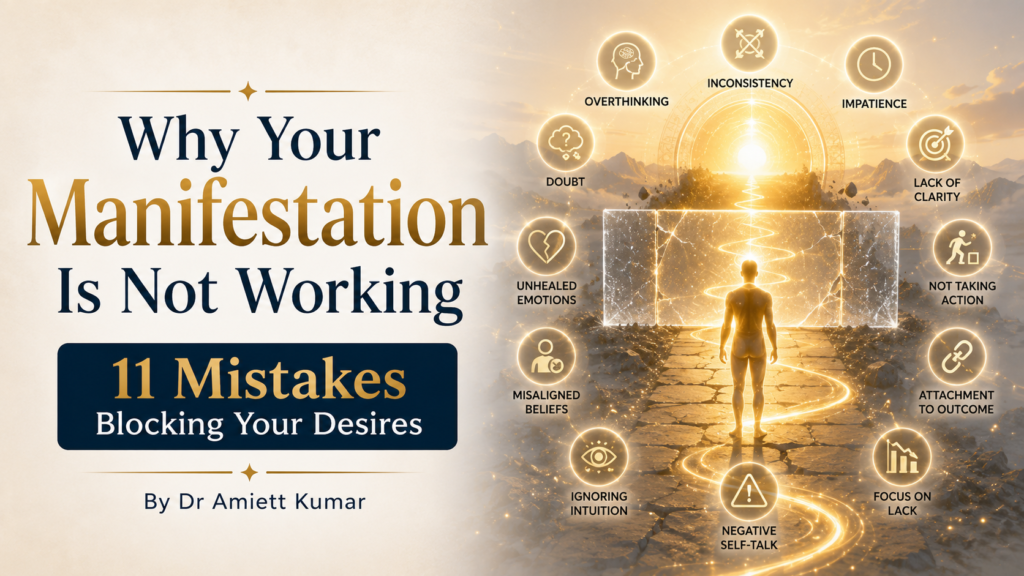
Common Manifestation Mistakes That Can Hold You Back
One mistake is relying on positive thinking while avoiding decisions. A vision board can inspire, but it cannot complete a qualification, repair trust, or create savings. Use inspiration to support work, not to excuse inaction. Another mistake is expecting immediate results. Important changes often require time, and some desired outcomes will remain uncertain even after sincere effort.
A second problem is confusing difficult emotions with failure. Feeling worried about money does not mean you have attracted financial trouble. Feeling lonely does not mean you lack the right energy for love. Emotional struggles deserve compassion and, when needed, qualified support. You can take constructive action without forcing yourself to feel positive every minute.
Be cautious about extreme affirmations and comparisons. If a statement makes you feel inadequate, replace it with language that reflects learning. If someone else’s success story makes you question your worth, remember that their circumstances, support, risks, and opportunities may differ considerably from yours.
Finally, do not use manifestation as a reason to control another person or ignore practical risks. Love requires mutual choice. Money decisions require care. Career progress can involve uncertainty. A healthy Law of Attraction practice should leave you more responsible, more open to evidence, and more respectful of other people’s independence – not less.
Frequently Asked Questions About Manifestation in 2027
How can I manifest my dream life in 2027?
Start by identifying what a meaningful 2027 would look like in your actual daily life. Describe a few priorities for relationships, financial stability, and work or personal growth. Use journaling, meditation, and visualization to clarify those intentions, then identify obstacles and create specific plans. Review progress regularly and adjust as you learn. These practices cannot guarantee any outcome, but they can help connect your goals to choices and habits within your influence.
What are the best manifestation techniques for beginners?
Begin with a short written intention, a five-minute visualization of the steps you need to take, and one realistic daily habit. Add meditation if you find it useful for attention and emotional awareness. Affirmations can support your practice when they are believable rather than exaggerated. You do not need expensive tools, a special date, or a complicated ritual. The best approach is one that helps you act responsibly and consistently.
Can I start manifestation before January 1, 2027?
Yes. The final weeks of 2026 can be an excellent time to review your goals, organize your surroundings, and begin a manageable routine. There is no scientific reason to believe manifestation requires a new calendar year. Starting early can help you enter January with greater clarity. Keep the preparation realistic: choose a direction, make one environmental change, and practice a small habit before adding more commitments.
Can manifestation help me attract money and financial success?
Manifestation exercises may help you clarify financial goals, notice opportunities, and stay motivated, but they do not directly produce money through thought alone. Improving finances usually requires informed choices about earning, spending, saving, debt, and risk. Use your intention to identify what financial security means to you and what skills or actions could support it. Avoid promises of guaranteed wealth and seek qualified advice for decisions that carry significant financial consequences.
How can I manifest love without becoming obsessed with one person?
Focus on the relationship qualities you value rather than demanding a particular person’s affection. Think about honesty, emotional safety, mutual respect, compatibility, and communication. Consider the choices you can control, including social opportunities, boundaries, and the way you listen and express yourself. You cannot manifest consent or override another person’s feelings. A healthy love intention leaves room for both people’s freedom and dignity.
Does subconscious mind reprogramming really work?
Popular phrases such as “subconscious mind reprogramming” can refer to many different practices. People can learn habits, change interpretations, and respond differently to automatic thoughts, but claims about instantly rewriting the subconscious to attract external outcomes are not established science. A more grounded method is to identify limiting assumptions, test them against evidence, practice alternative behaviours, and seek support when patterns are difficult to change.
How often should I meditate or repeat affirmations?
There is no universal schedule. A brief daily practice may be easier to sustain than an intense routine you abandon quickly. Try five to ten minutes of comfortable meditation and one or two meaningful affirmations linked to actions. Notice whether the practice helps your awareness and behaviour. If meditation causes distress or is unsuitable for your circumstances, stop and consider another approach or seek professional guidance.
What if my manifestation does not happen by the end of 2027?
An unmet goal does not mean you failed spiritually, thought incorrectly, or lacked worth. External results depend on many factors outside individual control. Review what you learned, what actions you took, what obstacles appeared, and whether the goal still matters. You may decide to continue, change strategy, seek help, or choose a different priority. Personal growth includes learning how to respond to uncertainty with realism and kindness.
Final Thoughts: Your Dream Life Is Built Through the Choices You Repeat
As 2027 approaches, it is tempting to believe that a new year will automatically bring a new version of you. But a calendar cannot make your decisions, improve your relationships, or develop your skills. Those changes depend partly on how you use the days you are given.
You can begin with a clear picture of the future, but allow reality to shape the route. You can practice affirmations without pretending that every challenge has disappeared. You can meditate to become more aware, visualize the process of change, and build habits that fit your actual responsibilities. You can pursue money without confusing wealth with worth, and seek love without trying to control another person.
The message is not that every dream will come true if you work hard enough. Life is too complex for that promise. The more useful message is that clarity, reflection, supportive environments, practical planning, and purposeful action can help you make better use of the opportunities available to you.
This is a fitting way to understand the approach to intention and consistency discussed in Dr Amiett Kumar’s work and Manifest Anything in 100 Days. Let your 2027 goals inspire you, then give them the dignity of patient effort. For more guidance, explore Dr Amiett Kumar’s articles, meditation resources, and discussions on manifestation and personal growth.
Your future is not a promise written on a vision board. It is a direction you can begin honoring with your next thoughtful choice.
Table of Contents