Introduction: Arjuna’s Fear Is Our Modern Overthinking
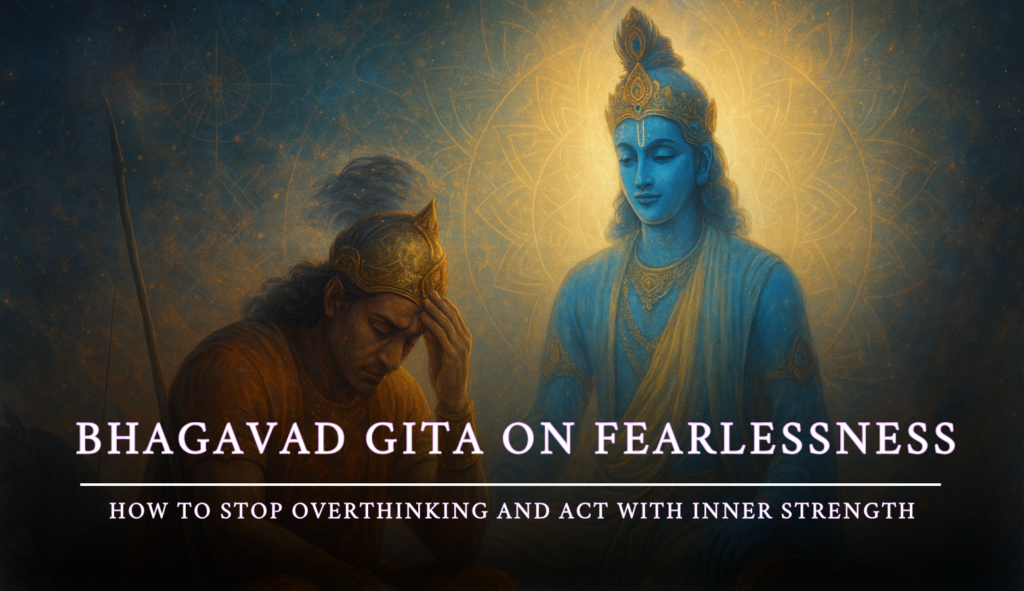
Long before anxiety became a clinical term and overthinking became a daily struggle, the Bhagavad Gita described the exact emotional state millions of people experience today. Arjuna’s breakdown on the battlefield is not just a mythological moment, it is a psychological map of what happens inside the human mind when fear, confusion, and self-doubt take over.
Arjuna wasn’t afraid because he was weak. He was afraid because he cared deeply about consequences. He overthought outcomes, judged himself harshly, imagined worst-case scenarios, and collapsed under emotional pressure. This is the same pattern that stops people today from taking decisions, speaking their truth, pursuing opportunities, or stepping into their higher potential.
What the Gita gives us is not just spiritual wisdom, it gives us a manual for mental clarity. It offers a step-by-step shift from confusion to confidence, from fear to courage, from paralysis to purposeful action. Through Krishna’s guidance, we learn that fearlessness is not the absence of fear, it is the alignment of the mind with a deeper, higher intelligence.
Modern psychology, neuroscience, and manifestation principles beautifully echo the same truth: you stop overthinking not by forcing the mind to be quiet, but by strengthening the Self behind the mind.
1. The Nature of Fear According to the Gita: A Mind Disconnected From the Self
The Gita explains that fear does not arise from external situations but from an inner disconnection. When the mind identifies only with temporary roles, “I am a leader,” “I am a son,” “I am responsible,” “I must win,” “I must not fail”, it becomes vulnerable to fear. These identities are fragile, easily shaken by pressure, opinions, outcomes, and expectations.
Krishna reminds Arjuna that his true identity is not the limited personality caught in confusion, but the Atman, the unchanging, eternal Self that is beyond fear. The moment someone forgets this deeper identity, fear becomes natural, because the ego operates from survival instincts, not wisdom.
Psychologically, this is similar to what we call ego-threat, where fear arises when a person feels their self-image or sense of control is at risk. Neuroscience shows that when the ego feels threatened, the amygdala activates, sending the body into fight-or-flight mode. This creates a cascade of reactions: tense muscles, rapid heartbeat, shallow breathing, and a narrow, anxious mindset.
The Gita’s insight is profound:
Fear is not a problem of circumstances, it is a problem of identity.
When you are connected to your inner self, the world feels manageable. When you are disconnected, even simple decisions feel overwhelming. Krishna’s first teaching to Arjuna is to shift from identifying with the fearful mind to identifying with the stable Self. This shift alone reduces fear dramatically because you stop treating your thoughts as absolute truth.
Overthinking weakens instantly when you stop assuming the mind’s voice is the real “you.”
2. Overthinking as Modern-Day “Vishada”, The Psychology of Arjuna’s Breakdown
The Gita begins with Vishada Yoga, the Yoga of Emotional Distress. Arjuna experiences physical weakness, emotional overwhelm, catastrophic thinking, guilt, confusion about purpose, and paralysis in action. This is the world’s oldest documented case of what we today call anxiety + overthinking + emotional burnout happening simultaneously.
Modern science provides a precise explanation for Arjuna’s state. When the mind feels trapped between choices or overwhelmed by responsibility, the amygdala signals a threat. The prefrontal cortex, the rational, decision-making centre, begins to shut down. Stress hormones like cortisol surge. Logic weakens. Catastrophic thoughts take over. The person can no longer see reality clearly because they are viewing life through the lens of fear.
This is exactly what Arjuna experienced: a mental freeze.
Not because he lacked wisdom, but because his emotional intensity exceeded his mental clarity.
Today, this happens whenever someone:
• overthinks before making a decision
• worries excessively about consequences
• replays worst-case scenarios
• feels responsible for everyone
• doubts their capability
• fears judgment or failure
The Gita teaches that Vishada is not failure, it is the starting point of transformation. Emotional breakdown can be a gateway to inner growth when guided correctly. Krishna did not dismiss Arjuna’s emotions; He elevated his consciousness above them.
This is the heart of the Gita’s psychology:
You cannot stop overthinking by suppressing fear.
You stop overthinking by rising above the mental state that produces fear.
The Gita’s wisdom remains timeless because it addresses the root of overthinking: a mind disconnected from purpose, clarity, and inner stability.
3. Overthinking as Modern-Day “Vishada” The Science Behind Mental Paralysis
The Bhagavad Gita begins not with wisdom, but with breakdown. Arjuna experiences Vishada, an intense emotional collapse. His limbs weaken, his breath shortens, his mind races, his vision blurs, and his clarity disappears. This moment is not symbolic; it is psychologically accurate.
Today, we call this combination anxiety, overthinking, and decision paralysis.
From a scientific perspective, Arjuna’s state represents what happens when the amygdala hijacks the mind. Under pressure, the brain’s fear center becomes hyperactive, generating rapid-fire thoughts about worst-case outcomes. At the same time, the prefrontal cortex, responsible for logic, planning, and clarity, begins to shut down. This creates a split where emotion controls thought, and reasoning becomes nearly impossible.
This is why overthinking often feels like sinking deeper the more you struggle. The nervous system goes into fight-or-flight, and the mind interprets every possibility as a potential threat. In this state, even simple decisions feel overwhelming.
Arjuna’s Vishada is not ancient history, it is a mirror of the modern human condition. Whether it is a career decision, a relationship conflict, or fear of judgment, overthinking traps the mind in a cycle of imagining outcomes instead of acting on reality.
The Gita teaches that Vishada is not a sign of weakness but a necessary turning point. It exposes the gap between who we are and who we are meant to become. Krishna doesn’t tell Arjuna to suppress his fear, He teaches Arjuna how to rise above the emotional turbulence and reconnect with inner stability.
This is the first major insight of the Gita:
Overthinking is a symptom of emotional overload, not lack of intelligence.
To overcome it, one must elevate consciousness, not force the mind into silence.
4. The Path of Clarity, Krishna’s First Teaching: Become the Witness
Before giving Arjuna any instruction on action or duty, Krishna teaches him one foundational principle: Become the witness of your mind, not the prisoner of it. This is known as Sakshi Bhava, the state of observing thoughts rather than identifying with them.
This shift is powerful. When you observe the mind, you create distance between yourself and your thoughts. The moment distance is created, overthinking loses its grip. You begin to see thoughts as mental events, not absolute truths.
Modern neuroscience supports this completely. Mindfulness and witnessing-awareness deactivate the amygdala and strengthen the prefrontal cortex, the region associated with clarity and decision-making. When you witness your thoughts:
• emotional intensity reduces,
• mental patterns become visible,
• cognitive bias weakens,
• and perspective expands.
Krishna essentially teaches Arjuna to step out of the storm rather than fight inside it. Fear grows when we become entangled in our inner dialogue. Fear dissolves when we observe the dialogue from a higher viewpoint.
In the Gita, Krishna tells Arjuna:
“You are not the mind that trembles; you are the Self that witnesses the trembling.”
This teaching transforms psychological experience. When you stop taking every thought personally, you stop reacting emotionally to them. Overthinking thrives on identification, witnessing breaks that cycle. With practice, thoughts lose power, emotions become manageable, and clarity returns naturally.
This is why Gita-based fearlessness is not about suppressing fear, it is about expanding consciousness beyond fear.
5. Nishkama Karma: The Gita’s Formula for Ending Fear of Outcomes
One of the biggest causes of overthinking is the obsession with outcomes:
“What if I fail?”
“What if people judge me?”
“What if things don’t go my way?”
“What if the result isn’t good enough?”
The Gita resolves this entire cluster of fears with one principle: Nishkama Karma, action without attachment to results.
Krishna teaches that fear arises not from action itself, but from mental projection into the future. The mind imagines consequences, and these imagined scenarios create emotional pressure. When you act with attachment, your identity becomes tied to the outcome, so the possibility of failure feels like a threat to the self.
But when you act with detachment, you free yourself from mental noise. You focus on effort, not expectation; progress, not perfection; purpose, not pressure.
Psychologically, detachment reduces performance anxiety. Neuroscience shows that the brain functions more efficiently under a state of relaxed concentration rather than outcome-based pressure. Athletes call this “the flow state,” where performance becomes effortless because the mind is no longer distracted by fear of the result.
In manifestation terms, Nishkama Karma aligns your energy with confidence and trust, rather than fear and urgency. When you stop chasing outcomes, you stop vibrating from lack, which is precisely when results start flowing toward you.
Krishna tells Arjuna:
“You have control over action alone, never over its fruits.”
This is not asking you to suppress desire. It is asking you to free your mind from the emotional weight of desire. The moment you detach, you stop overthinking and begin acting with strength, clarity, and inner stability.
Detachment is not a loss of ambition, it is the removal of fear from ambition.
6. Aligning With Dharma: Inner Strength Comes From Purpose, Not Pressure
One of the most profound teachings Krishna gives Arjuna is the concept of Dharma, not as a rigid duty, but as alignment with one’s true nature. Krishna reminds Arjuna that fear overwhelms the mind when we move away from our authentic path. When we act from a place of pressure, comparison, or societal expectation, the mind becomes unstable. But when action aligns with inner truth, clarity emerges naturally.
Modern psychology calls this identity alignment, when your actions match who you believe you are meant to be. When there is alignment, confidence rises. When there is misalignment, fear fills the gap. Many people overthink not because the task is difficult, but because the task does not match their authentic calling or values. They feel internally split.
Krishna’s message is simple yet transformative:
“Act from your inner nature, not from external pressure.”
Dharma gives the mind a direction rooted in meaning rather than fear. When people act from purpose, their nervous system shifts into a more regulated state. Their decisions feel clearer, and their emotional resilience strengthens. Purpose stabilizes the mind because it provides an internal compass. And when the compass is clear, overthinking diminishes on its own.
In the Gita, Arjuna stops trembling not because the battlefield changes, but because his inner reference point shifts, from fear of consequences to the clarity of Dharma. When purpose becomes the focus, fear loses its authority.
7. The Three Gunas: How Sattva, Rajas, and Tamas Influence Fear and Overthinking
The Gita describes three fundamental forces that shape the mind: Sattva (clarity), Rajas (restlessness), and Tamas (inertia). These Gunas operate within every person, influencing emotions, decisions, and mental states. Understanding them is essential to understanding why the mind overthinks.
A mind dominated by Tamas becomes dull, confused, avoidant, and pessimistic. Overthinking here takes the form of paralysis: not knowing where to start, feeling stuck, or being overwhelmed by the simplest decisions. This often manifests as procrastination or emotional heaviness.
A mind dominated by Rajas becomes restless, overstimulated, and anxious. Overthinking here feels like constant mental noise: jumping from one scenario to another, imagining negative outcomes, obsessing over details, and feeling pressure to control everything. Most modern overthinking is Rajasic in nature.
A mind influenced by Sattva becomes clear, balanced, calm, and discerning. In Sattva, the mind can think without spiraling, feel deeply without becoming overwhelmed, and act decisively without fear. This is the state of clarity Krishna guides Arjuna toward.
The Gunas are not moral categories: they are energetic states influenced by:
- sleep patterns
- diet
- environment
- emotional habits
- mental training
- spiritual practices
Krishna’s teaching suggests that fearlessness is not a personality trait; it is a state of mind cultivated through sattvic living. As Sattva increases, overthinking naturally decreases, because clarity overtakes confusion.
The practical message is powerful:
To change your emotional state, change the energetic quality of your mind.
As the inner Guna shifts, so does your ability to face life with courage.
8. The State of Fearlessness: Abhayam in the Bhagavad Gita
In the Gita, Krishna asks Arjuna to cultivate Abhayam, fearlessness. But this fearlessness is not aggression, recklessness, or denial. It is a calm steadiness that arises from inner alignment. Abhayam is the state where the mind no longer collapses under pressure because it stands anchored in clarity, Dharma, and Self-awareness.
Fearlessness, according to Krishna, is not built by eliminating fear but by strengthening the inner witness so that fear loses its power. When you act from Dharma, your mind becomes stable. When you detach from outcomes, your emotions remain balanced. When you witness your thoughts instead of merging with them, your identity expands beyond fear. Fear cannot dominate a mind that does not cling to imagined futures.
In psychological terms, Abhayam is emotional regulation, the ability to maintain stability under stress. In spiritual terms, it is the remembrance of one’s true nature. In energetic terms, it is coherence, mind, breath, and intention moving together.
Krishna doesn’t promise Arjuna that circumstances will become easier. Instead, He teaches Arjuna how to become stronger than circumstances. Fearlessness is not about eliminating challenges; it is about increasing inner stability so challenges no longer destabilize you.
This is the essence of the Gita:
Fear does not disappear when life becomes simple.
Fear disappears when the mind becomes strong.
Overthinking ends when the center of your awareness rises above confusion.
9. Conclusion: Acting With Strength Even When the Mind Trembles
The Bhagavad Gita does not promise a life without fear, doubt, or difficulty. What it offers is far more powerful: a mind trained to rise above its own noise. Arjuna’s transformation on the battlefield is not the story of fear disappearing, it is the story of a human being remembering who he truly is beneath his fear. His clarity was not created by changing circumstances; it was created by changing consciousness.
Fearlessness in the Gita is not the absence of trembling. It is the ability to act with purpose even when the mind shakes. It is the shift from ego-based identity to Self-based awareness. It is the courage that appears when attachment dissolves and Dharma becomes the guiding force. It is the clarity that emerges when the witness, not the emotional storm, leads the decision-making.
Modern psychology and neuroscience confirm what Krishna taught millennia ago:
A regulated mind acts with clarity.
An aligned mind acts with confidence.
A conscious mind acts with courage.
We overthink when we forget our inner strength.
We fear consequences when we forget the power of intention.
We freeze in confusion when we disconnect from our deeper identity.
But the moment we reconnect with purpose, awareness, and inner truth, the fog lifts. Action becomes simple. Decisions become grounded. The heart becomes steady.
This is the message the Gita leaves us with:
True fearlessness is not born from controlling life, it is born from understanding yourself.
When the Self becomes the centre, fear loses its authority. When clarity replaces confusion, overthinking melts away. When Dharma replaces doubt, action becomes effortless.
The battlefield of Kurukshetra exists in every human mind.
And Krishna’s guidance remains timeless because it teaches us how to conquer the only battlefield that truly matters, the one within.
Act from your truth.
Detach from results.
Witness the mind.
Align with purpose.
And let fear become a doorway, not a barrier.
Learn More from Dr Amiett Kumar:
- The Energy of Deserving: Why Your Self-Worth Decides What You Manifest
- The Productivity Trap: How Being Busy Destroys Real Progress
Table of Contents