By Dr Amiett Kumar Editorial Team | amiettkumar.com
Have you ever followed a manifestation routine for days or even months, only to wonder, “Why is my manifestation not working?” You repeat an affirmation, create a vision board, practise visualisation, watch law of attraction videos, and try to stay positive. Yet the result still feels far away. This can create frustration, self-doubt, and the fear that you are doing everything wrong.
The truth is that manifestation is often misunderstood. It is not a magical shortcut that removes the need for action, patience, learning, or honest self-reflection. At its most practical, manifestation is the process of bringing your thoughts, emotions, beliefs, decisions, and repeated actions into alignment with a meaningful goal. Spirituality can deepen this process, but spirituality does not require you to ignore reality. It invites you to meet reality with awareness, faith, responsibility, and courage.
Dr Amiett Kumar’s manifestation teachings regularly bring meditation, affirmation, visualisation, gratitude, identity work, and inspired action together rather than treating them as isolated tricks. Through the Amiett Kumar platform, YouTube content, podcasts, coaching programmes, and the wider Readers Books Club community, seekers are encouraged to work on their inner world while also taking practical steps in the outer world. This integrated approach matters because a calm mind can see opportunities more clearly, a grounded belief can support better decisions, and a clear plan can turn intention into movement.
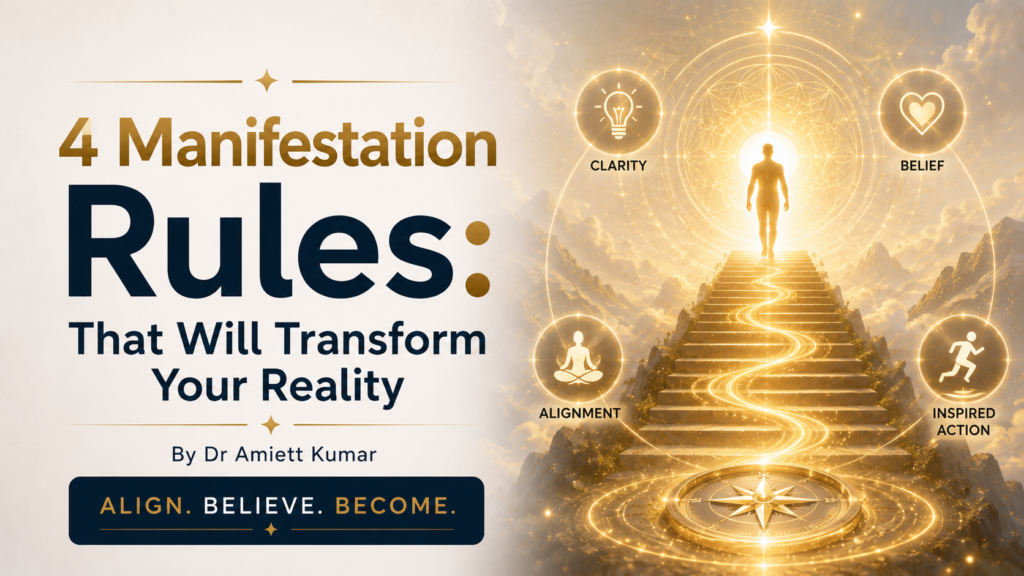
This guide explains four manifestation rules that can transform your reality by transforming the way you think, feel, choose, and act. It also addresses the most common manifestation mistakes, reasons manifestation is delayed, why affirmations are not working, and how to unblock manifestation without blaming yourself. Whether you are new to the law of attraction or have been practising for years, these four rules will help you create a more stable, realistic, and powerful manifestation practice.
Manifestation becomes practical when your thoughts, emotions, identity and actions begin moving in the same direction.
What Manifestation Really Means
Manifestation begins with a desired change, but it becomes meaningful only when that desire influences your attention and behaviour. Suppose you want a healthier body. The wish alone is not the transformation. The transformation begins when you become more aware of your sleep, food, stress, movement, self-talk, and daily choices. If you want a fulfilling career, your visualisation may give direction, but the manifestation process also includes learning skills, applying for opportunities, building relationships, handling rejection, and improving your work.
Meditation supports this process by creating a pause between automatic thoughts and conscious choices. Affirmation can help you rehearse a more empowering inner message. Visualisation can help you mentally explore the desired future. Coaching can reveal blind spots and turn vague wishes into practical commitments. The law of attraction gives many seekers a spiritual language for focus, energy, and intention, while psychology offers useful tools for goal-setting, behaviour change, emotional regulation, and consistency.
A mature manifestation practice does not ask you to pretend that pain, uncertainty, or obstacles do not exist. It asks you to stop allowing them to define your entire future. You acknowledge the present honestly, choose the direction deliberately, and take the next aligned step repeatedly.
Why Manifestation Is Not Working: The Hidden Gap
When people search for “manifestation not working”, “why my manifestation is not working”, or “manifestation taking too long”, they often assume the problem is a lack of positivity. In reality, the gap is usually more practical. The desire may be unclear. The affirmation may conflict with a deeply held belief. The visualisation may be disconnected from action. The person may be constantly checking for results, changing techniques every few days, or trying to control an outcome that also depends on other people and external circumstances.
Another common issue is emotional pressure. When every meditation session becomes a test of whether the universe is listening, the practice stops feeling peaceful. When every delay is treated as proof of failure, the nervous system remains in urgency. Urgency narrows attention and can make you impulsive, impatient, or unable to recognise gradual progress. A manifestation practice should help you become more centred and capable, not more frightened of your own thoughts.
The four rules below close this hidden gap. They move manifestation from wishful thinking to clear intention, from forced emotion to inner regulation, from fantasy to useful visualisation, and from passive waiting to consistent action.
Rule 1: Get Clear About the Reality and the Identity You Want
The first rule is clarity. A vague desire creates vague attention. “I want success”, “I want more money”, or “I want a better life” may sound inspiring, but they do not tell your mind what success means, what money is for, or what better would look like in daily life. Clarity does not mean controlling every detail. It means understanding the direction, the deeper reason, and the kind of person you need to become.
Start by separating the symbol from the real desire. You may say you want a luxury car, but the deeper desire could be freedom, recognition, comfort, safety, or proof that your work matters. You may say you want a relationship, but the real desire could be companionship, emotional security, shared growth, or belonging. When you understand the emotional need behind the goal, you can pursue it more wisely and avoid making one external object responsible for your entire happiness.
Next, make your intention specific enough to guide action. Instead of “I want financial abundance”, try: “I am building a stable income by improving my expertise, serving clients well, managing money responsibly, and creating new opportunities.” Instead of “I want to become confident”, try: “I am becoming a confident communicator who prepares well, speaks honestly, and handles discomfort without abandoning myself.” These statements combine aspiration with identity and behaviour.
Identity is important because people tend to protect the story they repeatedly tell about themselves. If your conscious goal is growth but your identity remains “I am unlucky”, “I always fail”, or “people like me never succeed”, every setback will appear to confirm the old story. You do not have to force yourself to believe an extreme opposite overnight. Build a bridge statement that feels believable: “I am learning to trust myself,” “I am becoming consistent,” or “I am open to receiving and creating better opportunities.”
Clarity also requires boundaries. You can manifest the intention to experience love, respect, and partnership, but you cannot ethically control another person’s choices. You can visualise a successful opportunity, but you cannot guarantee the behaviour of a specific employer, client, audience, or market. Focus on the qualities, conditions, and actions within your influence. This protects your manifestation practice from obsession.
Use this clarity exercise: write one sentence for what you want, one sentence for why it matters, one sentence for who you must become, and one sentence for the next measurable action. Read the four sentences slowly. If they create grounded energy rather than panic, you have a useful starting point.
Practical Exercise: The Four-Line Manifestation Intention
Complete these prompts in your journal: “The reality I intend to create is…”; “This matters to me because…”; “The identity I am developing is…”; and “The next action I will take within twenty-four hours is…”. Keep the language clear and personal. Do not copy an affirmation simply because it is popular online. Your intention should reflect your values, circumstances, and responsibilities.
Review the statement once a week rather than changing it every time you feel uncertain. A strong intention can evolve, but constant rewriting may become a form of avoidance. Give yourself enough consistency to collect real feedback from your actions.
Rule 2: Regulate Your Inner State Before You Repeat an Affirmation
The second rule is emotional alignment. Many people ask, “Why are affirmations not working?” One reason is that they repeat words while their body is in fear, resistance, or exhaustion. The sentence says, “I am abundant,” but the inner experience says, “Something is wrong, and I must fix it immediately.” Repetition alone does not always resolve this conflict.
Begin with regulation rather than performance. Sit comfortably and take a few slow breaths. Notice where tension is present without judging it. Allow the exhalation to become slightly longer. You are not trying to erase every negative emotion. You are creating enough space to choose your response. A short meditation can make affirmation practice less mechanical because it helps you hear the words instead of racing through them.
Choose affirmations that support identity and action. “Everything comes to me without effort” may encourage passivity or feel unbelievable. A stronger affirmation might be: “I am calm, alert, and willing to take the actions that support my goal.” For money, try: “I am building a healthy relationship with money through value, responsibility, learning, and wise decisions.” For relationships: “I am worthy of respectful love, and I communicate my needs with honesty.” For health: “I am listening to my body and choosing supportive habits one day at a time.”
Emotion matters, but you do not need to manufacture excitement. Quiet conviction is enough. Some days your affirmation may feel powerful; on other days it may simply remind you of your direction. Consistency is more valuable than dramatic intensity. If an affirmation triggers strong shame or distress, soften it. Replace “I am completely fearless” with “I am learning to move with courage even when fear appears.”
Spirituality can add another layer through surrender. After stating your intention, you can say, “I commit to my part and release the need to control every detail.” This protects faith from becoming force. Surrender does not mean giving up. It means acting fully while accepting that timing, people, and circumstances cannot always be commanded.
This rule also explains how to unblock manifestation when you feel emotionally stuck. Stop adding more techniques for a moment. Return to sleep, breathing, honest journaling, movement, supportive conversation, and meditation. If persistent anxiety, depression, trauma symptoms, or distress is affecting daily life, manifestation coaching is not a substitute for qualified mental-health care. Seeking appropriate support is an aligned action, not a spiritual failure.
A Simple Meditation and Affirmation Sequence
Practise this sequence for ten minutes. Spend two minutes noticing your breath. Spend two minutes naming the emotion that is present: fear, hope, impatience, gratitude, sadness, or uncertainty. Spend two minutes relaxing the jaw, shoulders, and hands. Then repeat one believable affirmation slowly for three minutes. Use the final minute to ask, “What would this version of me do today?” Write down the answer.
This sequence connects meditation, affirmation, and action. It is more useful than repeating dozens of disconnected lines while worrying about whether you are doing manifestation perfectly.
Rule 3: Visualise the Future, Then Face the Present Obstacle
The third rule is realistic visualisation. Visualisation can make a goal emotionally meaningful. Athletes, performers, speakers, and professionals often mentally rehearse important situations because imagery can help them prepare attention, decisions, and responses. In manifestation, visualisation also helps you experience the desired future as a direction rather than an abstract wish.
However, visualisation becomes a manifestation mistake when it replaces reality. Imagining only the perfect result can create temporary relief without creating progress. Research on positive fantasies has raised an important caution: pleasant fantasy alone may sometimes reduce effort because the mind receives a feeling of achievement before the work has been done. A more effective method is to visualise the desired future and then identify the most important inner or practical obstacle between you and that future.
For example, imagine yourself delivering an excellent presentation. See the room, hear your voice, and feel grounded. Then ask, What is the current obstacle? It may be lack of preparation, fear of judgement, unclear structure, or avoiding practice. Now create a response. “If I start overthinking at 7 p.m., then I will practise the opening for five minutes.” This is an if-then plan. Research on implementation intentions and mental contrasting suggests that connecting a desired future with obstacles and specific plans can support goal attainment.
This transforms visualisation from escape into rehearsal. You do not only see yourself receiving the result; you see yourself handling the process. Visualise sending the proposal, learning from feedback, managing a difficult conversation, waking up for practice, saving money, or continuing after a disappointing week. Process visualisation strengthens your relationship with the behaviours that make the outcome more likely.
Use all your senses, but keep the session focused. Five to ten minutes is enough. Notice what you see, hear, feel, and do in the scene. Most importantly, include your qualities: calmness, patience, integrity, discipline, creativity, or service. Then return to the present and choose one action.
Do not use visualisation to deny medical, legal, financial, or relational realities. If your goal involves health, combine hope and spiritual practice with professional medical guidance. If it involves money, combine abundance thinking with budgeting, skill-building, risk awareness, and informed decisions. If it involves another person, respect consent and autonomy. A grounded law of attraction practice expands responsibility rather than removing it.
Practical Exercise: Future, Obstacle, Plan
Write your desired future in one sentence. Close your eyes and visualise it for three minutes. Then write the most important obstacle within you or your current routine. Finally, create one if-then plan: “If [obstacle or situation] happens, then I will [specific response].” Keep the response small enough to do even on a difficult day.
Example: “If I feel discouraged because results are slow, then I will review my progress, complete one useful task, and avoid changing my entire plan for twenty-four hours.” This is how you protect consistency when manifestation is taking too long.
Rule 4: Take Aligned Action and Detach from Constant Checking
The fourth rule is action with detachment. This is where many law of attraction mistakes become visible. Some people take no action because they believe action shows a lack of faith. Others take frantic action because they fear the result will disappear if they slow down. Aligned action is neither passive nor panicked. It is the next useful step taken from clarity.
Inspired action is often described as action that feels intuitive or energetically right. That can be valuable, but not every important action feels inspiring. Some actions feel ordinary: making a call, editing a document, practising a skill, going to therapy, creating a budget, applying again, apologising, resting, or saying no. Transformation is often built through small actions that are repeated long after the initial motivation fades.
Turn your manifestation goal into a weekly system. Decide what you will practise, create, measure, and review. If your goal is a new career, your system may include three applications, two networking conversations, five hours of learning, and one portfolio improvement each week. If your goal is inner peace, the system may include daily meditation, reduced screen exposure before bed, one honest boundary, and regular professional support where needed. If your goal is a relationship, your system may include becoming more emotionally available, communicating clearly, expanding your social world, and refusing unhealthy dynamics.
Detachment means releasing compulsive checking. When you repeatedly ask, “Has it happened yet?” you train your attention to search for absence. You also make every day without the final result feel meaningless. Instead, track leading indicators: actions completed, skills improved, conversations started, emotional patterns changed, and opportunities noticed. The outcome matters, but the process is where your influence is greatest.
Detachment also protects you when reasons manifestation is delayed are outside your control. Markets change. Other people have choices. Applications take time. Healing is not linear. A delayed result does not automatically mean that you lack faith, have a low vibration, or are being punished. Sometimes the plan needs improvement. Sometimes more learning is required. Sometimes the goal needs to change. Sometimes patience is genuinely necessary.
Set a review rhythm. Review your goal weekly or monthly, not every hour. Ask three questions: What worked? What did not work? What will I adjust? This turns disappointment into information. A life coach or manifestation coaching programme can offer accountability, but your responsibility remains central. No coach can replace your decisions, and no technique can guarantee every outcome.
The Most Common Manifestation Mistakes
Understanding the rules becomes easier when you can recognise the patterns that weaken them. The first common mistake is changing the desire every few days. New techniques create excitement, but constant switching prevents depth. Choose one meaningful intention and one simple daily practice for a reasonable period.
The second mistake is using affirmations to suppress emotion. Saying “I am happy” while refusing to acknowledge grief does not create alignment. Name the truth, regulate the emotion, and then choose a supportive statement. Emotional honesty and optimism can exist together.
The third mistake is visualising only the reward. Include the process, the obstacles, and your response. See yourself doing the work with steadiness. The fourth mistake is waiting for signs instead of making decisions. Signs may feel meaningful, but they should not replace evidence, ethics, professional advice, or action.
The seventh mistake is ignoring practical feedback. If repeated action produces no progress, faith does not require you to continue blindly. Improve the strategy, seek advice, learn a skill, test a new channel, or reconsider the goal. Flexibility is part of alignment.
How to Make the Law of Attraction Work in Daily Life
People searching for how to make the law of attraction work often want one perfect technique. A sustainable practice is simpler. Begin the morning with five to ten minutes of meditation. Read one clear intention and one affirmation. Visualise the desired identity and one process action. During the day, complete the action. At night, record evidence of progress, gratitude, and learning.
This daily structure trains attention without demanding constant positivity. It also prevents spirituality from becoming disconnected from life. Gratitude helps you recognise what is present. Intention gives direction. Meditation improves awareness. Affirmation supports a chosen identity. Visualisation prepares the mind. Action changes circumstances. Reflection creates learning.
The work of a top manifestation coach should also connect inspiration with implementation. On the Amiett Kumar platform, the repeated emphasis on meditation, visualisation, affirmation, gratitude, and inspired action reflects this integrated approach. Use guidance as a structure, then adapt the practice responsibly to your own life.
A 21-Day Practice for the Four Manifestation Rules
For the next twenty-one days, work with one goal. In the morning, meditate for five minutes. Read your four-line manifestation intention. Repeat one believable affirmation three times. Visualise your future for two minutes and the process for two minutes. Identify the day’s most important obstacle and write an if-then response. Complete one aligned action before the day ends.
At night, write three short notes: one action completed, one lesson learned, and one thing you appreciate. Do not judge the day only by whether the final manifestation appeared. Judge it by whether you became more aware, more consistent, more courageous, or more skilful.
What to Do When Manifestation Is Taking Too Long
Delay can be emotionally difficult, especially when the goal matters deeply. First, separate delay from failure. A result that has not happened yet is not proof that it will never happen. Second, return to the facts. What actions have you taken? What feedback have you received? What depends on you, and what depends on other people or conditions? Third, check whether the goal still reflects your values or has become an attempt to prove your worth.
Next, reduce the time horizon. Ask what progress looks like this week. A person trying to manifest a successful business cannot control immediate revenue, but they can improve an offer, contact prospective clients, study customer needs, or publish useful content. A person seeking a relationship cannot control when the right partner appears, but they can heal patterns, build community, communicate honestly, and become available for healthy connection.
Continue the spiritual practices that create peace, but stop using them as a bargaining tool. Meditation is valuable even before the outcome arrives. Gratitude is valuable even when life is incomplete. Spirituality is not a transaction where perfect thoughts guarantee a reward. It is a relationship with meaning, awareness, trust, and responsible action.
Finally, allow redirection. Sometimes the deeper manifestation is not the exact form you first imagined. You may discover a better opportunity, a healthier relationship, a different career, or a more authentic goal. Detachment creates room for that discovery.
Frequently Asked Questions
Why is my manifestation not working even though I stay positive?
Positivity is only one part of the process. Your goal may be unclear, your plan may be missing, your affirmation may feel unbelievable, or your actions may not match the desired reality. Replace constant positivity with clarity, emotional regulation, process visualisation, and consistent action.
Why are affirmations not working for me?
Affirmations may feel ineffective when they are too extreme, repeated mechanically, or used to avoid real emotion. Choose a believable statement that supports identity and behaviour. Practise it after a short meditation and connect it to one action.
How can I unblock manifestation?
Pause the pressure. Clarify the goal, identify the main internal or practical obstacle, regulate stress, simplify your routine, and take one measurable step. Seek qualified support when mental health, medical, legal, or financial issues require professional care.
Does visualisation guarantee success?
No. Visualisation can support focus, preparation, confidence, and goal-directed behaviour, but it cannot guarantee an external result. Combine desired-future imagery with obstacle awareness, practical planning, skill, feedback, and action.
How long should manifestation take?
There is no universal timeline. Different goals depend on different levels of skill, resources, circumstances, and involvement from other people. Use timelines for your actions and reviews rather than treating a date as proof of spiritual success or failure.
Can a manifestation coach or life coach manifest a result for me?
No. Coaching can provide clarity, techniques, feedback, structure, and accountability. You remain responsible for your choices and actions, and some outcomes will always include factors outside anyone’s control.
What is the best daily manifestation routine?
A simple routine is five minutes of meditation, one clear intention, one believable affirmation, a short visualisation of the future and the process, one if-then plan for an obstacle, and one aligned action. End the day with reflection and gratitude.
Conclusion: Transform Your Inner Process to Transform Your Reality
The four manifestation rules are simple, but they are not superficial. Get clear about the reality and identity you want. Regulate your inner state before repeating an affirmation. Visualise the future while facing the present obstacle. Take aligned action and detach from compulsive checking.
Together, these rules answer the question of why manifestation is not working for many people. The problem is rarely that one imperfect thought cancelled the universe’s support. More often, the process needs clarity, emotional honesty, practical planning, consistency, feedback, or patience. Manifestation becomes more powerful when it helps you build these qualities.
You do not need to choose between spirituality and action. Meditation can calm the mind that makes the plan. Affirmation can strengthen the identity that follows the plan. Visualisation can make the direction emotionally real. The law of attraction can remind you to focus on possibility. Coaching can help you notice blind spots. Daily action can move possibility into experience.
As Dr Amiett Kumar’s manifestation framework repeatedly suggests, lasting change is created through an integrated practice rather than a single trick. Begin with one intention today. Become quiet enough to hear it, honest enough to refine it, brave enough to act on it, and patient enough to grow through the process. Your reality may not transform in one dramatic moment. It may transform through the small decisions that prove, day after day, that you are becoming ready for the life you intend to create.
Table of Contents