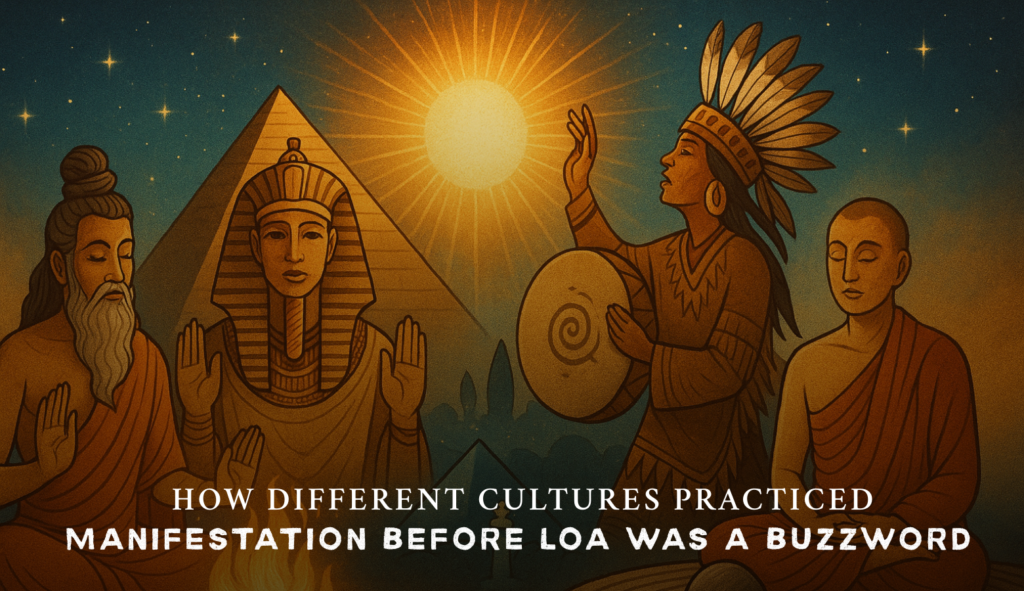
When most people hear the term “Law of Attraction” today, they think of modern books, films, or social media coaches. It feels like a trendy concept of the last few decades. But in truth, manifestation is as old as humanity itself.
Across cultures, from Vedic India to Native America, people understood that thoughts, intentions, and rituals could shape reality. They didn’t call it “LOA,” but they practiced it in ways deeply rooted in their spirituality, culture, and daily life.
Whether through mantras, vision quests, or sacred dances, ancient civilizations believed the mind was connected to the cosmos and that aligning with universal forces could bring health, prosperity, and love.
This blog explores how different cultures around the world practiced manifestation long before “LOA” became a buzzword, reminding us that this wisdom is timeless and universal.

Vedic India Sankalp, Mantras & Yajnas
India has one of the oldest recorded traditions of manifestation. In the Vedic era, manifestation wasn’t about “getting what you want” it was about aligning with cosmic order (Rta). The practices were both spiritual and scientific in their depth.
- Sankalp (Sacred Intention): Before any ritual, a practitioner made a Sankalp a clear statement of intention. This wasn’t a wish; it was a vow infused with clarity and faith, believed to carry creative power.
- Mantras: Ancient sages taught that sound vibrations shape reality. By chanting mantras like ॐ (Om) or the Gayatri Mantra, practitioners tuned into higher frequencies, aligning inner thought with universal energy.
- Yajnas (Fire Rituals): Offerings made into fire were symbolic acts of releasing desires into the cosmos. The flame was seen as a messenger carrying human intentions to the divine.
The Rigveda says: “मनसा वाचा कर्मणा” (Manasa Vacha Karmana) By thought, word, and deed, reality is created. This shows how manifestation was woven into daily life thousands of years ago.
- Suggested Image here: A Vedic sage sitting before a sacred fire, raising hands in intention as the flames carry light upward.
Ancient Egypt: Thought, Magic & Divine Alignment
In Ancient Egypt, manifestation was intertwined with spirituality, architecture, and daily rituals. The Egyptians believed the universe itself was born from divine thought and word. To them, speech and intention carried magical power.
- Heka (Sacred Word): Egyptians used heka, meaning “magic,” to describe the creative power of words. Priests and healers spoke incantations with focused intention, believing these sounds shaped reality.
- Pharaohs and Rituals: Pharaohs were considered divine intermediaries who maintained harmony (Ma’at). Through rituals and offerings, they manifested prosperity for the land.
- Sacred Symbols: Hieroglyphs, amulets, and the pyramids themselves were considered energetic tools, designed to attract protection, abundance, and alignment with cosmic forces.
An Egyptian proverb says: “To say the name of the dead is to make them live again.” This reflects the belief that thought and word could bridge worlds, shaping both life and afterlife.
Greek & Roman Philosophies: Mind as Creator
In ancient Greece and Rome, manifestation was framed through philosophy, psychology, and spirituality. The great thinkers believed that the mind and soul shaped reality as much as external events.
- Plato’s Ideas: Plato taught that the material world was only a shadow of the mind’s ideal forms. To manifest something meant aligning thought with these higher realities.
- Stoic Practices: Stoic philosophers like Epictetus and Marcus Aurelius emphasized that perception shapes experience. By training thoughts, one could create peace and success, regardless of circumstances.
- Hermetic Tradition: Rooted in Egypt and Greece, Hermetic wisdom declared, “As within, so without.” This principle mirrors the LOA idea that inner beliefs create external realities.
- Affirmations & Visualization: Roman leaders and warriors were trained to mentally rehearse victories, affirm strength, and embody confidence practices that look remarkably like today’s visualization exercises.
For them, manifestation was not superstition; it was philosophy in action. Align your thoughts, master your inner world, and the outer world follows.
Native American Traditions: Vision Quests & Nature Connection
For Native American tribes, manifestation was inseparable from spiritual connection with nature and the Great Spirit. They believed that harmony with the land, animals, and sky ensured abundance and guidance.
- Vision Quests: Young initiates would fast and meditate alone in nature, seeking visions that revealed their purpose. These visions weren’t just symbolic they were seen as manifestations of spiritual truth.
- Ritual Dances & Chants: Tribes practiced rain dances, harvest ceremonies, and healing chants to call upon natural forces. These rituals combined collective intention, rhythm, and faith to bring desired outcomes.
- Dreamwork: Dreams were considered messages from the spirit world. By honoring them, people manifested guidance for health, community, or survival.
Their belief was simple yet profound: by honouring life and spirit, one could call forth what was needed. Manifestation wasn’t about personal gain it was about collective balance and harmony.
African Spirituality: Rhythm, Ritual & Community Intention
Across Africa, manifestation was deeply rooted in rhythm, community, and reverence for ancestors. The belief was that energy, when raised together, could transform reality.
- Drumming & Chanting: Drums weren’t just musical instruments: they were tools to shift consciousness. Collective drumming created trance states, where communities set intentions for rain, healing, or protection.
- Ancestor Connection: Offerings and prayers to ancestors were a way of aligning present desires with ancestral wisdom. Ancestors were seen as guides who could help manifest blessings.
- Dance & Movement: Ritual dances, often performed in circles, symbolized unity and continuity of life. The vibration of movement was believed to attract fertility, abundance, and harmony.
- Community Manifestation: Unlike individual-focused LOA, African traditions often emphasized group intention. The whole tribe would unite in ritual to bring forth rain, healing, or prosperity for all.
This highlights a powerful truth: manifestation is amplified when collective energy is aligned. When people come together with one heartbeat, miracles unfold.
Eastern Practices: Taoism, Buddhism & Zen
In the East, manifestation was not about “getting things” but about aligning with the natural flow of the universe. Taoists, Buddhists, and Zen masters all emphasized harmony, presence, and inner cultivation as the keys to creating outer change.
- Taoism (China): The Tao, or “Way,” is the natural order of the cosmos. Taoist manifestation meant moving in harmony with this flow instead of forcing outcomes. By practicing wu wei (effortless action), desires manifested naturally.
- Buddhism (India/Asia): The practice of Bhavana literally means “mental cultivation.” Buddhists use visualization (imagining compassion, abundance, or enlightenment) to shape reality. Monks also practice Metta Bhavana (loving-kindness meditation), manifesting peace and goodwill.
- Zen (Japan): Zen emphasized simplicity and presence. To a Zen master, manifesting joy meant fully inhabiting the moment. By being present, they accessed the highest vibration: the frequency where everything flows with ease.
Eastern traditions remind us that manifestation is not chasing desires but embodying inner alignment, letting life’s abundance flow toward you.
Middle Eastern & Abrahamic Mysticism
The Middle East, birthplace of the Abrahamic traditions, also carried mystical practices resembling manifestation. Here, manifestation often took the form of prayer, devotion, and surrender.
- Sufi Mysticism (Islam): Sufi poets like Rumi described love and union with the Divine as the highest manifestation. Practices like whirling and chanting (zikr) raised vibration, allowing seekers to align with divine will.
- Kabbalah (Jewish Mysticism): The Kabbalistic Tree of Life is a symbolic map of manifestation. By visualizing and meditating on the Sefirot (divine energies), practitioners believed they could attract blessings and align with higher consciousness.
- Christian Mysticism: Faith and prayer were seen as powerful manifesting tools. “Ask, and it shall be given to you” (Matthew 7:7) reflects the same principle as LOA: belief and intention create reality.
- Islamic Teachings: The Qur’an emphasizes niyyah (intention). Every action begins with intention, showing alignment of inner thought with divine guidance.
These traditions remind us that manifestation is not just about desire, but about faith, devotion, and aligning human will with divine will.
Common Threads Across Cultures
Though diverse in rituals and beliefs, cultures across the world practiced manifestation in strikingly similar ways.
Common Threads:
- Intention as the Seed: Whether Sankalp in India, Heka in Egypt, or Niyyah in Islam: intention was always the starting point.
- Vibration & Sound: Mantras, chants, drumming, and affirmations all used vibration to shape energy.
- Visualization & Ritual: From vision quests to Buddhist Bhavana, visualization was universal. Rituals anchored these desires into the physical world.
- Alignment Over Force: Most cultures stressed harmony with nature, divine will, or universal flow. Manifestation was about aligning, not forcing.
- Collective Energy: While modern LOA often feels individualistic, ancient traditions emphasized community: manifesting for the tribe, the family, or the kingdom.
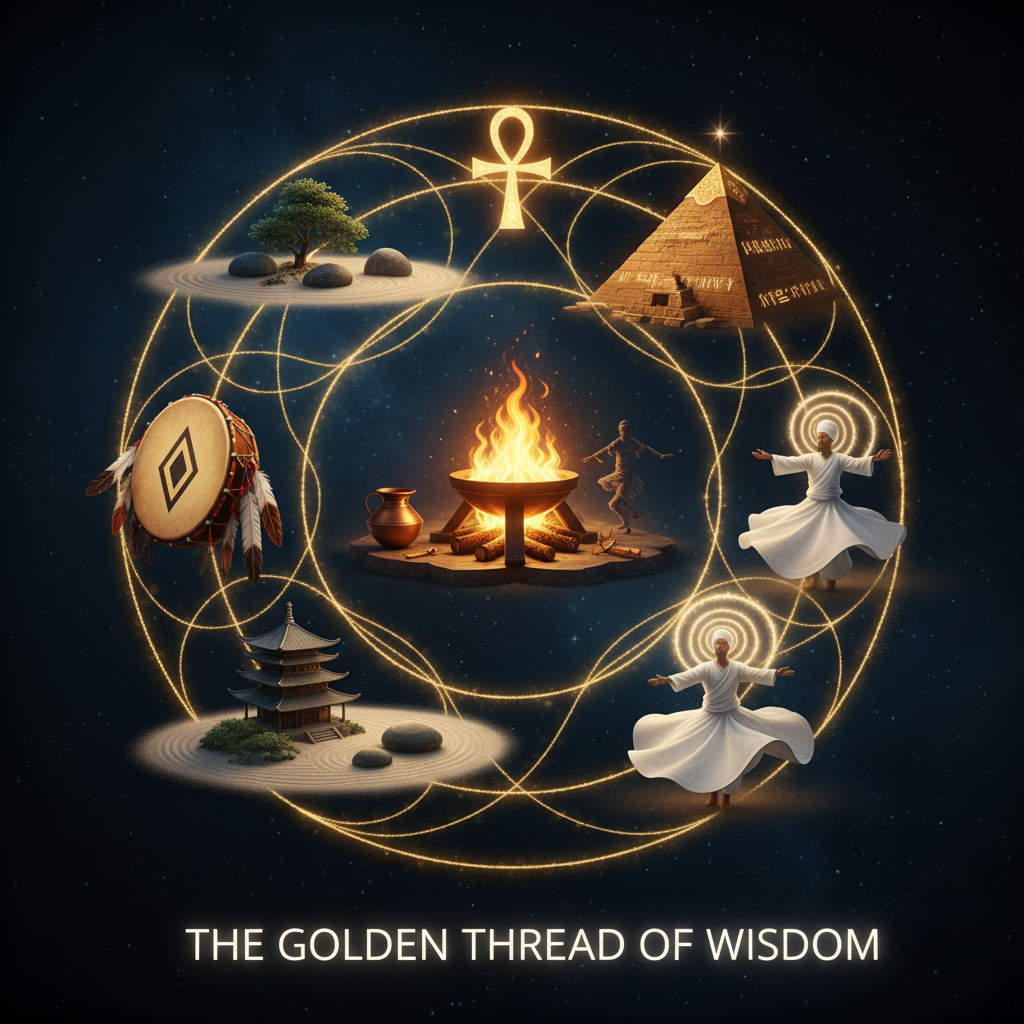
The wisdom is clear: manifestation is not a modern discovery. It is a universal truth, expressed in many languages and rituals. What we now call “Law of Attraction” is simply a new label for an ancient, timeless practice.
Conclusion: Manifestation Is Timeless Wisdom
Today, we hear about the Law of Attraction as if it’s a new discovery but the truth is, manifestation is as old as humanity. Across continents and centuries, cultures have understood a simple truth: thoughts, intentions, and rituals shape reality.
- In India, sages declared Sankalp and chanted mantras.
- In Egypt, priests used heka, the sacred power of words.
- In Greece, philosophers taught “as within, so without.”
- Native tribes went on vision quests, African communities drummed in unity, Eastern monks visualized compassion, and mystics across the Middle East prayed with unshakable intention.
Though their languages and rituals differed, their wisdom was the same: we are co-creators with the universe. What we focus on with clarity, emotion, and faith eventually takes form.
The modern LOA movement simply gave ancient wisdom a new name. But when we look back, we see a timeless thread: manifestation is not a trend it is our birth right, practiced by our ancestors in countless ways.
As the Rigveda declares: “मनसा वाचा कर्मणा” (Manasa Vacha Karmana) By thought, word, and deed, reality is created. And as today’s LOA teachers remind us: energy flows where attention goes.
The question is no longer “Does manifestation work?” The real question is: “Will we practice it with the same devotion, clarity, and alignment as our ancestors did?”
More from Dr Amiett Kumar:
Law of Attraction & Neuroscience: How Emotional Bonding Shapes Love, Energy & Manifestation
Table of Contents