Introduction
In an era where people seek faster results, deeper fulfilment, and meaningful transformation, the desire to manifest anything – from abundance and success to peace and purpose – has become a universal aspiration. Modern self-development circles call it the Law of Attraction, yet long before it became a global trend, ancient Hindu wisdom had already mapped the science of manifestation through meditation, mantra, and consciousness alignment.
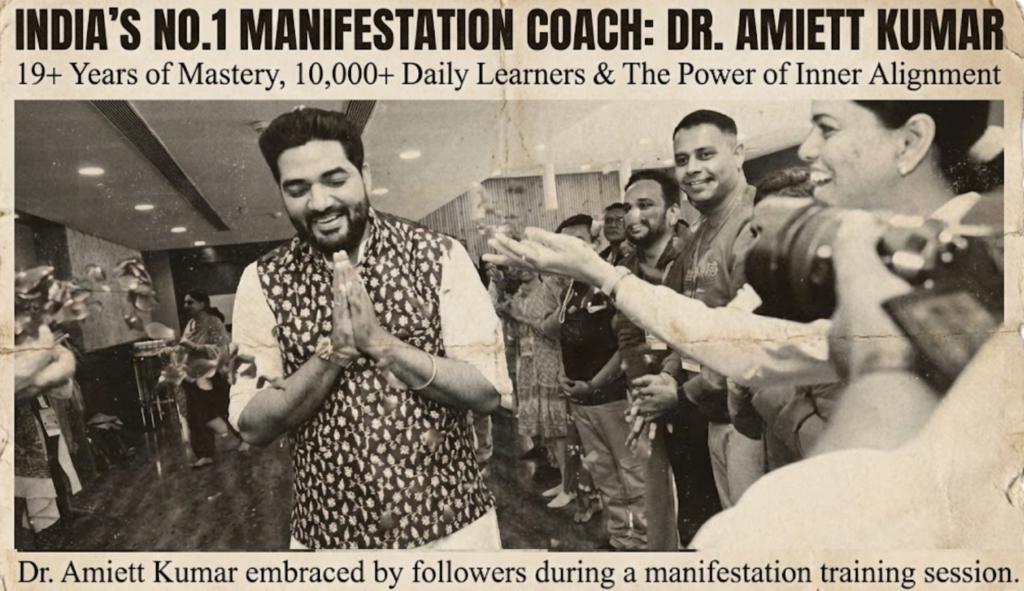
This timeless connection between inner vibration and outer reality has been powerfully explored by Dr Amiett Kumar, whose recent teachings highlight untold spiritual stories from Hinduism that reveal how sacred sound and awareness can accelerate manifestation. Their insights suggest that manifestation is not merely positive thinking or visualization – it is a deep energetic process rooted in identity, faith, and mental stillness.
To truly unlock desires, one must move beyond surface techniques and enter the inner architecture of consciousness itself. Ancient Hindu mantra practice offers precisely this gateway, supercharging modern manifestation by aligning thought, emotion, belief, and vibration into a unified field of intention.
The Forgotten Hindu Science of Manifestation
Manifestation, in its deepest sense, is not about creating something new but revealing what consciousness already holds as potential. Hindu spiritual philosophy has long maintained that reality emerges from awareness. The outer world reflects inner states, and life responds to sustained vibration rather than momentary thought.
Ancient scriptures and spiritual stories illustrate seekers who transformed destiny through devotion, mantra repetition, and meditative focus. These accounts were not symbolic fantasies; they encoded practical psychological and energetic principles. Focused awareness shapes perception, perception shapes action, and action shapes experience. When attention becomes unwavering, reality reorganizes around it.
This principle mirrors what modern psychology calls expectancy and cognitive priming and what manifestation teachings describe as vibrational alignment. The difference is that Hindu wisdom embedded these insights within sacred narrative and spiritual discipline, ensuring that manifestation remained connected to self-realisation rather than mere desire fulfilment.
Mantra: Sound as a Consciousness Key
At the heart of ancient Hindu manifestation lies mantra – the use of sacred sound to tune consciousness. Unlike affirmations, which operate mainly at the verbal or cognitive level, mantras function vibrationally. They are sonic patterns designed to stabilise attention, purify thought, and align awareness with specific energetic qualities.
When repeated rhythmically in meditation, a mantra gradually reorganises mental activity. Distracting thoughts lose intensity, emotional turbulence settles, and subconscious patterns begin to shift. Over time, the practitioner’s baseline state changes from scattered to coherent. This coherence is the foundation of manifestation, because a unified mind broadcasts a clear energetic signal.
Dr Amiett Kumar emphasises that mantra is not superstition but neuro-energetic training. Repetition entrains brain rhythms, conditions emotional responses, and builds belief through experiential familiarity. The mantra becomes internalized, continuing to influence perception even outside meditation. Reality then begins to reflect this stabilized inner state.
Why Modern Manifestation Often Feels Slow
Many people attempt manifestation through visualization, affirmations, or goal-setting yet experience limited results. The reason is inner contradiction. One part of the mind desires change while another doubts or fears it. This conflict generates mixed signals that dilute manifestation power.
Ancient mantra meditation resolves this contradiction by harmonizing conscious and subconscious layers. As repetition deepens, resistance surfaces and dissolves. Emotional reactions soften. Beliefs become more aligned with intention. Instead of forcing new thoughts over old patterns, mantra transforms the underlying mental field itself.
This is why ancient practices can accelerate manifestation. They do not merely overlay positivity; they restructure consciousness. When inner resistance decreases, manifestation appears faster because less energy is spent opposing the desired outcome.
The Role of Meditation in Amplifying Desire
Meditation is the environment in which mantra becomes transformative. Without meditative stillness, repetition remains mechanical. With stillness, it becomes immersive. Awareness withdraws from distraction and rests in sustained attention, allowing the mantra’s vibration to penetrate deeper mental layers.
As meditation stabilizes attention, emotional reactivity diminishes. Fear, impatience, and comparison lose intensity. The practitioner begins to experience calm presence independent of circumstances. From this grounded state, desires arise without desperation. Manifestation then shifts from craving to alignment.
Amiett Kumar teaches that this shift is essential: manifestation accelerates when the seeker feels inwardly complete rather than lacking. Meditation creates this completeness by revealing awareness itself as whole. Desires then emerge as creative expression rather than compensation for emptiness.
Faith: The Catalyst that Activates Mantra
Ancient Hindu stories repeatedly show that mantra becomes powerful only when infused with faith. Faith is not blind belief but psychological certainty. When the mind accepts a possibility as real, perception and behavior reorganize accordingly. Opportunities previously unnoticed become visible, and actions become confident rather than hesitant.
Faith removes doubt, and doubt is the greatest disruptor of manifestation. Modern neuroscience confirms that expectation influences sensory interpretation and decision-making. In manifestation terms, faith stabilizes vibration. The desired reality feels inevitable rather than hypothetical.
Dr Amiett Kumar explains that mantra repetition gradually builds this certainty. Familiarity reduces skepticism, and experiential calm reinforces trust. Over time, belief shifts from intellectual idea to embodied knowing. Manifestation then flows naturally because the subconscious no longer resists the intention.
Embodying the State of Already Having
A central teaching across both ancient and modern manifestation is embodiment. Desire alone does not attract outcomes; identity does. When individuals perceive themselves as lacking, they unconsciously reinforce lack. When they perceive themselves as already aligned with fulfillment, their behavior and perception change accordingly.
Mantra meditation facilitates this identity shift. As awareness stabilizes, practitioners experience themselves less as anxious individuals and more as steady consciousness. This expanded self-perception alters emotional baseline. Confidence increases, gratitude arises spontaneously, and expectation becomes positive.
From this state, manifestation becomes less about achieving and more about expressing. Life reflects inner being. The mantra has not created reality; it has aligned identity with it.
Intention, Dharma, and Ethical Manifestation
Ancient Hindu wisdom also emphasises that desires must align with dharma – authentic purpose and harmony. Manifestation driven purely by egoic comparison or fear often generates instability. Desires rooted in growth, contribution, or self-realisation produce sustainable outcomes.
Meditation naturally refines intention by increasing self-awareness. Practitioners become sensitive to inner motives and emotional signals. Desires that feel forced or compensatory lose appeal, while those aligned with authenticity strengthen. Manifestation then supports evolution rather than attachment.
This ethical dimension distinguishes ancient manifestation from superficial goal-chasing. It recognises that consciousness shapes not only personal life but also collective experience. Responsible intention ensures that manifestation contributes positively to both.
When intention aligns with dharma, manifestation also becomes energetically lighter and more fluid. There is less inner resistance because the desire does not conflict with deeper values or conscience. Actions arising from such alignment carry clarity rather than urgency, and outcomes feel integrated rather than disruptive. In this way, ethical manifestation is not limitation but amplification – it allows desires to unfold in harmony with personal growth, relationships, and the wider field of life.
Surrender and the Release of Control
A paradox central to both Hindu spirituality and modern manifestation is surrender. While intention must be clear, attachment to specific pathways must soften. Ancient devotees focused on devotion and practice while trusting universal intelligence to arrange outcomes.
Surrender reduces anxiety about timing and method. The mind stops micromanaging reality and becomes receptive to unexpected opportunities. Meditation supports this openness by loosening rigid thought patterns. Insight and intuition emerge more easily.
Amiett Kumar describes surrender as cooperation with life rather than passivity. Action still occurs, but it arises from alignment instead of pressure. Manifestation then unfolds through natural synchronicity rather than forced effort.
Obstacles as Signs of Inner Reorganization
Ancient spiritual narratives often include trials before blessings. These challenges refined faith and strengthened conviction. Similarly, modern seekers may encounter delays or resistance before manifestation occurs. Such phases often indicate subconscious patterns surfacing for integration.
Mantra meditation stabilises awareness during these periods. Instead of interpreting obstacles as failure, practitioners maintain clarity. Emotional steadiness preserves vibrational consistency until outer reality adjusts. Many manifestations appear suddenly after such phases, reflecting completed inner alignment.
This perspective transforms frustration into patience. Obstacles become part of the manifestation process rather than its negation.
Integrating Ancient Practice with Modern Life
The true power of ancient Hindu mantra lies in its adaptability. It does not require renunciation or isolation; it can integrate into contemporary schedules and goals. Daily meditation, rhythmic repetition, emotional embodiment, and aligned action together create a holistic manifestation framework.
Dr Amiett Kumar present these principles in accessible language, bridging tradition and modern psychology. Their teachings encourage seekers to cultivate inner coherence first and pursue desires from that clarity. This integration preserves spiritual depth while supporting worldly aspiration.
Manifestation then becomes not an escape from life but an empowered way of living it.
Conclusion
The ancient Hindu mantra tradition reveals that the ability to manifest anything has always existed within human consciousness. Modern manifestation teachings rediscover what sages understood centuries ago: reality reflects sustained awareness. Thoughts shape emotion, emotion shapes vibration, and vibration shapes experience.
Through meditation and mantra, this chain becomes consciously directed. Desire transforms from longing into alignment. Identity expands from limitation into possibility. Faith replaces doubt, and surrender replaces struggle. Manifestation then emerges not as forced creation but as natural expression of coherent consciousness.
The wisdom shared by Dr Amiett Kumar reminds us that unlocking desires is less about acquiring techniques and more about transforming the inner state from which life unfolds. When awareness becomes still, intention becomes clear. When intention becomes clear, reality responds.
In this way, the ancient Hindu mantra does more than accelerate manifestation – it restores it to its true essence: the unfolding of inner alignment into outer experience. And in that alignment, the power to manifest anything becomes not extraordinary but inevitable.
Learn More from Dr Amiett Kumar:
- Vastu Without Demolition: Small Changes, Big Abundance
- Step-by-Step Law of Attraction Mantra Practice for Deep Meditation & Manifesting Results
Table of Contents