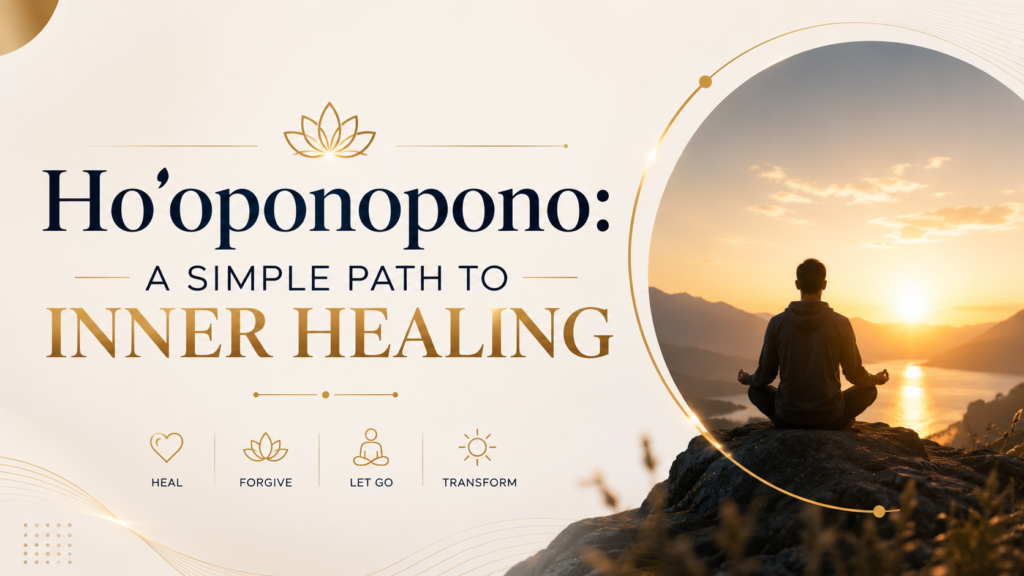
How four ancient words – I’m Sorry, Please Forgive Me, Thank You, I Love You hold the power to heal your past, clear your energy, and open the door to manifesting anything your heart truly desires
What if healing, real, deep, lasting healing, did not require years of therapy, decades of spiritual seeking, or a dramatic breakthrough moment? What if it were available to you right now, in this breath, through four short phrases so simple a child could speak them, yet so profound that ancient Hawaiian wisdom traditions have used them for centuries to restore peace, dissolve resentment, and realign the human soul with the infinite creative power of the universe?
Hoʻoponopono, pronounced ‘ho-oh-pono-pono’, is that practice. And in the teaching of Dr Amiett Kumar, India’s best manifestation coach, top life coach, and the guiding force behind one of India’s most beloved spiritual and personal growth communities, Ho’oponopono is not merely an interesting ancient ritual. It is one of the most powerful tools available to a modern seeker committed to the path of manifestation, healing, and inner transformation.
In this deep-dive blog, we explore everything you need to know about Hoʻoponopono its origins, its philosophy, its four sacred phrases, and how to integrate it into your daily practice of meditation, affirmation, visualisation, and law of attraction work. Whether you are new to the path or a seasoned student of spirituality and coaching, what follows may be the most liberating reading you do this year.
The Ancient Roots of Hoʻoponopono
Hoʻoponopono is a traditional Hawaiian practice of reconciliation and forgiveness. The word itself, in the Hawaiian language, means something close to “to make right” or “to correct an error”, with the doubling of the word “pono” (righteous, correct, and balanced) emphasising the importance of restoring not just surface harmony but deep, authentic alignment. For centuries, it was practised in Hawaiian communities as a form of collective healing, with families, communities, and individuals coming together under the guidance of a kahuna (a spiritual healer or keeper of wisdom) to resolve conflicts, address wrongdoing, and restore the bonds of love and trust that are the foundation of a healthy community.
Traditional Hoʻoponopono was a communal practice, a facilitated gathering in which the affected parties would speak, listen, and collectively work toward resolution. Prayers were offered, debts were cancelled, and forgiveness was extended until every participant could feel that peace had been genuinely restored. Only when all parties felt complete was the healing considered done.
In the twentieth century, the practice underwent a profound transformation from a communal ritual to an entirely internal, individual practice. The woman most responsible for this evolution is Morrnah Nalamaku Simeona, a Hawaiian healer who, in the 1970s and 1980s, adapted Hoʻoponopono for the modern world. She recognised that in the complexity of contemporary life, the traditional communal process was often not possible but that the healing it offered was no less urgently needed. She developed a version of the practice that could be done entirely within the individual’s own consciousness, making it available to anyone, anywhere, at any time.
Her student, Dr Ihaleakala Hew Len, took this modern version further still, and his work became the foundation of the Hoʻoponopono that is now practised by millions of people around the world. His extraordinary story, which we will explore in the next section, brought this ancient wisdom into global consciousness and aligned it perfectly with the teachings of spirituality, the law of attraction, and manifestation that form the heart of Dr Amiett Kumar’s coaching philosophy.
The Story That Changed Everything: Dr Hew Len and the Hawaii State Hospital
No story in the modern history of Hoʻoponopono is more remarkable or more relevant to the question of how inner healing creates outer transformation than that of Dr Ihaleakala Hew Len and his work at the Hawaii State Hospital for the Criminally Insane.
In the early 1980s, this ward was, by all accounts, a deeply troubled and dangerous place. Staff turnover was extremely high; employees were frequently assaulted or simply quit out of fear and despair. Patients were shackled, heavily medicated, and considered by most professionals to be beyond rehabilitation. The atmosphere of the ward was one of chronic violence, hopelessness, and suffering.
Dr Hew Len was hired as a staff psychologist, but he did something that was, by conventional standards, extraordinary. He agreed to take the position, but with one condition: he would not see the patients directly. Instead, he would sit in his office with the patient files, and he would work on himself. Using the Hoʻoponopono process, he would review each patient’s file, take complete responsibility for whatever he found in his own consciousness that might be contributing to that patient’s reality, and then apply the four phrases I’m Sorry, Please Forgive Me, Thank You, and I Love You – to whatever arose.
What happened over the following months and years is one of the most cited examples of inner work producing outer-world transformation in modern spiritual literature. Patients who had been considered permanently dangerous began to recover. Medications were reduced and, in some cases, eliminated. Patients who had been shackled for years were allowed to walk freely. Staff turnover decreased dramatically. The atmosphere of the ward transformed from one of fear and despair to one of relative calm and genuine hope. Within a few years, the ward had healed to such a degree that it was closed not because it had failed but because it no longer had enough patients to justify remaining open.
Dr Hew Len’s explanation for this transformation is both simple and profoundly challenging: “I was healing the part of me that created them.” In the philosophy of Hoʻoponopono, everything you experience, every person, every circumstance, and every challenge is a projection of your own consciousness. You did not cause it in a simple, linear sense. But at the level of shared consciousness, your inner world and the outer world you inhabit are intimately connected. When you clean your inner world, the outer world changes accordingly.
This is a teaching that resonates deeply with the law of attraction philosophy that Dr Amiett Kumar brings to his community: the understanding that the outer world is, at its deepest level, a mirror of the inner world. Change the inner world, and the outer world must follow.
The Core Philosophy: Total Responsibility and the Clean Slate
To truly understand Hoʻoponopono, you must first understand its foundational philosophical premise – a premise that is both deeply liberating and initially quite confronting: you are 100% responsible for everything in your experience.
Not responsible in the sense of fault or blame. Not responsible in the sense that you consciously chose your circumstances or deliberately created your suffering. Responsible in the deeper sense that, at the level of shared consciousness, everything you perceive as external reality passes through the filter of your own mind, your own accumulated memories, and your own unresolved emotional data, and that filter shapes what you see, what you attract, and what you experience.
In Hoʻoponopono, the cause of all suffering, personal, relational, and even global, is what the tradition calls “memories”: accumulated data in the subconscious mind that is not aligned with love. These memories may be from this lifetime or, in the tradition’s belief system, from lifetimes before. They may be personal or ancestral. They may be known or entirely unconscious. What matters is not their origin but their effect: they create a kind of static in consciousness, a distortion that prevents the clear, clean flow of inspiration, love, creativity, and divine guidance.
The purpose of Hoʻoponopono is to clean this static. To return to the state that the tradition calls the “zero state” or the “clean slate”, a state of complete openness, pure receptivity, and unobstructed connection to the divine intelligence that guides all things. In this zero state, manifestation is not an effort. It is a natural consequence of alignment. When the internal static is removed, what you need, what you are guided toward, and what flows into your life are perfectly coordinated by a wisdom greater than your own.
This is the point of profound intersection between Hoʻoponopono and the teachings of Dr Amiett Kumar on manifestation, law of attraction, and spirituality. The zero state of Hoʻoponopono is the same inner condition that Dr Amiett Kumar points to when he teaches about the essential preconditions for genuine manifestation: a subconscious mind cleared of limiting beliefs, a heart open and aligned with the frequency of what is desired, and a consciousness in genuine relationship with something larger than the personal self.
The Four Sacred Phrases: A Deep Exploration
At the heart of modern Hoʻoponopono practice are four phrases. They appear simple, almost disarmingly so. But each one carries a specific energetic and psychological function, and together they form a complete system of inner cleaning that addresses every level of the human being: the mind, the heart, the body, and the soul.
Phrase 1: “I’m Sorry”
“I’m sorry” is not an admission of conventional guilt. It is an acknowledgement of responsibility, the recognition that whatever is appearing in your experience, there is something within your own consciousness that has contributed to it. It is the practice of humility in its most genuine form: the willingness to say, not “I did this wrong” but “I am willing to take responsibility for what I am seeing and feeling, and I am willing to clean.” This phrase activates the process. It is the moment of turning inward rather than outward, the essential first step of all genuine inner work.
In the context of Dr Amiett Kumar’s teaching on life coaching and personal growth, “I’m Sorry” corresponds to the moment of taking radical personal responsibility, one of the most powerful and transformative shifts a human being can make. The victim of circumstance says, “This is happening to me.” The practitioner of Hoʻoponopono says, “This is appearing in my consciousness, and I choose to clean it.”
Phrase 2: “Please Forgive Me”
“Please Forgive Me” is a request, but it is not directed at another person. It is directed at the divine intelligence that the tradition calls ‘the source’, or simply ‘love itself’. It is the acknowledgement that the memories and static in your consciousness are not who you truly are; they are accumulated data that has obscured your essential nature, and it is the request to be freed from that data. It is the prayer beneath all prayers: “I know that this suffering, this limitation, and this distortion is not my true self. Please help me release it.”
This phrase carries particular resonance in the context of spirituality and meditation. Many people who come to meditation bring with them a lifetime of accumulated emotional and psychological material grief, resentment, shame, and fear that they have been carrying so long they have forgotten it is not their essential identity. “Please Forgive Me” is the beginning of the laying down of that burden. It is the first breath of genuine spiritual freedom.
Phrase 3: “Thank You”
“Thank You” is the phrase of trust and surrender. It is the acknowledgement that the cleaning is happening even when you cannot see it, feel it, or measure it. It is gratitude not for a result that has materialised but for the process itself. For the love and intelligence that is always at work within and around you, even in the darkest moments. For the opportunity, in every experience of pain or difficulty, to clean a little more and return a little closer to the zero state.
In the teaching of Dr Amiett Kumar on the law of attraction and manifestation, gratitude is one of the highest vibrational states a human being can occupy and one of the most powerfully magnetic. When you are in genuine gratitude, you are in alignment with abundance, with love, and with the creative flow of the universe. “Thank you” in Hoʻoponopono is not just a nicety. It is a vibrational practice. It shifts your inner state in a direction that is entirely consistent with the conditions needed to manifest anything your heart truly desires.
Phrase 4: “I Love You”
“I Love You” is the most powerful of the four phrases and the one that may initially feel the most difficult, depending on what you are working with. These three words are spoken to the divine presence within, to the memory or data being cleaned, to your own subconscious mind, and to the source of all healing. Love is not just the method of Hoʻoponopono it is the destination. It is the substance of the zero state. When all the static is cleared, what remains is love. Always. Only.
“I Love You” is also, in the tradition’s understanding, the most direct activation of the divine cleaning power. When you say “I love you” to a difficult person, to a painful memory, to a frightening situation, or to your own shadow, you are bringing the highest available frequency into contact with the lowest. And in that contact, the lower frequency dissolves. This is not a metaphor. In the energetic framework of Hoʻoponopono, love is not a sentiment. It is a force. The most powerful force in existence.
Hoʻoponopono and Manifestation: The Connection That Changes Everything
One of the questions most frequently asked in the Amiett Kumar community, where the practices of manifestation, law of attraction, affirmation, and visualisation are central, is this: if I am practising all of these tools consistently, why do some of my desired manifestations still not arrive? Why does the same unwanted pattern keep repeating? Why does my visualisation feel forced rather than fluid? Why do my affirmations feel like lies rather than truths?
The answer, in virtually every case, is the same: subconscious static. Unresolved emotional data. Memories in the Hoʻoponopono sense that are broadcasting a frequency which contradicts the frequency of the desired manifestation. You can affirm abundance all day long at the conscious level, but if your subconscious is running a deep programme of “I am not worthy of abundance”, the affirmation will not land. The subconscious programme wins every time.
This is where Hoʻoponopono becomes a profoundly important complement to the manifestation practices that Dr Amiett Kumar teaches. Before you can effectively use the law of attraction to manifest anything, you need a clear channel. You need a subconscious that is, as much as possible, free of the contradictory data that blocks and distorts the manifesting process. Hoʻoponopono is the cleaning of that channel.
Think of it this way: visualisation is the act of sending a clear, vivid signal to the universe about what you wish to create. Affirmation is the reprogramming of your subconscious identity to align with that desired creation. Meditation is the cultivation of the inner conditions of stillness, receptivity, and openness in which both visualisation and affirmation can work most effectively. And Hoʻoponopono is the clearing of the static that would otherwise interfere with the entire process. Together, these four practices form a complete, extraordinarily powerful system for inner transformation and outer manifestation.
As India’s top manifestation coach, Dr Amiett Kumar consistently teaches that the depth of your outer manifestation is determined by the quality of your inner work. Hoʻoponopono is inner work of the highest and most direct kind, and its effects on the manifestation process are often immediate, profound, and lasting.
How to Practise Hoʻoponopono: A Complete Step-by-Step Guide
One of the most beautiful aspects of Hoʻoponopono is its accessibility. It requires no special equipment, no particular setting, no prior spiritual experience, and no specific amount of time. It can be practised in five minutes or for an hour. It can be done in meditation, during a walk, while doing household tasks, or in the quiet before sleep. Here is a complete guide to bringing the practice into your life.
The Basic Practice
Begin by finding a quiet place to sit comfortably. Close your eyes. Take three slow, deep breaths, inhaling through the nose and exhaling through the mouth to settle the nervous system and begin the transition from the busy activity of the conscious mind to the deeper receptivity of the inner world. Allow your breath to return to its natural rhythm. Let your body relax.
Now bring to mind something you wish to clean. This might be a relationship difficulty, an emotional pattern, a financial challenge, a physical symptom, a fear, a resentment, a regret, or simply a feeling of being stuck. You do not need to analyse it, understand it, or resolve it consciously. You simply need to bring it into awareness and be willing to take responsibility for its presence in your consciousness.
With the situation or feeling held gently in your awareness, begin repeating the four phrases either aloud or silently, whichever feels more natural:
“I’m Sorry”
“Please Forgive Me”
“Thank You”
“I Love You”
Repeat these phrases in this order or in whatever sequence feels right for as long as feels appropriate. There is no fixed duration and no fixed number of repetitions. You will often notice, as you repeat the phrases with genuine feeling, that something begins to shift. A tightness in the chest loosens. A story you have been telling yourself begins to feel less solid. A sense of peace, quiet, subtle, but unmistakable, begins to arise. This is the cleaning at work. Trust it.
The Meditation Integration
For practitioners of meditation, the Amiett Kumar community is a deeply meditation-orientated community. Hoʻoponopono integrates seamlessly and powerfully with an existing practice. Begin your meditation session in your usual way, settling the body, establishing the breath, and allowing the mind to quiet. Once you have reached a state of reasonable inner calm, introduce Hoʻoponopono into the practice.
In a light meditative state, the phrases land at a deeper level of the subconscious than they do in ordinary waking consciousness. The cleaning is more thorough. The peace that follows is more profound. Many practitioners report that meditating with Hoʻoponopono produces experiences of unexpected emotional release, with tears that arise and pass quickly, leaving in their wake a sense of lightness and genuine inner spaciousness.
The Continuous Background Practice
One of the most distinctive aspects of Dr Hew Len’s approach to Hoʻoponopono is the recommendation to make it a continuous background practice, not just a formal sit but an ongoing inner cleaning that runs through the entire day. Whenever anything arises that creates even a flicker of reactivity, irritation, anxiety, judgement, desire, or fear, rather than following the reactive thought, you simply turn inward and begin the four phrases. You are constantly cleaning. Constantly returning. Constantly clearing the channel.
This approach aligns beautifully with the mindfulness traditions that many members of the Amiett Kumar Readers Books Club community are familiar with: the practice of bringing gentle, non-reactive awareness to whatever arises in each moment. Hoʻoponopono adds an active, loving response to that awareness: not just noticing, but cleaning. Not just observing, but transforming.
Hoʻoponopono for Specific Manifestation Goals
For those working with specific manifestation intentions, a relationship, a financial goal, a health aspiration, or a creative project, Hoʻoponopono can be used in a targeted way. Begin your affirmation or visualisation practice as usual. State or feel your intention clearly. Then, before or after the affirmation and visualisation, spend several minutes applying the four phrases specifically to any resistance, doubt, fear, or contradiction that arises in relation to that goal.
You may notice that when you hold a specific desire in mind and then say, “I’m sorry, please forgive me, thank you, I love you,” you will feel, in some part of yourself, a response. A memory might surface. An old story might arise. A belief that contradicts the desire might become visible. This is not failure. This is the practice working exactly as it should. You have flushed up the static. Now you can clean it. And when it is cleaned, the path to manifesting anything you desire becomes clearer, more open, and more direct.
Hoʻoponopono and the Teachings of Dr Amiett Kumar: A Perfect Synthesis
The reason Hoʻoponopono sits so naturally within the teaching ecosystem of Dr Amiett Kumar is that both are grounded in the same fundamental insight: the outer world is a projection of the inner world, and the path to changing the outer begins with transforming the inner.
As India’s best manifestation coach and top law of attraction teacher, Dr Amiett Kumar has always insisted that manifestation is not a technique; it is a state of being. You do not do manifestation. You become the version of yourself who naturally, effortlessly, joyfully embodies the reality you desire. And the path to becoming that version of yourself runs directly through the inner clearing that Hoʻoponopono, meditation, affirmation, and coaching together make possible.
The Readers Books Club community, with its deep commitment to books, learning, and the practical application of wisdom, has embraced Hoʻoponopono enthusiastically because it represents exactly what this community stands for: an ancient teaching, made accessible to a modern audience, that actually works. Not as a feel-good mantra. Not as a spiritual bypass. But as a genuine, daily, living practice of inner cleaning that creates space for love, clarity, and the free flow of divine inspiration.
Community members who have integrated Hoʻoponopono into their daily practice alongside the guided meditations, affirmation practices, and visualisation techniques taught in the Amiett Kumar coaching programmes consistently report the same thing: their manifestation practice becomes lighter, more natural, and more effective. The struggle against resistant thoughts decreases. The sense of being in flow with life increases. Relationships heal. Financial patterns shift. Creative blocks dissolve.
This is not magic. It is the natural consequence of removing the obstacles to what is already, always, trying to flow toward you. The universe wants to give you everything your heart genuinely desires. Hoʻoponopono simply clears the path.
Begin Today: Your Hoʻoponopono Practice Starts Now
You do not need to understand Hoʻoponopono completely before you begin. In fact, the tradition actively discourages over-intellectualising the process. You simply need to begin. To choose one thing, one relationship, one fear, one recurring pattern, and one unfulfilled desire and bring it into the practice. To say the four phrases with genuine feeling. And to trust that something is happening, even when you cannot yet see it.
Start tonight, before sleep. Lie down in the quiet. Let your mind settle. Bring to mind one person, situation, or inner experience that carries some heaviness. And then, simply, gently, Sincerely,
“I’m Sorry.”
“Please Forgive Me.”
“Thank You.”
“I Love You.”
Repeat until you feel something soften. Until the story loses a little of its grip. Until the space between the words feels a little more spacious than it did before. Then sleep. And notice what is different in the morning.
To deepen your practice, explore the full range of healing, manifestation, and coaching resources available at amiettkumar.com, including Dr Amiett Kumar’s guided meditation library, affirmation programmes, law of attraction coaching, and the Readers Books Club, where the books that have shaped his own understanding of Hoʻoponopono and inner healing are available for the entire community.
Subscribe to the Amiett Kumar YouTube channel, where the one-million-strong community of seekers gathers regularly for teaching, guidance, and genuine shared transformation. Follow the podcast. Explore the coaching programmes. And above all, begin the practice. Today. Now. In this breath.
Because the healing you have been searching for is not somewhere out there in the future. It is here. In the four most powerful phrases a human being can speak. In the willingness to take responsibility, to ask for forgiveness, to offer gratitude, and to choose love again and again and again until the channel is clear and the life you were born to live flows in freely, abundantly, and completely.
“The universe is not withholding from you. It is waiting for you to clean the static that is blocking its gifts. I’m sorry. Please forgive me. Thank You. I love you. Say these four phrases every day and watch your entire world begin to change.”
About Dr Amiett Kumar
Dr Amiett Kumar is India’s best manifestation coach, top law of attraction teacher, life coach, and the guiding force behind amiettkumar.com and the Readers Books Club, two of India’s most trusted personal growth platforms. With over one million subscribers on YouTube and a deeply engaged podcast and coaching community, Dr Amiett Kumar has dedicated his life to bringing the world’s most powerful tools for inner transformation, including Hoʻoponopono, meditation, affirmation, visualisation, and law of attraction, to every seeker in India and beyond.
Explore Dr Amiett Kumar’s full range of coaching, guided practices, and community resources at www.amiettkumar.com
Table of Contents