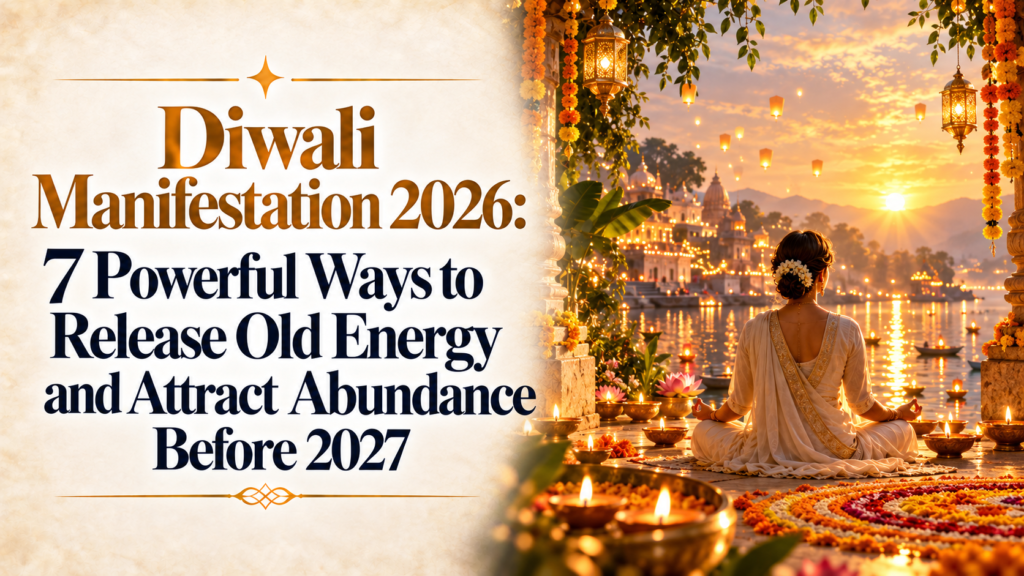
Diwali has always carried the symbolism of light entering darkness, renewal after stagnation, and prosperity arriving in a home that has been cleaned, prepared, and made ready to receive. In 2026, Diwali falls on Sunday, November 8, in India, creating a natural pause before the final weeks of the year. That timing makes the festival especially meaningful for anyone who wants to reflect on what 2026 taught them and decide how they want to enter 2027.
For people interested in manifestation, meditation, affirmation, visualisation, spirituality, the law of attraction, and personal growth, Diwali can become more than a festival on the calendar. It can become a reset point. You can use the days around Diwali to clear physical and emotional clutter, review your relationship with money, express gratitude for what is already present, visualise the future you are building, strengthen healthier subconscious patterns, and take aligned action before the year ends.
That is the grounded meaning of Diwali manifestation 2026 used in this guide. It is not a promise that lighting a diya, repeating a sentence, or performing a ritual will automatically create money, success, love, or opportunities. Manifestation becomes more useful when it combines intention with attention, emotional regulation, self-awareness, practical planning, and behaviour. A spiritual ritual may help you pause and focus, but the life you want still needs choices, conversations, habits, learning, boundaries, financial responsibility, and consistent action.
This distinction matters because abundance is larger than money. Financial security matters, but abundance can also mean time, supportive relationships, health, peace, ideas, courage, opportunities, useful skills, confidence, generosity, and the ability to enjoy what you already have. If your idea of abundance is only “more”, you may remain in a state of lack even while your life improves. If abundance also includes appreciation, capacity, clarity, and wise action, manifestation becomes less about chasing and more about becoming ready to receive and manage what you are asking for.
If you follow Dr Amiett Kumar or the Amiett Kumar community for meditation, visualisation, affirmation, the subconscious mind, the law of attraction, manifestation techniques, coaching, or mental clarity, you will recognise a recurring principle: inner work becomes powerful when it changes the way you live. You can visualise a confident future self, but you still have to send the application. You can affirm abundance, but you still need to review your spending. You can meditate for peace, but you still need boundaries around what repeatedly drains you.
This Diwali, the invitation is simple: do not only decorate the space around you. Reset the patterns inside you.
The seven practices below are designed to help you release old energy and move toward 2027 with more clarity, gratitude, and practical abundance.
What Does Diwali Manifestation Really Mean?
The phrase Diwali manifestation combines a traditional festival of light and prosperity with a modern personal-growth practice. These are not the same thing, and it is respectful to keep the distinction clear. Diwali has deep religious, regional, family, and cultural meanings across India and beyond. Manifestation, as the term is commonly used in self-development, refers to deliberately focusing on a desired direction and aligning beliefs, attention, emotions, and actions with that direction.
The connection works symbolically. Diwali already gives us powerful images: cleaning, light, Lakshmi Puja, new beginnings, gratitude, generosity, family, prosperity, and removing darkness. A manifestation practice can use those themes as prompts for reflection. What are you cleaning out of your life? What deserves more light? Where are you operating from scarcity? What type of prosperity do you want to build? What old belief does not deserve to come into 2027 with you?
In this sense, a Diwali manifestation ritual is less about controlling the future and more about preparing yourself for it. You cannot control every external event. You can influence your preparation, attention, habits, communication, skills, financial decisions, and willingness to act.
This is why the most useful form of manifestation for abundance includes both inner and outer work. The inner work gives direction. The outer work gives the direction a path.
There is also a psychological reason a festival can be a useful reset. Humans often use meaningful dates as temporal landmarks. A birthday, Monday, New Year, first day of a month, or festival can create the feeling of a fresh chapter. You do not have to wait for a special date to change, but meaningful dates can make reflection easier because they separate “before” from “after” in the mind.
Diwali 2026 gives you a natural landmark before 2027. Use it wisely.
Way 1: Clean More Than Your Home Release Physical, Digital, and Emotional Clutter
Diwali cleaning is one of the most familiar parts of the season. Rooms are reorganised, unnecessary objects are removed, surfaces are cleaned, and homes are prepared for celebration. From a manifestation perspective, this is a useful reminder: you cannot create spaciousness while constantly protecting every old thing.
Start with your physical environment, but do not stop there.
Look at the spaces that influence your daily state: your bedroom, work desk, wallet, phone, inbox, wardrobe, files, subscriptions, and social media feed. Clutter is not automatically bad, and minimalism is not a spiritual requirement. The question is whether your environment supports the person you are trying to become.
A crowded desk may make deep work harder. A phone full of unnecessary notifications may repeatedly interrupt meditation, reading, and important tasks. An inbox full of old promotional emails can create low-level mental noise. A wallet filled with useless receipts may seem trivial, yet it can reflect avoidance around money organisation. When you clear these areas intentionally, you reduce small frictions that compete with your attention.
Digital cleaning is particularly important before 2027 because many people now carry more clutter in their devices than in their homes. Unfollow accounts that repeatedly trigger comparison without adding value. Delete apps you open automatically but rarely enjoy. Organise important documents. Remove screenshots you do not need. Create one folder for financial records and one for goals or learning resources. You are not “manifesting” by deleting files; you are creating an environment that makes focused behaviour easier.
Then move to emotional clutter.
Emotional release does not mean pretending pain never happened. It does not mean forcing forgiveness before you are ready or calling every difficult emotion “negative energy.” Some experiences need processing, grieving, repair, or professional support. Releasing old energy simply means deciding what you no longer want to keep rehearsing without purpose.
Ask yourself: Which conversation am I replaying even though it is over? Which mistake am I still using as evidence that I cannot change? Which person am I mentally arguing with every day? Which regret is useful as a lesson but harmful as an identity? Which commitment belongs to an older version of me?
A simple Diwali reflection is to create two columns on paper. In the first, write what you are ready to release before 2027. In the second, write what you are choosing instead. For example: “I release the habit of delaying money conversations; I choose clear monthly financial reviews.” Or, “I release the need to prove myself to everyone; I choose focused work and stronger boundaries.”
Notice how this turns a vague spiritual idea into behaviour.
If you like symbolic rituals, you can safely tear up the release list after reading it, or simply close the journal and move on. The symbolism is optional. The decision is the important part.
For manifestation, clearing works because attention is limited. Every unresolved commitment, repeated comparison, and unnecessary source of stimulation competes with the new direction you say you want. You do not need a perfectly empty life. You need enough space to notice what matters.
A useful affirmation for this stage is: “I release what no longer supports my growth, and I make space for clarity, peace, and aligned opportunity.”
Repeat it only if it helps you act differently. The purpose of an affirmation is not to avoid reality. It is to remind you of the reality you are choosing to build.
Way 2: Use Gratitude to Move from Scarcity to Recognition
The second practice is gratitude, but not the version that demands you ignore what is difficult.
Real gratitude can exist alongside ambition, disappointment, grief, and unfinished goals. You can want a better financial situation and still appreciate the support you have today. You can want a healthier relationship and still recognise the lessons previous relationships taught you. You can desire growth without insulting your present life.
This distinction is important for abundance manifestation. Many people use manifestation from a psychological position of constant absence. They repeatedly think: I do not have enough money. I am behind. Everyone else is ahead. Nothing is happening. Where is my result? Even when they repeat positive affirmations, the dominant internal experience remains monitoring what is missing.
Gratitude interrupts this loop by training attention to notice what is already working.
Research on gratitude interventions suggests modest positive effects on well-being across many studies, although effects vary across populations and methods. That does not prove gratitude will attract money or magically change external circumstances. It does support the idea that deliberately noticing and expressing appreciation can influence emotional experience and well-being.
For a Diwali gratitude practice, go beyond a generic list of “family, health, home.” Make your gratitude specific.
Instead of “I am grateful for work,” write, “I am grateful that I learned how to handle difficult client conversations this year.”
Instead of “I am grateful for money,” write, “I am grateful that I was able to pay my rent on time this month,” or, “I am grateful that I finally started tracking my expenses.”
Instead of “I am grateful for my body,” write, “I am grateful that my body carried me through a difficult season and that I can support it better now.”
Specificity creates emotional truth. Then add a second layer: gratitude for capacity. Ask what you are now able to do that your past self struggled with. Perhaps you can say no more confidently, recover from a setback, use a skill you once lacked, stop chasing a relationship that repeatedly hurt you, start saving, or return to meditation after months away. Naming these changes helps you see the practical abilities and emotional strengths you have already built.
This type of gratitude is powerful because it shows you evidence of growth. It tells the subconscious mind, in practical terms, “Change has already happened before. I am capable of changing again.”
If you want to connect gratitude with manifestation, use it as a bridge rather than a performance. Spend five quiet minutes appreciating what already exists. Then ask: “From this foundation, what would I like to expand in 2027?”
That question feels different from “Why do I still not have what I want?” One comes from recognition; the other comes from constant lack.
You can also create a Diwali abundance inventory. Write down forms of abundance that are already present: useful contacts, knowledge, books, savings, opportunities, healthy relationships, access to the internet, mentors, a supportive team, a functioning laptop, time, creativity, health improvements, or lessons from failure. Again, this is not denial. It is a more complete accounting of reality.
For readers who follow Dr Amiett Kumar, Readers Books Club, meditation, spirituality, affirmation, visualisation, or the law of attraction, gratitude can serve as the emotional base of a manifestation practice. But keep it grounded: gratitude changes what you notice and how you relate to your present. What you do with that state still matters.
A Diwali affirmation for this stage could be: “I recognise the abundance already present in my life, and I use it wisely to create more value, peace, and opportunity.”
Way 3: Redefine “Lakshmi Manifestation” as Readiness for Prosperity
During Diwali, Goddess Lakshmi is associated with prosperity, good fortune, and abundance in Hindu traditions. For many families, Lakshmi Puja is a central spiritual practice. If you use the phrase Lakshmi manifestation, do so respectfully. It should not reduce a sacred tradition to a quick “money hack.”
A more meaningful approach is to ask: What would it look like to become more ready for prosperity?
Prosperity is not only receiving. It is also managing.
Many people want more money but avoid looking at bank statements. They want higher income but do not improve the skill that could increase their value. They want financial freedom but cannot clearly define what that means. They say they want abundance but spend impulsively every time they feel stressed.
This is where money manifestation becomes useful only when paired with financial honesty.
Before Diwali, schedule a 45-minute money clarity session. Open your accounts and review your real numbers without judgement. How much came in during the last three months? Where did it go? What subscriptions are unnecessary? What debt needs a plan? What emergency fund do you currently have? What financial goal matters most before the end of 2027?
Do not try to solve your entire financial life in one session. The purpose is awareness.
Next, define one abundance goal that is specific enough to guide behaviour. “I want more money” is emotionally understandable but strategically weak. “I want to build a six-month emergency fund,” “I want to increase monthly freelance income by 25%,” or “I want to clear this specific debt” creates a clearer target.
Then connect the goal to value creation.
Ask: What skill, service, product, relationship, negotiation, or business system could realistically contribute to this goal? Which conversation am I avoiding? What should I learn? Who could I help? Where can I improve my offer? What can I stop wasting money on? Which financial behaviour would make me more capable of holding the abundance I say I want?
This is one of the most important manifestation questions: If the opportunity arrived tomorrow, would my current habits be able to hold it?
Receiving is only half of abundance. Capacity is the other half.
If someone suddenly earns more but has no spending awareness, more income may simply create bigger expenses. If a business gets more clients but has no delivery system, opportunity becomes stress. If a creator goes viral but has no boundaries, attention becomes burnout.
That is why prosperity requires structure.
You can still include a spiritual practice. During Lakshmi Puja or a quiet moment near Diwali, set an intention for wealth that includes responsibility. Instead of only thinking, “May more money come,” you might reflect on: “May I have the wisdom to create, receive, manage, share, and protect resources well.”
That is a richer definition of abundance.
A grounded abundance affirmation could be: “I am becoming someone who creates value, receives prosperity with gratitude, and manages money with wisdom.”
This sentence does not promise money will appear because you repeated it. It reinforces an identity you can act from.
Way 4: Visualise the Process, Not Only the Outcome
Visualisation is one of the most popular manifestation techniques, and Diwali is a natural time to use it because the festival already feels like a threshold between what has been and what can begin next.
But there is a common mistake in visualisation: people imagine only the final scene.
They see the new home, the bank balance, the award, the relationship, the successful business, the peaceful body, or the dream trip. Outcome imagery can be motivating, but if visualisation ends there, it can become entertainment.
A more practical approach combines outcome visualisation with process visualisation.
Research on mental simulation has distinguished between imagining the desired outcome and imagining the steps required to reach it. Process-oriented simulation can support planning because the mind rehearses actions, obstacles, and sequences rather than only the reward.
For your Diwali manifestation 2026 practice, choose one meaningful goal for 2027. Do not choose seven goals just because this article has seven steps. One clear goal creates better practice.
First, close your eyes and imagine the outcome for one or two minutes. Make it realistic and specific. If your goal is financial stability, imagine looking at your savings account after months of consistent contributions. If your goal is a new role, imagine receiving and calmly reading the offer. If your goal is improved health, imagine living a normal day with better energy.
Then change the scene and visualise the process. See yourself opening your laptop and learning the skill, saying no to an unnecessary purchase, sending the proposal, waking up and going for the walk, having the uncomfortable conversation, continuing after an imperfect week, and doing the boring Tuesday actions that make the beautiful final image possible. The goal is to make the path visible, not only the destination.
This is where manifestation meets behaviour. Many dreams do not fail because the dream was wrong; they fail because the person was emotionally connected to the outcome but not prepared for the process.
Use the following question after visualisation: “What did my future self repeatedly do that my current self can begin this week?”
Write the answer immediately. Perhaps the future version of you follows up with clients, tracks money weekly, reads one book a month, meditates before reacting, exercises three times per week, or has stopped spending hours in comparison. These repeated behaviours turn the visualised future into a lived routine.
Now your visualisation has produced an action.
This is especially useful for people who search how to manifest, future self manifestation, manifestation techniques, or visualisation for abundance. The visualisation should not replace the plan. It should make the plan emotionally meaningful.
You can do this practice near a diya or after meditation if that feels personally significant, but safety matters never close your eyes around unattended flames.
A useful affirmation after visualising is: “I can see the future I want, and I am willing to practise the steps that create it.”
Way 5: Rewrite the Beliefs You Want to Leave in 2026
A new year does not automatically create a new identity. You can change your calendar while keeping the same internal script, which is why the beliefs you carry into 2027 deserve as much attention as the goals you write down.
These old scripts may sound like: “I always mess things up,” “Money never stays with me,” “I am too late,” “People like me do not get opportunities like that,” “I cannot stay consistent,” “If I say no, people will leave,” or “I have to work constantly to deserve success.” When these sentences repeat often enough, they can begin to feel like facts rather than interpretations.
These beliefs may not be consciously chosen. They can come from repeated experiences, family messages, comparison, rejection, cultural expectations, or old coping strategies. In self-development language, people often call them subconscious patterns or manifestation blocks.
The practical goal is not to “erase” your subconscious overnight. It is to identify patterns, question them, and repeatedly practise better alternatives.
Start with one belief that has cost you something in 2026 and write it exactly as it appears in your mind. Then ask three questions in sequence: Where did I learn this? What evidence supports it, and what evidence challenges it? Finally, what belief would be more accurate and more useful? Writing the answers in full sentences makes the exercise more reflective and less like a checklist.
For example, “I am bad with money” may become, “I have made financial mistakes, but money management is a skill I can improve.” “I never finish anything” may become, “I have struggled with consistency, but I have completed difficult things before and can build simpler systems.” “I am not confident” may become, “Confidence grows when I prepare, practise, and survive discomfort.”
Notice the difference. These are not exaggerated affirmations. They are bridge beliefs.
Bridge beliefs are powerful because the mind can accept them.
If you jump from “I am deeply afraid of money” to “I am a millionaire magnet” and the sentence feels completely false, you may spend the whole practice arguing with yourself. A bridge belief reduces the gap between current identity and desired identity.
After finding the new belief, connect it to a behaviour. If the belief is “I can become more financially organised,” the behaviour may be a Sunday money review. If the belief is “I can communicate with confidence,” the behaviour may be preparing three points before an important meeting. If the belief is “I can build healthy relationships,” the behaviour may be expressing needs before resentment builds.
This is subconscious mind reprogramming in a grounded sense: new thoughts become more credible when repeated experiences support them.
Affirmations can be part of that process. They are most useful when they are believable enough to rehearse and concrete enough to guide behaviour.
For Diwali, create a set of three affirmations for 2027: one for identity, one for abundance, and one for peace. You might use “I am becoming disciplined, clear, and consistent” for identity, “I create value, notice opportunities, and make wiser financial choices” for abundance, and “I do not have to react to every thought, message, or fear” for peace. Keep them believable enough that your daily behaviour can gradually support them.
Repeat them during morning meditation or before sleep if that fits your routine. More importantly, look for one small action each day that makes the sentence more true.
Way 6: Regulate Before You Manifest Calm the Nervous System and Clear Mental Noise
Manifestation content often focuses on what to think, but not enough on the state from which you are thinking.
When the mind is overwhelmed, threatened, exhausted, or highly anxious, it becomes harder to think flexibly. Small problems can feel larger. You may interpret uncertainty as danger, seek reassurance repeatedly, overcheck messages, avoid decisions, or chase quick solutions.
That is why mental clarity, emotional regulation, and what many people call nervous system healing have become important themes in personal growth.
The phrase nervous system healing is popular online, but it should not be used as a vague cure-all. If you have persistent anxiety, panic, trauma symptoms, depression, sleep problems, or other health concerns, manifestation practices are not a replacement for qualified medical or mental-health care.
For everyday stress and overstimulation, however, simple regulation practices can be helpful.
Meditation is one option. Research has explored meditation as training in attention and emotional regulation, including focused attention and open monitoring practices. You do not need an hour-long routine. Before doing affirmations or visualisation, sit quietly for five minutes and let your attention settle.
Try this simple Diwali clarity practice.
Sit comfortably. Put your phone on silent. Take slow breaths without forcing a complicated pattern. Notice your body against the chair or floor. When thoughts arrive, label them gently: planning, worrying, remembering, comparing. Then return to your breath or another neutral anchor.
After a few minutes, ask: “What matters most for me to carry into 2027?”
Do not force an answer. The purpose of the silence is not to receive a supernatural message; it is to create enough internal quiet that your own priorities are easier to hear.
You can then do your visualisation or affirmation practice.
This order matters because a calmer mind can engage with intention differently from an agitated mind. If you are repeating abundance affirmations while compulsively checking your bank account every few minutes, the words and behaviour are working against each other. If you first regulate, then review the facts, then choose an action, the practice becomes more coherent.
Emotional regulation also means making room for disappointment. You do not have to remain “high vibe” at all times. A difficult day does not cancel your manifestation. Anger, sadness, fear, and frustration are normal human experiences. The goal is not to suppress them; it is to stop letting every temporary state make permanent decisions for you.
This is a useful principle before Diwali and before 2027: Feel the emotion. Pause the reaction. Choose the next action.
A simple affirmation for this stage is: “I can create from clarity instead of urgency.”
Way 7: Turn Your Diwali Intention into a 53-Day Bridge to 2027
The final practice is what makes the first six useful: action.
Diwali 2026 falls on November 8. That leaves roughly seven and a half weeks before January 1, 2027. Instead of treating the remaining year as “almost over,” use it as a bridge.
A lot can change in seven weeks if the target is specific.
In seven weeks, you can complete a short course, rebuild a morning routine, track every expense, save a meaningful amount, publish consistently, or reconnect with important people. None of these requires a dramatic overnight transformation; they require a clear target and repeated action.
You can also prepare for interviews, reduce screen time, meditate daily, organise your finances, or finally finish the book that has been open beside your bed for months. The remaining weeks of the year are long enough to create visible evidence that your 2027 identity has already started.
The goal is not to transform your whole life before New Year. The goal is to create evidence that the identity you want for 2027 has already begun.
Choose one primary area: money, career, health, relationships, mental clarity, learning, business, or spirituality.
Then define one measurable result for December 31.
For example, instead of “manifest more money,” choose, “Save ₹30,000 by December 31 and create a plan to increase income in Q1 2027.” Instead of “be more peaceful,” choose, “Meditate for 10 minutes on at least 40 of the next 53 days and keep my phone out of the bedroom.” Instead of “grow my business,” choose, “Send 50 qualified outreach messages and improve my offer page before year-end.”
Now decide the weekly behaviour that creates the result.
This is where manifestation before 2027 becomes practical. The intention gives emotional direction. The weekly behaviour gives it structure.
A useful weekly review can include four questions: What did I do this week that supported my intention? Where did I act from an old pattern? What did I learn? What is the next most important action?
If you want to involve gratitude, end by noting one thing that improved even slightly. If you want to involve visualisation, spend one minute seeing yourself completing the next week’s action. If you want to involve affirmation, choose one sentence connected to that week’s challenge. Together, these practices create a loop of intention, action, feedback, and adjustment, and that loop is stronger than simply waiting for signs.
It also protects against a common manifestation trap: interpreting every coincidence as proof while ignoring your actual behaviour. Signs can feel meaningful personally, but your progress becomes easier to evaluate when you also track concrete evidence. Did you save? Did you practise? Did you apply? Did you communicate? Did you finish? Did you ask? Did you rest when rest was necessary?
A 53-day bridge gives Diwali manifestation a beginning and an end. You are not making a vague promise to “be different next year.” You are entering 2027 with proof that the transition already started.
A final affirmation for this stage is: “My future is shaped by the intentions I choose and the actions I repeat.”
A Simple Diwali Manifestation Ritual for Abundance
If you want to combine the seven ideas into one simple ritual, keep it respectful and practical.
Begin by cleaning one meaningful space your desk, bedroom, wallet, or digital home screen. Then sit with a notebook. Write what you are ready to release from 2026 and what you are choosing instead. Spend a few minutes writing specific gratitude for what this year has already given you, including difficult lessons that made you wiser.
Next, review your money honestly. You do not need to do a full financial audit during a festival celebration, but write one financial intention and one practical step.
Then meditate quietly for five minutes.
After your mind settles, visualise one important 2027 goal. See the result briefly, then visualise the process that creates it. Write down the first action.
Choose three affirmations you can genuinely practise: identity, abundance, peace.
Finally, schedule the first action in your calendar.
That last step matters.
An intention in a notebook is meaningful. An intention attached to a date becomes more likely to meet real life.
If you are participating in Lakshmi Puja with your family, allow the spiritual practice to remain spiritual. You do not have to turn every sacred moment into a productivity exercise. Your manifestation reflection can happen separately before or after.
The purpose is integration, not appropriation.
Diwali Manifestation Affirmations for 2026
Affirmations are best used as reminders of a direction you are willing to support through action. You do not need 100 statements. Choose two or three that feel personally relevant.
For abundance, you might use: “I welcome opportunities to create value, earn wisely, and manage money responsibly.” For self-belief: “I no longer need perfect confidence before taking the next right step.” For peace: “I release urgency and return to clarity.” For gratitude: “I recognise what is already working and build from it.”
For future-self manifestation, you might say: “I practise the habits my 2027 self will be grateful for.” For receiving: “I allow support, appreciation, opportunity, and prosperity without guilt.” For boundaries: “Protecting my time and energy makes space for what matters.” For money manifestation: “My relationship with money is becoming calmer, clearer, and more responsible.”
If one statement feels false, rewrite it until it becomes a believable bridge. The best affirmation is not the most dramatic one. It is the one that helps you return to a useful state and behaviour.
How Diwali Manifestation Can Support Money, Love, Career, and Peace
People often search manifestation by category: money manifestation, love manifestation, career manifestation, health manifestation, or abundance manifestation. The seven principles in this guide apply across all of them because the mechanism is not the object itself. It is the relationship between intention, attention, identity, behaviour, and environment.
For money, release avoidance, review numbers, define a financial goal, visualise the process, strengthen a healthier money belief, regulate fear before financial decisions, and take weekly action. For career, release comparison, appreciate skills already gained, define the opportunity you want, visualise preparation and performance, replace “I am not ready” with a bridge belief, regulate interview anxiety, and apply consistently.
For relationships, release the need to control another person, practise gratitude for healthy connection already present, define the kind of relationship you want to participate in, visualise honest communication, challenge beliefs about worthiness, regulate before reacting, and create boundaries. For peace, release unnecessary stimulation, appreciate quiet moments, define what calm life looks like, visualise the routines that support it, replace “I must solve everything now” with a more balanced belief, meditate, and remove one recurring source of avoidable chaos.
In each case, manifestation is not about forcing the universe to deliver a specific person or outcome on command. It is about becoming clearer, more prepared, and more aligned with the life you want to build.
What Not to Do During a Diwali Manifestation Practice
A useful practice also needs boundaries.
Do not use manifestation to blame yourself for every difficult event. Illness, unemployment, discrimination, economic conditions, accidents, grief, and other challenges are not proof that you “manifested badly.” Spiritual practice should not become self-blame.
Do not make risky financial decisions because you believe abundance requires absolute faith; responsible money manifestation includes due diligence. Do not use affirmations to avoid necessary conversations, because relationship problems may still require honest communication. And do not treat anxiety as a spiritual failure; emotional regulation, spirituality, and professional support can coexist.
Do not compare your Diwali with someone else’s social-media version; abundance does not need to look luxurious. Do not turn Lakshmi Puja into a guarantee of wealth; honour the spiritual meaning of the practice within your tradition and keep personal manifestation claims separate. Finally, do not add so many rituals that the practice itself becomes overwhelming. A five-minute reflection followed by one meaningful action can be more valuable than an elaborate routine you cannot sustain.
Frequently Asked Questions
When is Diwali in 2026?
Diwali and Lakshmi Puja are observed on Sunday, November 8, 2026 in India according to commonly used Hindu calendar calculations. Puja timings vary by city, so people following a specific muhurat should check a reliable local Panchang for their location.
What is Diwali manifestation?
Diwali manifestation is a modern personal-growth practice that uses the festival’s themes of light, renewal, prosperity, gratitude, and clearing as prompts for intention-setting. It is not a traditional requirement of Diwali and should not be presented as a guarantee of external results.
What is the best Diwali manifestation ritual for abundance?
A grounded ritual is to clear one space, write what you are releasing, practise gratitude, review one area of your finances, meditate, visualise one 2027 goal and its process, choose one affirmation, and schedule the first practical action.
Can I manifest money on Diwali?
You can use Diwali as a meaningful time to set financial intentions, examine limiting money beliefs, practise gratitude, and plan actions connected with earning, saving, investing, debt reduction, or value creation. No ritual can guarantee financial outcomes, so money manifestation should be paired with practical financial decisions.
What are good affirmations for abundance?
Useful abundance affirmations are believable and action-oriented. Examples include: “I create value and manage money wisely,” “I am becoming more confident in financial decisions,” and “I welcome opportunities while taking responsible action.”
How does gratitude help manifestation?
Gratitude can shift attention from constant lack toward what is already present. Research suggests gratitude interventions can have small positive effects on well-being, although results vary. In manifestation practice, gratitude can support a calmer, more appreciative state, but it does not guarantee a specific external outcome.
Is visualisation scientifically proven to make goals come true?
No. Visualisation is not proof that thoughts alone cause external events. Research on mental simulation suggests that imagining processes and future actions can support planning and self-regulation in some contexts. It is most useful when combined with realistic goals and action.
Can meditation remove manifestation blocks?
Meditation can help with attention and non-reactive awareness, which may make habitual thoughts easier to notice. It does not automatically remove trauma, mental-health conditions, or every limiting belief. Persistent distress should be addressed with appropriate professional support.
What should I release before 2027?
Release patterns that no longer serve a useful function: repeated comparison, avoidable clutter, financial avoidance, resentment you are ready to process, unnecessary commitments, self-defeating scripts, and habits that repeatedly pull you away from your priorities.
How can I manifest before 2027?
Choose one meaningful intention, define the behaviour that supports it, create a weekly plan, practise meditation or visualisation if useful, and track evidence of action through the final weeks of 2026. Use Diwali as a starting point, not as a deadline for perfection.
Final Thoughts: Light the Diya, Then Live the Intention
Diwali gives us a beautiful metaphor: light changes the experience of a room, but someone still has to light the lamp.
Manifestation works best with the same humility.
A clear intention can change the way you see your possibilities. Gratitude can change what you notice. Visualisation can help you mentally rehearse a desired direction. Affirmations can give language to a new identity. Meditation can create a pause between emotion and reaction. Spirituality can give meaning to change.
But then you have to live the intention.
If you want abundance, create value and learn to manage resources. If you want love, communicate honestly and choose relationships with mutual respect. If you want confidence, practise difficult things. If you want peace, protect your attention. If you want a new identity, collect evidence through repeated behaviour.
This is the deeper opportunity of Diwali manifestation 2026.
Do not wait until January 1 to become your future self. Use November 8 as a meaningful checkpoint. Clean what needs cleaning, release what has finished teaching you, appreciate what is already here, clarify what you want, calm your mind, rewrite one old belief, choose one action, and then repeat that action until 2027 arrives.
The most powerful manifestation may not be a sudden miracle. It may be the moment you realise that the person entering the new year is already thinking, choosing, and behaving differently from the person who began 2026.
Light the diya, set the intention, and then become someone who can carry that light forward through the choices you make after the ritual is over.
Table of Contents