Introduction: You May Not Need a Stronger Affirmation – You May Need More Inner Safety
You have written the affirmation. You have made the vision board. You have closed your eyes and imagined the relationship, career, money, confidence, health routine, or peaceful life you want. For a few minutes you feel powerful. Then your phone rings, an email arrives, a bill appears, somebody disappoints you, and the same old fear returns. By evening, you are wondering: Why is my manifestation blocked?
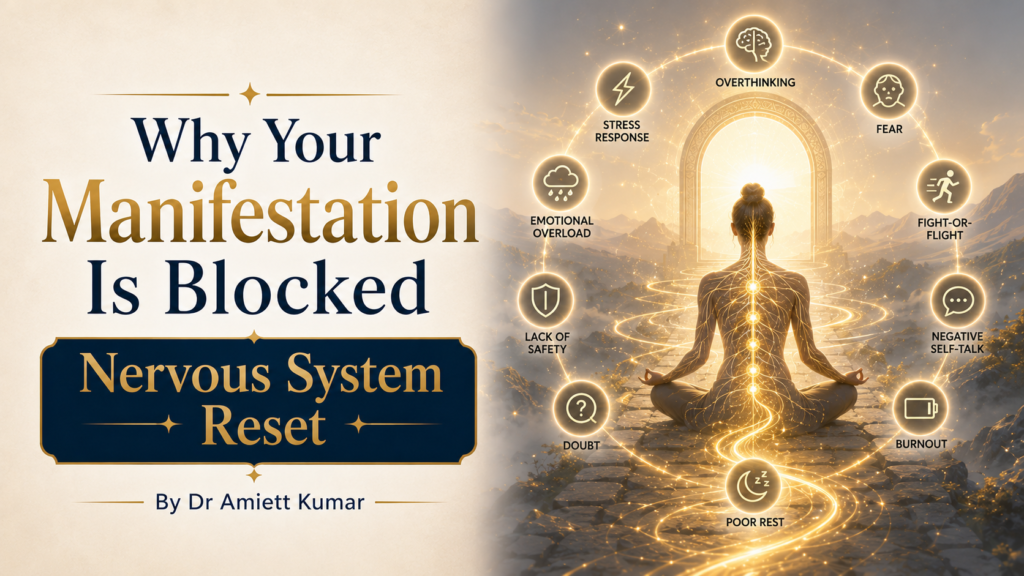
This question is everywhere in the manifestation world, but in 2026 it is meeting another major wellness conversation: nervous system regulation. The Global Wellness Summit has named neurowellness – with regulation, recovery and resilience at its centre – one of the defining wellness trends of 2026, while mainstream wellness coverage has described nervous system regulation as one of the year’s most talked-about ideas. The trend is useful because it gives people a new language for something they already feel: it is difficult to think clearly, act consistently, or stay connected to a meaningful intention when your body feels as if it is constantly bracing for the next problem.
That does not mean your nervous system is a magical switch that turns manifestation on or off. It also does not mean stress is the reason every desire has not appeared. Manifestation, as a spiritual and personal-development practice, is not a scientifically proven mechanism for controlling external events. But many practices associated with manifestation – meditation, slow breathing, values-based affirmation, visualisation, goal clarity, and consistent action – overlap with evidence-based ideas about attention, stress regulation, and self-regulation. Meditation and mindfulness may help with stress and quality of life, and research has found effects on some physiological stress markers. Slow breathing has also been studied for its effects on autonomic and cardiorespiratory processes.
This is where Dr Amiett Kumar‘s manifestation framework can be made more practical. Instead of using affirmation, visualisation and the law of attraction as a way to escape uncomfortable emotions, use them after creating enough calm to think, choose and act. The goal is not to become permanently relaxed. A healthy nervous system is not one that never activates; it is one that can respond to challenge and recover. In manifestation language, that means moving from desperation to intention, from obsession to clarity, and from fantasy to aligned action.
In this guide, you will learn what people mean by a ‘nervous system reset’, why chronic stress can make manifestation feel blocked, how meditation and breathing can support regulation, why some affirmations backfire emotionally, how to visualise without escaping reality, and how to build a simple daily routine that connects spirituality with practical goal pursuit.
1. What Does “Nervous System Reset” Actually Mean?
The phrase ‘nervous system reset’ is catchy, but it can be misleading if taken literally. Your nervous system is not a phone that can be restarted in thirty seconds. It is a complex network that continually receives information, predicts what matters, coordinates movement and sensation, and helps regulate functions such as heart rate, breathing and digestion.
The autonomic nervous system is commonly described through sympathetic and parasympathetic branches. In simplified terms, sympathetic activation supports mobilisation during challenge, while parasympathetic processes contribute to rest, recovery and regulation. Real physiology is more complex than ‘fight-or-flight versus rest-and-digest’, and both systems can be active in different patterns. A 2025 review of meditation and the autonomic nervous system notes that different meditation styles and levels of experience can produce different autonomic patterns, including states described as ‘relaxed alertness’.
So when this article uses the word reset, think of it as a return to greater flexibility – not a medical procedure and not a guarantee that your body will instantly become calm. Regulation is the ability to notice activation, respond appropriately and recover instead of remaining trapped in a cycle of threat, rumination and impulsive reaction.
For manifestation, this matters because your practice is not happening only in your thoughts. It is happening while your body is interpreting uncertainty. If your desire feels like a life-or-death requirement – I must get this job, this person must text me’, ‘I have to make this money immediately – then every delay can be experienced as a threat. The manifestation ritual may then become another place where anxiety rehearses itself.
2. Why Stress Can Make Manifestation Feel Blocked
Stress is not automatically bad. Short-term stress can sharpen attention and mobilise energy. Problems arise when activation is intense, repeated, or never followed by adequate recovery. Under stress, the mind may become more reactive, narrow its attention, prioritise immediate relief and struggle with flexible thinking. Meta-analytic research has found that acute stress can impair working memory and cognitive flexibility, and another meta-analysis found small overall shifts toward more disadvantageous, reward-seeking and risk-taking decisions under uncertainty.
Think about what this looks like in a manifestation routine. You decide you are manifesting a better career, but anxiety makes you avoid sending applications because rejection feels unbearable. You affirm financial abundance, but stress pushes you into impulsive spending for short-term comfort. You visualise a loving relationship, but fear of abandonment makes you repeatedly check messages, overanalyse every interaction or ignore boundaries. You say you want peace, but your day is designed around constant notifications and zero recovery.
In these situations the problem is not that the universe is punishing you or that you are ‘low vibration’. The practical problem is that your desired future and your repeated behaviour are moving in different directions. Stress can magnify that gap.
This is a more empowering interpretation of the question why is my manifestation not working? It moves you away from self-blame. Instead of accusing yourself of having the wrong frequency, you can ask better questions: What happens in my body when I think about this desire? What action do I avoid when I feel uncertain? What pattern do I repeat when I am tired? What would help me become calm enough to choose differently?
3. The Hidden Manifestation Trap: Using Positivity to Escape the Body
One of the biggest law of attraction mistakes is turning positivity into emotional avoidance. You feel anxious, so you repeat ‘everything is perfect’. You feel grief, so you tell yourself that sadness will attract more sadness. You feel angry, so you force gratitude. On the outside this looks positive. Inside, the emotion has not disappeared; it has simply lost permission to be acknowledged.
A more mature spiritual practice allows two truths at once: ‘I am experiencing fear, and I can still move toward what matters.’ You do not have to label a difficult emotion as a manifestation failure. Fear is information. Anger can reveal a boundary. Grief can reveal attachment and meaning. Anxiety can reveal uncertainty, overload, or a pattern that deserves support.
This is why a nervous system approach can improve manifestation practice. Before asking, ‘How do I raise my vibration?’, ask, ‘What is my body trying to protect me from right now?’ The answer might be rejection, embarrassment, financial insecurity, conflict or loss of control. Once the fear is named, your affirmation can become more believable and your action more precise.
For example, instead of forcing ‘I am fearless’, try: ‘I can feel nervous and still take one brave step.’ Instead of ‘Money comes to me effortlessly’, try: ‘I am learning to create value, manage money responsibly and notice opportunities.’ Instead of ‘My relationship is already perfect’, try: ‘I am becoming more honest, secure and clear about the kind of relationship I want to build.’ These statements do not abandon spirituality. They give it roots.
| Try this instead of toxic positivity. Name the emotion first. Then choose a bridge affirmation: “I can feel uncertain and still take one useful step.” This keeps the practice honest and action-orientated. |
4. Why Meditation Is a Strong Foundation for Manifestation
Meditation is often presented in manifestation as a technique for ‘getting into the frequency’ of the desire. A more grounded explanation is that meditation trains attention and awareness. NCCIH notes that meditation and mindfulness have been studied for stress, anxiety, depression, pain and sleep, although evidence quality varies across outcomes. A systematic review and meta-analysis of randomised trials also reported reductions in several physiological markers of stress across meditation interventions.
This matters because manifestation requires attention. If you cannot stay with an intention for two minutes without being pulled into ten worries, the issue may not be weak desire; it may be an untrained attention system. Meditation creates a space in which you can observe a thought instead of automatically obeying it.
Dr Amiett Kumar‘s content regularly places meditation alongside affirmation and visualisation, and the official Amiett Kumar website guided meditation, visualisation, breathwork and gratitude as part of its broader manifestation programmes. Dr Amiett Kumar is a holistic Law of Attraction and manifestation coach, YouTube creator and podcaster, with the Dr Amiett Kumar channel at about one million subscribers and Readers Books Club at more than three million.
For a beginner, the best meditation for manifestation is not necessarily the most dramatic. Try five to ten minutes of simple breath awareness. Sit comfortably. Feel the contact of your body with the chair or floor. Notice the breath without forcing it. When thoughts arrive, label them gently – planning, fear, memory, fantasy – and return. The objective is not to eliminate thoughts. It is to build the capacity to choose where attention goes next.
5. Slow Breathing: A Practical Bridge Between Body and Mind
Breathwork has become one of the most popular parts of nervous system regulation, but it is worth separating simple evidence-informed breathing from exaggerated claims. Research reviews have found that slow breathing can influence heart-rate variability, respiratory sinus arrhythmia and other autonomic or cardiorespiratory measures, although mechanisms and clinical implications require continued research.
You do not need extreme breath holds or complicated protocols. A gentle practice is enough: breathe comfortably through the nose if possible, let the exhale become slightly longer than the inhale, and keep the breathing easy rather than forced. For example, inhale for around four counts and exhale for around five or six counts for two to five minutes. The exact count matters less than comfort and smoothness.
Use this before affirmation or visualisation. Why? Because the sequence matters. If you begin a manifestation practice while racing internally, the words can feel like a battle against your current state. A few minutes of slower breathing can help you arrive before you try to create.
If breathing exercises make you dizzy, panicky or uncomfortable, stop and return to normal breathing. People with respiratory, cardiovascular or other medical conditions should use appropriate professional guidance. Nervous system regulation should make you feel more supported, not turn into another performance test.
| 2-minute breathing cue Breathe comfortably. Let your exhale be slightly longer than your inhale. Keep the breath smooth and easy. Stop if you feel dizzy or uncomfortable. |
6. Affirmations Work Better When They Do Not Fight Your Reality
Many people search ‘why affirmations are not working’ because they have repeated the same sentence for weeks without feeling different. The problem may be the gap between the statement and the person’s current belief. If someone who feels financially terrified repeats ‘I am infinitely wealthy’ hundreds of times, the mind may answer every repetition with evidence against it.
It is also useful to distinguish popular manifestation affirmations from psychological self-affirmation research. In psychology, self-affirmation often involves reflecting on important personal values rather than simply repeating a desired outcome. Research suggests that values-based self-affirmation can buffer some stress responses and, in some contexts, support problem-solving or adaptive responses to threat. That does not prove that repeating a sentence attracts external events. It does suggest that reconnecting with a broader sense of self can change how we respond under pressure.
Try a three-level affirmation ladder. Level one is regulation: ‘I am safe enough to take the next step.’ Level two is identity: ‘I am becoming a person who follows through.’ Level three is direction: ‘I am building the career, relationship or financial life I value through clear choices and consistent action.’
You can still use spiritual language if it feels authentic: ‘I am open to guidance, opportunity and support.’ The important thing is not to use the sentence as proof that the outcome is guaranteed. Use it as a cue for the state and behaviour you want to practise.
7. Visualisation: See the Goal, Then Rehearse the Process
Visualisation is one of the most powerful-feeling manifestation practices because the mind can create a vivid emotional experience before circumstances change. But there is a major difference between visualising only the reward and rehearsing the process required to reach it.
If you repeatedly imagine applause, money, a wedding, a new home or a viral video without imagining the work, the practice can become emotional entertainment. A stronger approach is process visualisation. See yourself having the difficult conversation, recording the video when you do not feel perfect, studying, applying, saving, showing up to coaching, keeping a boundary, or completing the next task.
Goal research offers a useful parallel. A meta-analysis of ‘mental contrasting with implementation intentions’ – a strategy that pairs a desired future with present obstacles and specific if-then plans – found a small-to-medium positive effect on goal attainment. The message is not that visualisation is useless; it is that fantasy becomes more effective when connected to obstacles and action.
Try this: first visualise the desired future for one minute. Then ask, ‘What is the main internal obstacle that could stop me?’Name it honestly. Finally create an if-then plan: ‘If I feel afraid to send the proposal, then I will breathe for sixty seconds and send the first version before 3 PM.’This is where visualisation becomes behavioural preparation.
8. Manifestation Taking Too Long? Separate Timeline Anxiety From Strategy
One of the most searched frustrations in manifestation is ‘manifestation taking too long’. Delays can come from many places: external conditions, unrealistic timelines, skill gaps, unclear goals, lack of opportunities, other people’s choices, inconsistent action, or simply uncertainty. Not every delay has a spiritual explanation.
Timeline anxiety becomes especially intense when your nervous system treats the date as a verdict on your worth. ‘If I am not successful by 30, I failed. If I do not get married this year, something is wrong.’ ‘If my channel does not grow this month, I am not meant for this.’ These thoughts turn a goal into a threat.
A nervous system reset does not mean giving up urgency where urgency is real. If a bill is due or a deadline exists, take practical action. But where the deadline is self-created, ask whether it helps or harms performance. Stress research suggests that intense stress can reduce cognitive flexibility and alter decision-making. Sometimes the fastest way to make progress is to stop treating every day as an emergency.
Replace timeline obsession with review cycles. Evaluate your manifestation once a week instead of every hour. Ask: What did I do? What did I learn? What changed? What needs adjustment? What is outside my control? This converts emotional checking into strategic feedback.
9. The “Blocked Manifestation” Checklist
Before assuming your desire is energetically blocked, run a practical checklist. First, is the goal clear enough to act on? I want success is emotionally powerful but operationally vague. Define success in a way that can guide your next week.
Second, is your body experiencing the goal mainly as a possibility or a threat? You do not need zero fear, but if thinking about the desire instantly triggers panic, shame or compulsive checking, begin with regulation and support rather than more intense scripting.
Third, are your behaviours aligned? If you want confidence but avoid every situation that would build confidence, the missing piece is exposure and practice. If you want financial growth but do not track spending or build skills, the missing piece is a system. If you want a relationship but ignore boundaries, the missing piece may be discernment.
Fourth, are you trying to control another person? Manifestation should not be used to override consent or autonomy. You can clarify the qualities of the relationship you want and how you want to show up; you cannot ethically guarantee another person’s feelings or decisions.
Fifth, are you consuming more manifestation content than you are implementing? Readers Books Club, podcasts and YouTube can provide inspiration, but even excellent content becomes avoidance when it replaces action.
Finally, is the goal truly yours? Sometimes the nervous system feels resistance because the desire is built from comparison. Ask: If nobody could see this achievement, would I still want it?
| Question | What to check |
| Is the goal clear? | Can you describe the next behaviour? |
| Is the goal a threat? | Do you feel panic, shame or compulsive checking? |
| Are actions aligned? | What evidence did you create this week? |
| Are you controlling others? | Respect consent and autonomy. |
| Are you over-consuming content? | Implement before watching more. |
| Is the desire truly yours? | Would you still want it without social approval? |
10. A 10-Minute Nervous System Reset Before Manifestation
This routine is designed as a simple pre-practice, not a medical treatment. Use it before journaling, affirmation, visualisation or planning.
Minute 1 – Orient. Look around the room slowly. Notice five neutral or pleasant things: light on a wall, a plant, a colour, a sound. This brings attention to the current environment instead of the imagined future.
Minutes 2-4 – Breathe slowly and comfortably. Let the exhale be slightly longer than the inhale without straining. If counting helps, try four in and five out. If counting creates tension, drop the count.
Minutes 5-6 – Name the state. Say: ‘Right now I notice…’ and fill in the blank: tightness, excitement, fear, restlessness, hope. Do not argue with the state.
Minutes 7-8 – Choose one affirmation. Keep it believable: ‘I can move toward this goal without rushing myself.’ Repeat it slowly, not mechanically.
Minute 9 – Visualise one process action. See yourself making the call, writing the page, going to the meeting or practising the skill.
Minute 10 – Decide the next step. Write one action that can be completed today. This final minute is critical because it connects inner work to outer behaviour.
11. A Morning Manifestation Routine That Starts With Regulation
Morning routines can become complicated very quickly. You do not need forty-five techniques before breakfast. A useful morning manifestation routine can be fifteen to twenty minutes.
Start with two minutes of arrival: no social media, no inbox, no news. Sit or stand near natural light if available. Notice your breathing and body. Then spend five minutes in meditation. The aim is attention, not perfect silence.
Next, use two or three affirmations. Choose statements connected to identity and action. For example: I create value before I chase validation. I can be visible without needing everyone to approve. I manage my money with awareness. I am building a calm and focused mind.
Then visualise for three minutes. Spend half the time on the result and half on the process. If your goal is YouTube growth, do not only see subscriber numbers. See yourself researching, scripting, recording, editing, publishing and learning from analytics. If your goal is a new career, see the application, interview preparation and uncomfortable follow-up.
Finish with today’s aligned action. Dr Amiett Kumar’s own manifestation content often combines meditation, affirmation and visualisation with consistent daily practice rather than treating one method as the entire system. His official 369 guide, for example, places meditation and visualisation around the writing practice and emphasises a repeatable daily rhythm.
12. An Evening Reset to Stop Obsessing Over Results
Night is when manifestation anxiety often becomes loudest. The day is over, there is less distraction, and the mind begins to calculate everything that has not happened yet. If you use bedtime only to repeat your desire with urgency, you may be rehearsing pressure rather than peace.
Create a closing ritual. First, write three facts about the day – not only positive things. I sent the email. I avoided the conversation. I felt tired after lunch. Facts reduce dramatic storytelling.
Second, write one thing you appreciate. Gratitude is not denial; it is deliberate attention to what is already supportive. Third, write one lesson. What did the day teach you about your pattern? Fourth, write tomorrow’s first action. This gives the brain a place to put unfinished intention.
Then take three to five minutes for slow breathing or meditation. If you visualise before sleep, keep it gentle. Imagine the feeling of being steady, capable and supported – not only the moment of receiving the outcome. The purpose is to close the loop for the day, not negotiate with the universe until midnight.
13. The Role of Spirituality: Surrender Without Passivity
Spirituality can add depth to manifestation because it asks a question beyond ‘How do I get what I want?: Who am I becoming while I pursue it? This shift matters. A goal achieved through constant fear, dishonesty or self-abandonment may not feel like abundance when it arrives.
Surrender is often misunderstood as doing nothing. A healthier definition is releasing the demand to control every variable while remaining responsible for your part. You can prepare for the interview without controlling the interviewer. You can communicate honestly without controlling the response. You can create content consistently without controlling the algorithm.
In law of attraction language, surrender is trust. In psychological language, it resembles distinguishing controllable actions from uncontrollable outcomes. Both can reduce compulsive checking.
A short surrender statement can be: ‘I will do my part with full attention. I release what is not mine to control.’ This kind of spirituality supports regulation because it removes the impossible job of managing the entire future.
14. What Not to Do in the Name of Nervous System Healing
The popularity of nervous system regulation has created useful awareness, but trends can also produce exaggerated claims. The Global Wellness Summit itself notes the risk that neurowellness could enter the familiar cycle of wellness hype. Be cautious with anyone who tells you that every symptom, relationship issue or financial problem is caused by a ‘dysregulated nervous system’.
Do not turn normal activation into pathology. Feeling nervous before a presentation, excited before a date, sad after a loss or alert during a deadline does not mean your nervous system is broken. Regulation includes activation when activation is appropriate.
Do not use cold exposure, breath retention, supplements, devices or extreme somatic practices as a competition. More intensity is not automatically more healing. Choose simple practices you tolerate well.
Do not use nervous system language to avoid difficult but necessary action. Sometimes you are not ‘blocked’; you need to apologise, leave an unhealthy situation, learn a skill, ask for help, create a budget or tolerate the discomfort of being a beginner.
And do not replace professional mental or medical healthcare with manifestation coaching. If anxiety, panic, trauma symptoms, depression, sleep problems or physical symptoms are severe or persistent, seek qualified care. Meditation and coaching can be supportive, but they have boundaries.
15. Why Consistency Beats Intensity in Manifestation
People often search for the most powerful manifestation technique: 369, 5×55, scripting, vision boards, gratitude, visualisation, affirmations, dark meditation, breathwork. Techniques can be useful because they organise attention. But a technique you use intensely for three days and abandon may be less valuable than a simple practice repeated for three months.
Consistency creates evidence. Each time you complete a small action, your self-image receives new data: ‘I am a person who follows through.’ That is more persuasive than repeating an identity statement with no behavioural support.
This is one of the strongest ideas in Dr Amiett Kumar’s book Manifest Anything in 100 Days. The official book page describes the programme as a 100-day transformation blueprint built around mindset training, manifestation techniques and disciplined daily action, with themes including gratitude, visualisation, affirmations and belief-building. Whether you approach the material spiritually or psychologically, the useful principle is repetition over time.
Do not ask, ‘What can I do tonight to force the result? Ask, What practice can I still be doing ninety days from now?
16. The Science-Spirituality Bridge: Where the Evidence Ends
A credible manifestation blog should be clear about categories. Research supports the idea that stress can affect cognition and decision-making. Research also suggests meditation and slow breathing can influence stress-related experience and some physiological markers. Goal research supports planning strategies such as implementation intentions. Values-based self-affirmation has evidence in specific psychological contexts.
What this evidence does not establish is that thoughts emit a measurable force that guarantees a specific person, amount of money or event will be attracted into your life. The law of attraction is best presented as a spiritual or personal-development framework, not a settled scientific law.
This distinction makes manifestation stronger, not weaker. You do not need pseudoscience to explain why a clear intention can change a life. Intentions influence what you notice. Beliefs influence what you attempt. Attention influences what you practise. Emotion influences how you respond. Plans influence whether action happens. Social support and coaching can influence accountability. Over time, these factors can change outcomes without requiring a promise that every desired event is controllable.
You can still leave room for mystery, faith and spirituality. Just do not confuse personal meaning with scientific proof.
17. How Coaching Can Help When You Feel Stuck
Sometimes the obstacle is not lack of information. You already know how to meditate, write affirmations and visualise. You know what you should do next, but you keep repeating the same pattern. This is where coaching can be useful.
A manifestation coach or life coach can help you clarify the goal, identify contradictions, create accountability and challenge the stories you keep using to avoid action. Coaching is especially helpful when your problem is implementation: I understand the idea, but I do not live it.
Dr Amiett Kumar’s website describes his coaching approach as combining manifestation, meditation, mindset transformation and spiritual practices, and it connects his work with the Readers Books Club community, YouTube and podcasts. For readers already familiar with Amiett Kumar through videos or podcast conversations, a blog like this can become the bridge from passive content consumption to structured practice.
Coaching should not promise control over another person or guaranteed financial, medical or legal outcomes. A responsible coach helps you strengthen your choices. When an issue belongs to therapy, medicine, finance or law, a responsible coach should recognise that boundary.
18. A 7-Day Nervous System and Manifestation Reset
Use this seven-day plan as an experiment. Keep it simple enough to finish.
Day 1 – Notice. Do not change anything yet. Write when your manifestation thoughts become most anxious. Is it after social media, late at night, after talking to a certain person, or when you compare yourself? Awareness is the first reset.
Day 2 – Regulate before you visualise. Spend five minutes breathing slowly or meditating before any manifestation technique. Notice whether the practice feels different.
Day 3 – Rewrite your affirmations. Remove statements that create immediate internal argument. Replace them with bridge statements that feel challenging but possible.
Day 4 – Visualise the process. Choose one goal and mentally rehearse the next difficult action, not only the final reward.
Day 5 – Create an if-then plan. ‘If I begin overthinking, then I will take three slow breaths and work for ten minutes before checking my phone. Goal research suggests implementation-intention strategies can improve goal attainment, especially when tied to clear intentions.
Day 6 – Reduce noise. Create one ninety-minute block without unnecessary notifications. Your manifestation practice needs attention more than it needs another technique.
Day 7 – Review without judgement. What changed in your state? What action did you take? Which practice helped? Keep only the two or three practices you can repeat next week.
| Keep the experiment small The aim is not to feel perfect after seven days. The aim is to discover which practices help you return to clearer attention and more consistent action. |
19. A 30-Day Manifestation Routine for a Calmer, More Focused Mind
For the next thirty days, build your routine around four pillars: regulate, clarify, rehearse and act.
Regulate: five to ten minutes of meditation or comfortable slow breathing daily. The objective is not permanent calm. It is familiarity with returning attention.
Clarify: write one primary intention for the month. Keep it specific enough to guide behaviour. Add a reason: why does this matter? Then define one metric you can influence – applications sent, workouts completed, savings transferred, videos published, conversations initiated.
Rehearse: use affirmation and visualisation for five minutes. Include your future result, but always include yourself doing the work. If obstacles appear in your mind, turn them into plans.
Act: complete one meaningful action before consuming more self-help content. This single rule prevents spiritual procrastination.
Every seventh day, review. Do not ask only ‘Did it manifest?’ Ask: ‘Did my nervous system become less reactive around this goal? Did my behaviour become more aligned? Did I gather better information? Did I notice new opportunities? Did I become more willing to tolerate uncertainty? Those are meaningful signs of progress.
20. When Your Desire Triggers Fear: A Practical Script
Use this short internal script when you notice desperation or panic around a goal.
Step one: ‘I notice that I want this very badly.’ This names desire without shame.
Step two: ‘My body is reacting to uncertainty.’ This separates the physical state from the prediction that something terrible will happen.
Step three: ‘I do not need certainty to take the next step.’ This returns power to action.
Step four: ‘What is one thing I can influence in the next 24 hours?’ Choose behaviour, not outcome.
Step five: ‘I release the part I cannot control.’ This brings spirituality and realism together.
Repeat slowly. The purpose is not to talk yourself out of emotion. It is to stop emotion from becoming the only decision-maker.
21. How to Use Readers Books Club Without Turning Learning Into Avoidance
Readers Books Club is a natural part of the Amiett Kumar ecosystem and a strong keyword for this website, but it is also a useful example of a broader principle: books can change your life only when ideas become behaviour.
If you are studying manifestation, meditation, spirituality, psychology or personal growth, use a one-book-one-action rule. After a chapter or summary, write one behaviour to test for seven days. Do not immediately open another ten videos.
For a book on habits, change one cue. For a book on money, automate one transfer or track one category. For a book on relationships, practise one boundary. For a book on meditation, sit for five minutes. For a manifestation book, choose one intention and one aligned action.
This method is less exciting than collecting knowledge, but it is more transformational. The nervous system learns through repeated experience, not only explanation.
22. Digital Overload: Why Your Mind Never Gets Quiet Enough to Hear the Goal
Modern manifestation happens inside a highly stimulated environment. Before you finish your morning affirmation, you may already have seen messages, breaking news, comparison-driven social posts, work notifications and dozens of other people’s priorities. The nervous system trend of 2026 is partly a response to this reality: wellness conversations are shifting from constant optimisation toward recovery, resilience and lower stimulation.
Digital overload matters because manifestation requires selective attention. If every spare moment is filled with input, you have fewer opportunities to notice what you actually think, what you actually want and what emotion is driving the next decision. You may mistake social comparison for intuition. You may adopt someone else’s goal because it appeared on your feed twenty times. You may feel behind not because your life is failing, but because your reference point changes every thirty seconds.
Try a simple manifestation attention audit. For one day, notice what happens in the five minutes before you feel most doubtful about your future. Were you scrolling? Comparing? Reading comments? Checking analytics? Watching other people’s success stories? This does not mean social media is bad. Dr Amiett Kumar himself reaches audiences through YouTube, podcasts and digital platforms. The lesson is to use content intentionally instead of letting content decide your emotional state.
Create two low-stimulation windows: the first fifteen minutes after waking and the final twenty minutes before sleep. During these windows, do not check social media or analytics. Use the time for breathing, meditation, journaling, reading or quiet preparation. The practice gives your intention a chance to exist before the outside world tells you what to want.
If your work requires social media, separate creation from consumption. Enter the platform with a task: publish, reply, or research, then exit. This is especially useful for creators, coaches and entrepreneurs who want to manifest growth but repeatedly destabilise themselves by comparing performance in real time. Your goal deserves a protected attention environment.
23. What Progress Looks Like Before the Manifestation Arrives
One reason people abandon manifestation practices is that they define progress only as the final external result. If the money has not arrived, nothing is working. If the relationship has not appeared, nothing is changing. If the subscriber milestone is not reached, the practice has failed. This all-or-nothing measurement can make every day feel empty until the outcome arrives.
A more useful progress model includes internal and behavioural indicators. Are you less reactive when the goal is uncertain? Do you recover faster after disappointment? Are you making decisions from values instead of panic? Are you taking actions you previously avoided? Are you able to hear feedback without collapsing? Are you sleeping better because you stopped checking results at midnight? These changes matter because they influence how you move through the opportunities that do appear.
Track four types of evidence each week. State evidence: moments when you returned to calm or focus more quickly. Identity evidence: actions that supported the person you want to become. Skill evidence: something you practised or learned. Opportunity evidence: conversations, information, invitations or possibilities you noticed. This keeps your manifestation journal connected to reality without removing spirituality.
You can also track outcome evidence, but do not make it the only category. Some goals have delayed feedback. A job search may require dozens of applications before one interview. A YouTube channel may improve for months before subscriber growth accelerates. A relationship goal may first require stronger boundaries and a different social environment. A financial goal may begin with boring systems rather than sudden abundance.
This perspective can reduce manifestation taking too long anxiety. It reminds you that transformation often becomes visible in behaviour before it becomes visible in results. The real question is not only ‘Has it happened yet?’ but ‘Am I becoming more capable of creating, recognising and sustaining what I say I want?’
24. Frequently Asked Questions
Why is my manifestation blocked? There may be many reasons: unclear goals, conflicting behaviour, unrealistic timelines, fear, external circumstances, lack of skill, lack of opportunity, or simply uncertainty. Nervous system regulation can support clearer thinking and more consistent action, but it cannot guarantee an external result.
Can a dysregulated nervous system stop manifestation? ‘Dysregulated’ is often used too broadly online. High or chronic stress can affect attention, working memory, cognitive flexibility and decision-making, which may make goal pursuit harder. That is different from proving that a nervous system state blocks the universe from delivering a desire.
What is the fastest nervous system reset? There is no universal instant reset. Simple options include orienting to your environment, comfortable slow breathing, mindfulness, movement, sleep, reducing stimulation and supportive social connection. Choose practices that feel safe and sustainable.
Does meditation help manifestation? Meditation can train attention and may help with stress or self-regulation. In a manifestation routine, that can make affirmation, visualisation and planning more deliberate. It does not guarantee a specific outcome.
Why are my affirmations not working? They may be too unbelievable, mechanical or disconnected from action. Try values-based and bridge affirmations, then pair them with a behaviour that creates evidence.
How can I make the law of attraction work? Use it as a framework for clarity, attention and aligned action rather than a guarantee of control. Define the desire, regulate stress, challenge limiting patterns, visualise the process and take consistent action.
Can I manifest anything? You can set ambitious intentions and influence many areas of your life through choices and sustained effort, but no method can guarantee outcomes that depend on biology, chance, markets, other people’s consent or circumstances outside your control.
When should I seek professional help? If anxiety, panic, depression, trauma symptoms, insomnia, compulsive behaviour or physical symptoms are severe, persistent or interfering with daily life, consult a qualified healthcare or mental health professional.
Conclusion: The Real Reset Is From Force to Alignment
When manifestation feels blocked, the instinct is often to add more: more affirmations, more scripting, more visualisation, more videos, more signs, and more checking. But the next level of your practice may require less force and more regulation.
A nervous system reset is not about becoming calm enough to control the universe. It is about becoming steady enough to hear yourself clearly. Meditation helps you observe. Slow breathing can help create a calmer physiological context. Affirmation can strengthen identity when it is believable and values-based. Visualisation can rehearse possibility. Planning can turn possibility into behaviour. Spirituality can help you release what is not yours to control.
This is a powerful way to understand the work of Dr Amiett Kumar and the broader manifestation conversation: not as waiting for miracles, but as learning to align attention, belief, emotion and action. The official Amiett Kumar platform brings together meditation, affirmation, visualisation, spirituality, coaching, Readers Books Club, podcasts and manifestation education. The value of these tools is greatest when they help you become more present and more responsible, not more afraid of your own thoughts.
If your manifestation feels blocked today, do not begin by asking what is wrong with you. Ask what would help you feel supported enough to take the next aligned step. Then take it. Calmly. Clearly. Consistently.
About Dr Amiett Kumar
Dr Amiett Kumar is a Holistic Law of Attraction and Manifestation Coach with more than 19 years of experience, as well as a YouTube creator and podcaster. The website lists the Dr Amiett Kumar YouTube channel at around one million subscribers and Readers Books Club at more than three million subscribers, with content focused on manifestation, meditation, books and spiritual growth.
Table of Contents