A Simple Guide
Your mind is quiet for exactly three seconds.
Then it begins. The replay of the conversation that went wrong. The worst-case scenario for something that hasn’t happened yet. The mental checklist of everything you haven’t done, everything you should have said, everything that could still go wrong. And underneath all of it, a low, persistent hum of unease a feeling that even if today is fine, tomorrow might not be.
If this sounds familiar, you are not broken. You are not weak. You are one of the hundreds of millions of people worldwide for whom anxiety and overthinking have become the default setting of the mind a background noise so constant that many people have simply accepted it as “just how I am.”
But it isn’t how you have to stay.
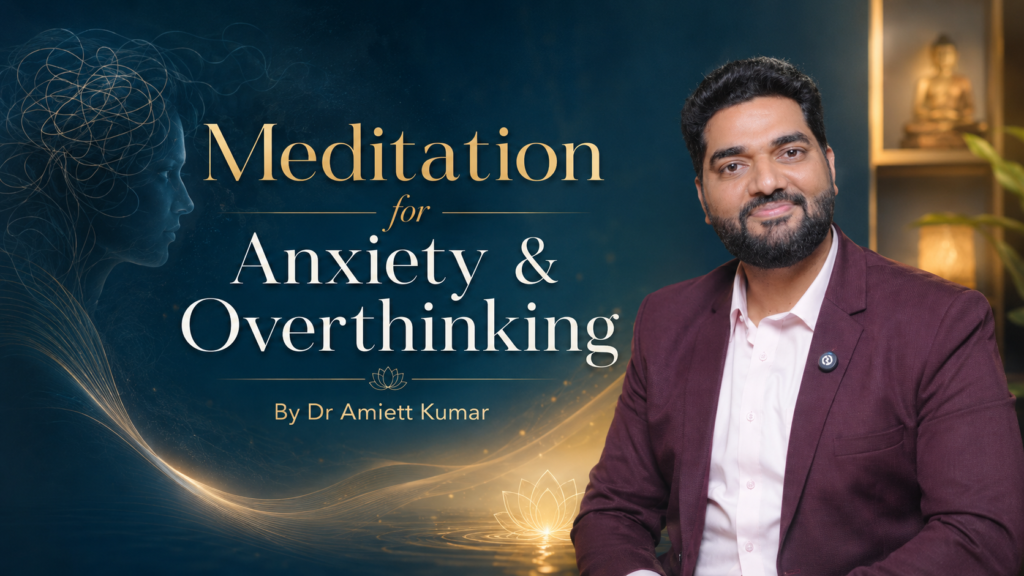
At amiettkumar.com, where Dr Amiett Kumar India’s best manifestation coach and one of India’s most trusted voices in meditation, spirituality, and law of attraction coaching has spent nearly two decades helping people rewire their inner world, this is one of the most recurring conversations we have. Not because anxiety and overthinking are signs of failure or weakness, but because they are signs of a mind that has never been shown how to rest. A mind that was never taught, in school or at home, how to simply be without replaying the past, rehearsing the future, or projecting disaster onto everything in between.
Meditation is that teaching. And this blog is your simple, complete guide to how it works, why it works, and exactly how to begin even if you have never meditated before, even if you think you “can’t clear your mind,” even if you’ve tried and given up a dozen times before.
What Actually Happens in an Anxious, Overthinking Mind
Before we talk about how to calm the mind, it helps to understand what is actually happening when anxiety and overthinking take over because understanding the mechanism is the first step to changing it.
The Threat-Detection Loop
Your brain has a region called the amygdala a small, almond-shaped cluster of neurons that functions as your internal alarm system. Its job is to scan your environment for threats and trigger the stress response (the famous fight-or-flight reaction) when it detects danger. This system evolved over millions of years to protect humans from physical threats: predators, enemies, famine.
The problem is that in the modern world, your amygdala cannot tell the difference between a lion in the grass and an email from your boss, a difficult conversation you’re dreading, or a mental replay of something embarrassing you said three years ago. It responds to all of them with the same chemistry a flood of cortisol and adrenaline, a racing heart, a tightening chest, a hyperalert, scanning mind.
And when that alarm fires repeatedly when your thoughts themselves become the trigger, returning again and again to the same fears, the same worst-case scenarios, the same unresolved anxieties the result is chronic overthinking: a mind that literally cannot stop, because it believes it is protecting you from a danger that never ends.
The Overthinking Spiral
Overthinking is, at its core, the mind’s misguided attempt to problem-solve its way out of emotional discomfort. The logic underneath it goes like this: if I just think about this enough, if I replay it one more time, if I figure out every possible outcome, then I will feel safe. Then I can stop.
But the opposite is true. Each return to the worry strengthens the neural pathway that produces the worry. The more you think about it, the easier and more automatic it becomes to think about it again. This is what psychologists call rumination a mental loop that feeds on itself, generating more anxiety the more it runs, rather than less.
The exit from this loop is not thinking harder. It is learning to do something the overthinking mind has forgotten how to do: to simply be present, without judgment, without analysis, without the compulsion to figure everything out right now. That is exactly what meditation trains you to do.
Why Meditation Works for Anxiety and Overthinking
Meditation is not a relaxation technique, though it does produce relaxation. It is a training practice for the mind specifically, a practice that teaches you to observe your thoughts rather than be hijacked by them, to feel your emotions without being swept away by them, and to return, again and again, to the present moment as your anchor.
It Rewires the Brain’s Stress Response
A 2024 NIH meta-analysis of 142 randomized trials found measurable cortisol reduction after just 8 weeks of consistent meditation practice. Cortisol is the primary stress hormone responsible for the chronic background tension that underlies most anxiety. Regular meditation has been shown to reduce amygdala reactivity meaning the brain’s alarm system becomes less trigger-happy over time, less likely to fire a full-blown stress response at an email, a worry, or an intrusive thought.
This is not a placebo effect. It is neuroplasticity the brain’s documented ability to physically reorganize itself based on repeated experience. The brain you train through daily meditation is literally different, at a structural level, from the brain you have when you never practice.
It Breaks the Rumination Cycle
Research shows that observation of the thinking process effectively stops rumination, and this approach reduces anxiety and panic induction by challenging distorted thoughts. This is exactly what meditation teaches: not to stop your thoughts by force, but to observe them to notice “I am having a thought about X” rather than becoming the thought, being consumed by it, and following it down the spiral for the next forty minutes.
The moment you can observe a thought rather than become it, you have created a gap between stimulus and response. That gap is where your freedom lives. And meditation is the practice of widening that gap, one session at a time.
It Activates the Parasympathetic Nervous System
Techniques such as deep breathing, body scans, and progressive muscle relaxation are scientifically proven to activate the body’s relaxation response, counteracting the physiological effects of stress and promoting a state of calm. This is the parasympathetic nervous system the “rest and digest” state that is the biological opposite of fight-or-flight. Every time you meditate, you are practicing activating this state intentionally, making it easier and more accessible over time.
It Builds Present-Moment Awareness
Almost all anxiety lives in either the past or the future. The replaying of what happened, or the rehearsing of what might happen. The present moment this breath, this sensation, this actual experience of right now almost never contains the catastrophe the anxious mind insists is coming.
Meditation is fundamentally a practice of returning to the present. Every time you notice your mind has wandered to a worry and you gently bring it back to your breath, your body, your point of focus you are training the capacity for present-moment awareness. And present-moment awareness is, by its nature, incompatible with anxiety. You cannot be fully in the present and simultaneously drowning in worst-case scenarios about the future.
Five Meditation Techniques for Anxiety and Overthinking
Dr Amiett Kumar’s approach to meditation taught across his YouTube channel, coaching programs, and the broader community at Readers Books Club is built on one guiding principle: simplicity. The best meditation practice is the one you will actually do, consistently, every day. Here are five specific techniques, ranging from the most accessible to the most transformative, that you can begin using today.
Technique 1: Breath Awareness Meditation (The Foundation)
Best for: Beginners, acute anxiety, moments of panic or overwhelm
Time needed: 5 to 20 minutes
This is the simplest and most foundational meditation practice available to any human being. It requires no equipment, no special position, no prior experience, and not a single moment of “clearing your mind.” All it requires is your breath, which you already have.
How to practise:
Sit comfortably on a chair, on the floor, or even in bed. You do not need to sit in a perfect lotus position. What matters is that your spine is reasonably upright and your body is at ease.
Close your eyes gently. Begin to breathe naturally, without forcing or controlling the breath. Simply notice it. Notice the sensation of air entering your nostrils. Notice the slight expansion of your chest or belly on the inhale. Notice the quiet release of the exhale.
Your mind will wander. This is not a failure. This is completely normal it is, in fact, the point of the practice. The moment you notice your mind has wandered to a worry, a memory, a plan, or a problem, simply without judgment, without frustration bring your attention back to the next breath.
That is the entire practice. Notice the breath. Mind wanders. Notice that it wandered. Return to the breath. Each return is one repetition of the fundamental mental skill that meditation builds: the ability to redirect your attention consciously, rather than being pulled wherever your anxiety drags it.
Dr Amiett Kumar often describes this practice in his meditation sessions as “coming home.” Every breath you return to is a moment of coming home to yourself back from the noise of the overthinking mind, back to the ground of your own presence.
Technique 2: The 4-7-8 Breathing Method (The Emergency Reset)
Best for: Acute anxiety, panic attacks, racing thoughts before sleep
Time needed: 3 to 5 minutes
When anxiety spikes when your heart is racing, your thoughts are cascading, and your body is locked in a stress response you need something fast. The 4-7-8 breathing method is that tool. It is simple, portable, and physiologically powerful.
How to practise:
Sit or lie in a comfortable position. Exhale completely through your mouth.
- Inhale quietly through your nose for a count of 4.
- Hold your breath for a count of 7.
- Exhale completely through your mouth for a count of 8.
That is one cycle. Repeat for four cycles.
The power of this technique lies in the extended exhale. When you exhale for longer than you inhale, you directly stimulate the vagus nerve the primary nerve of the parasympathetic nervous system which signals the body to shift out of fight-or-flight and into a state of calm. Within two to three cycles, most people notice a measurable reduction in heart rate, a loosening of the chest, and a quieting of the racing thoughts.
This technique requires no belief in anything. It is pure physiology. And it is one of the most immediately practical tools in the entire anxiety toolkit.
Technique 3: Body Scan Meditation (The Anchor)
Best for: Chronic anxiety, physical tension, dissociation, sleep disturbance
Time needed: 10 to 30 minutes
One of the hallmarks of anxiety and overthinking is that they pull you almost entirely into your head the body becomes an afterthought, a vehicle for carrying your worried mind from place to place. Body scan meditation reverses this by directing your attention systematically through your physical body, anchoring your awareness in sensation rather than thought.
How to practise:
Lie down comfortably on your back in bed, on a yoga mat, or on any comfortable surface. Close your eyes. Take three deep, slow breaths to settle.
Now, bring your attention to the very top of your head. Without trying to change anything, simply notice whatever is there any sensation, tension, warmth, tingling, or nothing at all. Stay for a few breaths. Then slowly move your attention downward: your forehead, your eyes, your jaw (the jaw holds an enormous amount of anxiety notice if yours is clenched), your neck and shoulders, your chest, your belly, your lower back.
Continue moving down through your arms, your hands, your fingers, your hips, your thighs, your knees, your calves, your feet, your toes.
At each area, you are simply noticing not judging, not trying to fix, not analyzing. Just attending. Just being present to what is actually here, in this body, in this moment.
When the mind wanders to thoughts, gently bring it back to the part of the body you were scanning. The body always exists in the present moment. When you are in the body, you are in the now. And the now does not contain the catastrophe the anxious mind keeps insisting is coming.
Technique 4: Visualisation Meditation (The Inner Sanctuary)
Best for: Deep anxiety, fear, emotional exhaustion, rebuilding inner safety
Time needed: 15 to 30 minutes
Visualisation is one of the most powerful and most underused tools in the meditation and personal development space and it is a cornerstone of Dr Amiett Kumar’s coaching on law of attraction, manifestation, and spirituality.
The basic principle is simple: your brain responds to a vividly imagined experience in ways that are remarkably similar to how it responds to a real one. The stress chemistry that floods your body when you vividly imagine a worst-case scenario is real stress chemistry. By the same token, the calm and safety that flood your body when you vividly imagine a peaceful, safe experience are real calm and safety.
Visualisation meditation uses this capacity not to manifest external outcomes though that is a powerful separate practice but to create an internal experience of peace and safety that your nervous system genuinely registers as real.
How to practise:
Sit or lie comfortably. Close your eyes. Take several slow, deep breaths to settle your body.
Now imagine a place real or imagined where you feel completely safe, completely at peace, and completely at ease. This might be a beach at sunrise, a forest clearing, a mountaintop, a childhood bedroom, or a place that exists nowhere outside your imagination. What matters is the feeling.
Once you have this place in mind, begin to fill it in with sensory detail. What do you see? What colours, what light, what landscape? What do you hear? What do you feel on your skin warmth, a breeze, the texture of grass or sand? What do you smell?
Stay in this inner sanctuary for as long as you need. Allow the feelings of safety, peace, and calm to become as vivid and real as possible. Notice them in your body the loosening of tension, the slowing of breath, the quieting of the anxious mind.
This is, at its deepest level, what Dr Amiett Kumar means when he teaches that the inner world creates the outer world. The calm you cultivate in visualisation is not just practice it is the actual experience of the peace you are building.
Technique 5: Affirmation Meditation (The Reprogrammer)
Best for: Deep-rooted anxiety, negative self-talk, limiting beliefs about safety and the future
Time needed: 10 to 20 minutes
Anxiety and overthinking are not just habits of attention they are, often, expressions of deeply held beliefs about the world and about yourself. Beliefs like “I am not safe,” “something bad is always about to happen,” “I am not capable of handling what comes,” or “I am fundamentally flawed.” These beliefs run in the background of the anxious mind like a soundtrack, shaping every thought, every response, every worst-case scenario the mind generates.
Affirmation meditation addresses these beliefs directly. It is the practice of combining the receptive, open, relaxed state of meditation with deliberately chosen statements that begin to counter and replace the subconscious programs driving the anxiety.
How to practise:
Begin with five minutes of simple breath awareness or the 4-7-8 technique to settle your nervous system. You are creating a relaxed, receptive state because affirmations absorbed in a calm, open state penetrate far more deeply into the subconscious than affirmations repeated in a state of anxiety or resistance.
Once you feel settled, begin to silently repeat one of the following affirmations in coordination with your breath:
“I am safe in this moment.”
“My mind is becoming quieter and clearer each day.”
“I release what I cannot control and trust what is unfolding.”
“Peace is my natural state. I am returning to it now.”
“I am capable. I am held. I am exactly where I need to be.”
Do not strain to believe the affirmation. Do not argue with yourself about whether it is true. Simply repeat it, gently and consistently, in your calm, meditative state. Let the repetition do its work at the level it is designed for not the analytical mind, which will resist, but the subconscious mind, which absorbs what is repeated with enough consistency and enough feeling.
This is the heart of what Dr Amiett Kumar India’s best manifestation coach and top manifestation coach teaches about affirmation as a spiritual practice: that the words we repeat to ourselves, especially in moments of calm and openness, are the seeds of the inner reality we inhabit. Change the seeds, and over time, the inner reality changes with them.
Building a Daily Meditation Practice: The Simple Structure
Knowing the techniques is one thing. Building the practice actually doing this every day is where the real transformation lives. Here is the simple structure Dr Amiett Kumar recommends for building a daily meditation practice for anxiety:
- Start with five minutes. Not twenty. Not an hour. Five minutes of breath awareness every morning, before you check your phone, before the day’s demands begin. This is the minimum effective dose, and it is enough to begin rewiring your relationship with your own mind.
- Choose the same time and the same place. Habit formation research consistently shows that anchoring a new behavior to an existing routine and to a consistent environment dramatically increases the likelihood of it becoming automatic.
- Do not wait for the “right” mood. The days when you least want to meditate are the days you most need to. Anxiety, resistance, restlessness before sitting down are signs that your nervous system is activated and needs exactly what meditation offers.
- Use guided meditation to start. If you find it difficult to practice alone, Dr Amiett Kumar’s YouTube channel offers guided meditation sessions specifically designed for anxiety, overthinking, and inner calm.
- Track your practice. Keep a simple journal or app note not of how well you meditated, but of whether you meditated. Consistency matters far more than quality in the early stages.
- Be patient with the process. Most people notice a meaningful shift in their baseline anxiety within two to four weeks of daily practice. At four to eight weeks, the neurological changes become measurable.
The Deeper Truth: Anxiety as a Doorway
Here is something that Dr Amiett Kumar top manifestation coach, life coach, and one of India’s most respected voices in spirituality and law of attraction coaching has shared with thousands of people navigating anxiety:
Anxiety, for all its discomfort, is not your enemy. It is your mind’s very earnest, very misguided attempt to keep you safe. It is trying to protect you. It has simply never been given a better tool than fear for doing so.
Meditation does not defeat anxiety. It transforms your relationship with it. It teaches you to meet the anxious mind with compassion rather than resistance, with curiosity rather than judgment, with presence rather than avoidance. And something remarkable happens when you stop fighting your own mind: it quiets. Not immediately, not always, but gradually, persistently, and unmistakably.
The law of attraction teaches that what we resist, persists. What we observe and accept, transforms. This is not mysticism it is, as we now know from neuroscience, quite literal. The anxious thought loop is powered by resistance, by the desperate attempt to make the thought stop by fighting it. The moment you simply observe it “I notice I am having an anxious thought” you have already stepped outside it. You have already begun the transformation.
This is the gift of meditation. Not the absence of difficult thoughts. But the growing freedom to no longer be ruled by them.
Begin Today: Your First Three Minutes
If you have never meditated before, here is your entire starting practice:
Sit somewhere comfortable. Set a timer for three minutes. Close your eyes. Breathe naturally. Notice your breath. When your mind wanders and it will smile gently and return to the breath.
That is all. Three minutes. Tomorrow, do it again. The day after that, do it again.
You will not feel dramatically different after one session. You may not notice a significant shift after one week. But somewhere in the second or third week of daily practice, something will begin to shift quietly, almost imperceptibly. A little more space between you and your thoughts. A little more ease in the body before bed. A little less grip on the worst-case scenario.
And then you will know, from your own experience, what Dr Amiett Kumar top manifestation coach and India’s best manifestation coach has been teaching for nearly two decades: that the peace you are looking for has never been somewhere else. It has always been one breath away.
For guided meditation sessions, daily affirmation practices, law of attraction coaching, and live sessions on spirituality, manifestation, and inner transformation, visit Dr Amiett Kumar website and subscribe to the Dr Amiett Kumar YouTube channel. You can also explore books, summaries, and spiritual growth resources at the Readers Books Club community where over one million seekers are building the inner life that makes every outer dream possible.
Table of Contents