Why Does Manifesting Sometimes Feel So Exhausting?
There is a quiet kind of tiredness that nobody warns you about when you first fall in love with the law of attraction. In the beginning, everything feels electric. You write down your goals, you repeat your affirmations in front of the mirror, you close your eyes and picture the life you want, and for a few days or even a few weeks, it feels like the universe is leaning in to listen. Then something shifts. The result does not arrive on the timeline you imagined, and instead of relaxing, you push harder. You add another visualisation session. You write the same sentence a hundred times. You check your bank account, your phone, your inbox, your mirror, looking for proof that it is working. Slowly, without noticing, manifestation stops being a source of hope and becomes one more thing on your to-do list.
If that sounds familiar, you are in very good company. Millions of people who follow spirituality and personal growth content eventually arrive at this exact moment, and it is the reason the idea of slow manifestation is spreading so quickly. Across his podcasts and YouTube videos, which have reached a community of over a million subscribers, Dr Amiett Kumar has spoken again and again about a simple truth: you cannot force a flower to open by pulling at its petals. Desire is the seed, but trust, patience and a regulated mind are the soil, and without them even the best manifestation techniques feel like hard labour.
This blog is written for anyone who wants to learn how to manifest without forcing. Whether you are brand new to manifestation, a long-time reader of the teachings of Amiett Kumar, or a member of the Readers Books Club who loves learning through books and reflection, you will find here a gentler way. We will look at why manifestation burnout happens, how your nervous system quietly shapes your results, and seven practical ways to trust the process while still moving toward the life you want. Take a deep breath before you begin. There is nothing to chase here.
What Is Slow Manifestation?
Slow manifestation is the practice of working with the law of attraction at the pace of your own inner growth rather than at the pace of your impatience. It does not mean that your dreams will take longer to arrive. It means that you stop treating the waiting period as a problem to be solved and start treating it as part of the process itself. In slow manifestation, the question changes from “Why hasn’t it happened yet?” to “Who am I becoming while it unfolds?”
Most popular advice about how to manifest anything is built around intensity. Do it every day, do it with feeling, do it at exactly the right time, and never let a single doubtful thought slip in. That approach sounds powerful, but for most people it creates the opposite of what they want. Strict rules produce pressure, pressure produces anxiety, and anxiety is the very state that makes it hardest to feel safe, open and receptive. Slow manifestation turns this around. It invites you to soften your grip, listen to your body, and let consistency replace intensity.
There is also a deeper layer. Your subconscious mind, which runs most of your habits, reactions and beliefs, does not respond well to force. It responds to repetition, safety and emotional truth. When you try to manifest from a place of urgency, your subconscious often hears a hidden message: “I do not have this yet, and I am afraid I never will.” Slow manifestation works at that deeper level, gently replacing the story of lack with a steady sense of trust. That is why many people who work with a manifestation coach or life coach notice that the biggest changes begin not with a new technique, but with a new relationship to waiting.
The Hidden Cost of Forcing: Understanding Manifestation Burnout
Manifestation burnout is what happens when the practices that were meant to uplift you start to drain you. It rarely arrives with a dramatic announcement. More often it shows up as a subtle heaviness around your rituals. You feel guilty on the days you skip your meditation. You feel anxious when a negative thought appears, because you believe it might “cancel” your desire. You compare your progress to other people’s success stories and quietly conclude that you are doing something wrong. Over time, the joy goes out of the practice, and what remains is vigilance, a constant monitoring of your thoughts, moods and results.
There is a simple reason this happens. Many of us unknowingly carry the same habits into manifestation that we carry into work and relationships: perfectionism, over-control and the belief that our worth depends on outcomes. When these patterns meet the law of attraction, they become manifestation obsessions. You do not simply want the job, the relationship, the house or the healing. You need it, and you need it to prove something about you. That kind of need creates tension in the body, and tension is the opposite of the open, trusting state in which people tend to take inspired action, make clear decisions and notice opportunities.
This is where nervous system manifestation becomes such an important idea. Your nervous system is the part of you that constantly scans for safety or danger. When it is stuck in a stress response, your thoughts become narrow, your sleep suffers, your emotions swing, and your capacity for mental clarity drops. In that state, even the most beautiful affirmation can feel like a lie, because your body is saying one thing while your words are saying another. It is not that your desire is wrong or that you are failing. It is that a nervous system running on alarm cannot easily hold the feeling of “everything is working out for me.” Healing that foundation is not a detour from manifestation. It is the road.
A quick note of care: the practices in this article are for personal growth and general wellbeing. If you are dealing with persistent anxiety, depression or trauma, please seek support from a qualified mental health professional alongside any spiritual practice. Manifestation can sit beautifully next to therapy, but it should never replace it.
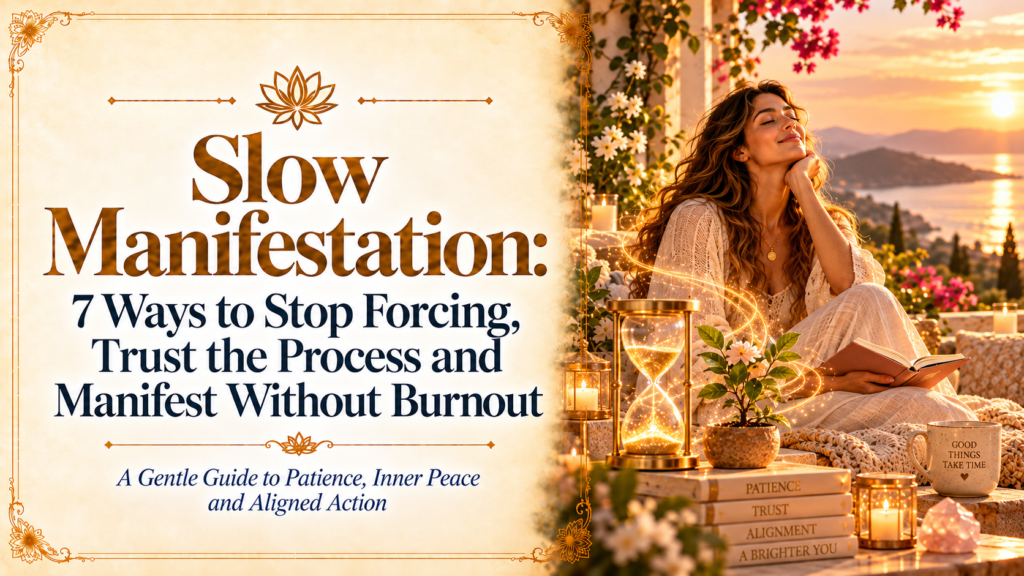
7 Ways to Stop Forcing, Trust the Process and Manifest Without Burnout
The seven ways below are designed to be read in order, because each one builds on the last. You do not need to master them all at once. In keeping with the spirit of slow manifestation, choose one that speaks to you, live with it for a week, and then add the next.
1. Regulate Your Nervous System Before You Manifest
If there is one shift that changes everything, it is this: stop trying to think your way into a better future while your body is still bracing for the worst. Before you sit down to visualise, journal or repeat an affirmation, spend a few minutes helping your body feel safe. This is the heart of nervous system healing, and it is also the most overlooked of all manifestation techniques.
Emotional regulation does not require anything complicated. Begin by slowing your breath, lengthening the exhale so that it is a little longer than the inhale. Let your shoulders drop away from your ears. Place one hand on your chest and one on your belly, and simply notice the rise and fall. If your mind is racing, name what you feel without judging it: “There is worry here. There is excitement here. There is tiredness here.” Naming an emotion often softens its intensity, and it tells your system that you are listening rather than fighting.
Once your body begins to settle, your manifestation practice changes character. Visualisation becomes a pleasure instead of a performance. Affirmations land with more believability. You begin to notice that you are no longer asking the universe for something from a place of emptiness but sharing a wish from a place of enough. Many people find that even two or three minutes of calm breathing before their practice makes the next twenty minutes dramatically more effective. Think of it as tuning an instrument before you play. A beautiful song played on an out-of-tune instrument still sounds off.
Over weeks and months, this simple habit builds what many teachers call a regulated baseline. Your default state shifts from reactive to responsive. You pause before you panic, you recover faster from disappointment, and you stop treating every delay as a sign that you are being denied. This is a nervous system manifestation in its most practical form, and it is the foundation on which everything else in this article rests.
2. Practise Manifestation Detachment (Without Giving Up)
Detachment is one of the most misunderstood ideas in the world of the law of attraction. Many people hear “let go of the outcome” and imagine they must pretend not to care, which is neither possible nor healthy. True manifestation detachment is not indifference. It is the ability to hold a desire lightly, the way you would hold a bird in an open palm. You are aware of it, you appreciate it, you care for it, but you are not gripping it so tightly that it cannot breathe.
A helpful way to understand this is to separate the wanting from the needing. Wanting is healthy, creative and alive. Needing is rooted in fear, and it quietly says, “I cannot be okay unless this happens.” To practise manifestation without obsession, ask yourself a gentle but honest question: “If this never arrives in the exact form I imagine, can I still be at peace?” You do not have to answer yes immediately. Simply noticing how tightly you are gripping is already a powerful act of awareness.
Some practical ways to build detachment include setting your intention once with clarity and then deliberately moving your attention to other areas of your life. Invest in your health, your friendships, your creativity, and your learning. If you enjoy reading, pick up a book from your Readers Books Club list instead of refreshing your phone for signs. When your life is full of meaning in several directions, no single outcome has to carry the weight of your entire happiness, and paradoxically, that is often when outcomes begin to move.
Detachment also means releasing the need to control how and when. You may picture one particular path to your goal, but the universe often has a wider and more surprising set of doors than the one you are staring at. Staying open to alternative routes is not settling. It is intelligence. When you say, “This or something even better,” and truly mean it, you remove an enormous amount of pressure from yourself and from the process.
3. Use Meditation for Manifestation to Reach the Subconscious Mind
Most of what shapes your daily experience happens below the surface of your conscious awareness. Your beliefs about money, love, worth and safety were largely formed in childhood and reinforced for years, and they act like an invisible thermostat, keeping your life at a familiar temperature. You can set a new goal in your conscious mind, but if the thermostat in your subconscious mind says, “That is not for people like us,” you will feel resistance, self-sabotage or a strange discomfort when things begin to improve.
This is why meditation for manifestation is so valuable. Meditation quiets the noisy surface of the mind and creates a gentle bridge to the deeper layers where beliefs are stored. In a calm, receptive state, new ideas can be received with less resistance, and old patterns can be observed without being fed. This is also why so many traditions of spirituality place stillness at the centre of practice. Silence is not empty. It is where the mind begins to reorganise itself.
You do not need an hour a day, a perfect cushion or a mountain retreat. A simple routine is enough. Sit comfortably, close your eyes and follow your breath for a few minutes until your thoughts begin to slow. Then, instead of forcing an image or a feeling, quietly ask your inner world a question such as, “What do I need to feel safe receiving this?” Then wait without demanding an answer. Insights often arrive later, in the shower, on a walk or just before sleep. The practice is not about producing a result in the moment. It is about creating the inner space in which clarity can rise.
Consistency matters more than duration. Ten calm minutes each morning will do more for your mental clarity than a single two-hour session once a month. If you miss a day, do not treat it as a failure. Simply begin again, because beginning again is itself a form of trust. Over time, meditation turns manifestation from something you do into something you are, a steady, centred presence that naturally attracts aligned choices and people.
4. Rewrite Your Affirmations So Your Body Can Believe Them
Affirmations are one of the most popular tools in manifestation, and also one of the most misused. Many people repeat statements like “I am a millionaire” or “I am completely healed” while their body, mind and bank statement tell a very different story. The result is not confidence but an inner argument. Part of you says the sentence; another part immediately says, “That is not true.” And the second voice is usually louder, because it is backed by years of evidence and emotion.
A slow manifestation approach to affirmation is to make your statements believable and bridge-like. Instead of leaping straight to the finished result, choose words that your nervous system can accept as possible. “I am learning to trust my own timing” is easier to feel than “Everything I want is here right now.” “I am becoming more open to receiving” is gentler, and therefore more effective, than a bold claim your mind rejects. As your belief grows, your affirmations can naturally grow with it, moving from “I am open to,” to “I am ready for,” to “I am enjoying.”
How you say an affirmation matters as much as what you say. Speak slowly. Breathe between sentences. Let the words land in your body rather than rushing through them like a checklist. Try placing a hand over your heart and letting each phrase settle for a moment before you move on. Some people enjoy writing their affirmations by hand in a journal, followed by a quiet minute of simply noticing how the words feel. If you notice resistance, do not scold yourself. Resistance is information, and it points directly to the beliefs that need your kindness.
Finally, pair your affirmations with small, believable actions. Saying “I am a confident speaker” while avoiding every opportunity to speak will never convince your subconscious mind. But saying it while you take one small, brave step, such as sharing an idea in a meeting or recording a short video, begins to build real evidence. Affirmations work best when they are not a replacement for action but a companion to it, a quiet voice of encouragement that walks beside you rather than a loud command shouted from far away.
5. Make Visualisation Slow, Sensory and Soft
Visualisation is often taught as a kind of mental pressure: see it clearly, hold it firmly, feel it intensely, and never let the picture blur. For many people this turns a lovely practice into a test they are always failing. If you have ever closed your eyes to visualise and ended up frustrated because you could not “see” anything clearly, take heart. Visualisation is not about producing a perfect movie in your mind. It is about inviting the felt experience of your desire, and that can come through sound, touch, emotion and even simple knowing, not only sight.
Slow visualisation begins with a short scene rather than a grand fantasy. Instead of picturing your entire dream life at once, choose one ordinary moment from it. Perhaps it is the first quiet morning in your new home, the sound of a message confirming good news, or the feeling of walking into a room as someone who is fully at ease. Let yourself notice small details: the temperature of the air, the sound of your own breathing, the texture of what you are holding. The more ordinary and sensory the scene, the more believable it feels, and the more comfortable your nervous system becomes with the idea of living it.
Keep the emotional tone gentle. You are not trying to whip up euphoria. You are practising a feeling of settled gratitude and calm anticipation, the feeling of someone who already trusts that things are unfolding. If your mind drifts to doubt, do not fight it. Simply return to your breath and begin the scene again. This patient returning is the real practice, and it strengthens the same attention muscle that supports mental clarity in every area of life.
Also, remember to end each session by letting go. Take a slow breath and say inwardly, “This, or something even better, in perfect timing.” This small closing ritual reminds your mind that visualisation is an invitation, not a demand. It is also a quiet way of practising manifestation detachment, because you are planting the seed and then stepping back to let it grow. Five or ten minutes a few times a week is plenty. In slow manifestation, how sincerely you practise matters far more than how long.
6. Clear Manifestation Blocks With Curiosity, Not Criticism
Every person who has spent time with manifestation has met a block. You want something, you work at it, and yet some invisible force seems to hold you back. You may find yourself procrastinating at the final step, feeling uncomfortable when good news arrives, or quietly sabotaging a promising opportunity. These are manifestation blocks, and they are almost never a sign that you are unworthy or doing it wrong. More often, they are protective patterns that your subconscious mind learned long ago, when keeping small and safe was the best way to survive.
The most useful response to a block is curiosity. Rather than asking, “What is wrong with me?” try asking, “What is this part of me trying to protect me from?” The answer is often surprising and tender. A fear of success might be protecting you from criticism. A fear of receiving love might be protecting you from an old wound. A tight relationship with money might be protecting you from the memory of scarcity. Once you see the protective intention behind the block, you can thank it, reassure it, and slowly teach your system that you are safe enough now to expand.
Journaling is a beautiful tool for this. Take a few quiet minutes and complete a few sentences honestly, without editing: “If I received what I want, the part of me that would worry is…” or “The story I learned about people like me and success is…” Read what you wrote with the warmth you would offer a close friend. You may find that many of your limiting beliefs were never yours in the first place. They were inherited from family, culture or early experience. Seeing them clearly loosens their grip, and that is often when new choices become possible.
If a block feels heavy, deep or tied to painful memories, it is wise to seek support. A trusted life coach, a manifestation coach or a qualified therapist can offer a safe space in which to explore it. Good coaching does not fix you, because you are not broken. It helps you see your patterns, regulate your emotions and take aligned action with more confidence. Asking for guidance is not a lack of faith in the universe. It is one of the most practical forms of trust you can show yourself.
7. Take a Digital Detox to Protect Your Mental Clarity
One of the most underrated manifestation techniques has nothing to do with affirmations or visualisation at all. It is simply spending time away from your screen. In an age where every spare moment is filled with scrolling, notifications and comparison, it is remarkably difficult to hear your own inner voice. You may be trying to manifest peace, clarity or purpose while consuming a constant stream of other people’s highlight reels, opinions and urgent headlines. No amount of positive thinking can fully compete with that kind of noise.
A digital detox does not have to be dramatic. You do not need to throw your phone into a river or disappear for a month. Begin with small, kind boundaries. Keep the first thirty minutes of your morning screen-free so that your day begins with your own thoughts rather than someone else’s agenda. Stop scrolling an hour before bed so that your nervous system can wind down and your sleep can deepen. Choose one day a week, or even half a day, to put your devices away and spend time in nature, with friends, or with a good book. If you are part of the Readers Books Club community, let that time be a reading hour, because a physical book is one of the gentlest ways to rest your attention.
There is a particular reason a digital detox supports slow manifestation. Constant checking trains your brain to expect instant rewards, and that expectation quietly spills into your manifestation practice. You begin to want results as quickly as a notification arrives, and when the universe does not respond on that schedule, you feel disappointed or discouraged. Stepping away from the speed of the screen helps you recover a more natural rhythm, the rhythm of seasons, of growth, of waiting that is not wasted. In that slower rhythm, trust becomes easier, and your intuition has room to speak.
You will likely notice some quick benefits. Your mind feels less cluttered, your mood steadies, and your attention returns to what truly matters to you. Many people also find that the comparison habit loosens, which is a major relief for anyone who has felt behind on their own journey. Remember that your path is not a race, and no one else is living the exact life that is meant for you. A quieter mind is not an empty one. It is a clear one, and clarity is often the most powerful manifestation tool there is.
A Gentle Daily Rhythm for Slow Manifestation
If you would like to bring all seven ways together without turning them into another rigid routine, imagine a simple, flexible rhythm for your day. In the morning, before you reach for your phone, take a few slow breaths and place a hand on your heart. Let your body arrive in the day before your mind begins to plan it. If you have a few minutes, sit in meditation and ask yourself how you want to feel today, not what you want to achieve. Then speak one or two believable affirmations that match the person you are becoming, and let them settle in your body rather than rushing through them.
During the day, let your manifestation practice be as light as a quiet companion. Notice when you begin to grip, rush or compare, and take one calm breath to soften. Take your meals away from your screen when you can. Take small, aligned actions toward your goals, whether that is sending a message, learning a skill or tidying your space, and then let go of the result. In the evening, spend a few minutes in a short, sensory visualisation or simply in gratitude for what is already working. Close the day by releasing control with a quiet sentence such as, “I did my part, and I trust the rest.” Then put your devices away and let sleep do its restorative work.
On some days you will do all of this beautifully, and on other days you will do almost none of it. Both kinds of days are part of the practice. Slow manifestation is not about a perfect streak. It is about a gentle, repeated return to yourself, and every return counts.
Signs That Slow Manifestation Is Working
Because slow manifestation focuses on inner change first, the early signs are often subtle, and it helps to know what to look for. You may notice that you react less sharply to delays and setbacks. You may find that you sleep a little better, that your breathing is deeper, and that your thoughts feel less crowded. You may catch yourself pausing before an old pattern of worry or overthinking, and choosing a kinder response. You might also notice that you are enjoying your life more in the middle of waiting, laughing more easily and caring less about proving anything.
Soon after, outer signs often follow. Opportunities appear that match your intentions more closely, conversations open in unexpected ways, and decisions feel clearer and less fearful. You may find yourself taking inspired action without pressure, simply because it feels right. None of this guarantees a specific outcome on a specific date, and no honest teacher can promise that. But it does mean you are becoming the kind of person who is ready to receive, and that readiness is the true foundation of lasting results.
Common Mistakes to Avoid on the Slow Path
Even with the best intentions, a few habits can quietly pull you back into manifestation burnout. The first is turning slow manifestation into a new form of perfectionism. If you find yourself feeling guilty for not being “slow enough” or “detached enough,” pause and remind yourself that these ideas are meant to relax you, not grade you. The second is using detachment as a way of avoiding action. Trusting the process does not mean sitting still and waiting for miracles. It means doing your part with an open hand, moving steadily and kindly while releasing the need to control the details.
Another common mistake is monitoring your thoughts so strictly that every moment of doubt feels like a threat. The truth is that doubt is human, and it does not cancel your desires. You can feel uncertain and still be moving in the right direction. A final mistake is trying to do it entirely alone. Reading, listening to podcasts and watching videos are wonderful ways to learn, and many people find deep comfort in the teachings of Dr Amiett Kumar on YouTube, but personal guidance, supportive community and honest conversations can speed your growth in ways that self-study sometimes cannot.
Learning Through Stories: Why Books and Community Help
Slow manifestation is a lifestyle, and lifestyles are strengthened by good company. This is one reason reading communities such as the Readers Books Club can be so supportive for people on a path of personal growth. A good book gives you time. It lets an idea unfold across chapters instead of arriving as a quick clip, and it invites you to pause, underline, reflect and return. When you read about spirituality, mindset, the law of attraction or emotional healing in this unhurried way, the lessons sink deeper into your subconscious mind than a hurried scroll ever could.
Community matters too. When you share your journey with others who understand, you remember that you are not alone in your doubts or your delays. You hear how others have navigated their own seasons of waiting, and you borrow some of their courage. If you have been following the podcasts and videos of Amiett Kumar, consider turning your learning into a small practice with a friend or reading circle, where you discuss one idea each week and try it out together. Shared reflection turns inspiration into integration.
Why Learn From Dr Amiett Kumar
In a space that is often loud with promises, many people are looking for a calm, grounded voice. The work of Dr Amiett Kumar, widely followed through his YouTube channel and podcasts, speaks to this need by connecting manifestation with practical tools such as meditation, affirmation, visualisation, emotional regulation and self-awareness. His content is appreciated by viewers who want to manifest anything meaningful in their lives without losing their peace in the process. For many in his community, he is regarded as one of the top manifestation coaches and as India’s best manifestation coach, and the warmth, clarity and consistency of his teaching are a large part of the reason why.
What stands out in this style of coaching is the emphasis on inner stability before outer achievement. Instead of urging you to hustle harder at the law of attraction, the approach invites you to understand your mind, heal your nervous system, clear manifestation blocks and then move forward with confidence. If you are looking for a top manifestation coach whose teachings feel supportive rather than pressured, exploring the videos and podcasts of Amiett Kumar is a lovely place to begin. You can watch, pause, practise and return as often as you need, and you can move at your own pace.
Frequently Asked Questions About Slow Manifestation
What is slow manifestation?
Slow manifestation is a gentle approach to the law of attraction that replaces force, urgency and constant monitoring with patience, nervous system regulation and trust. It does not delay your results. It simply changes your relationship to the waiting period so that you can enjoy your life while your intentions unfold.
How do I manifest without forcing?
To manifest without forcing, begin by calming your body with slow breathing, then set your intention clearly once and release the need to control how and when it arrives. Support your intention with meditation, believable affirmations, soft visualisation and small, steady actions. Each time you notice yourself gripping or rushing, return to your breath and remind yourself that you are allowed to trust the process.
Can manifestation really cause burnout?
Yes, in the sense that over-practising, over-controlling and constantly checking for results can leave you mentally and emotionally drained. Manifestation burnout often appears as anxiety, guilt around your rituals and a loss of joy in the practice. The remedy is to simplify, rest, regulate your emotions and reconnect with the reason you started.
Does the nervous system really affect manifestation?
Your nervous system shapes how safe, open and clear you feel, which influences your thoughts, choices, relationships and actions. A calmer, more regulated state makes it easier to take inspired action and to believe in your own affirmations. While it is not a magic switch, working with your nervous system is one of the most practical ways to make your manifestation practice more sustainable.
How long does it take to manifest something?
There is no universal timeline, and anyone who promises one is overstating the case. Timing depends on your circumstances, your actions, your beliefs and many factors outside your control. What slow manifestation offers is a way to stay peaceful, consistent and open while your life moves, so that waiting no longer feels like suffering.
Is meditation necessary for manifestation?
Meditation is not compulsory, but it is one of the most helpful companions to manifestation. It improves mental clarity, supports emotional regulation and helps you meet your subconscious mind with greater honesty. Even a few quiet minutes a day can make a noticeable difference.
Where can I learn more from Dr Amiett Kumar?
You can explore guided teachings, podcasts and full-length videos on the Amiett Kumar YouTube channel and on the official website, AmiettKumar.com. These resources cover meditation, affirmation, visualisation, spirituality and the law of attraction in an accessible, practical way.
Final Thoughts: Trust the Process, Gently
Manifestation was never meant to feel like a battle. At its heart, it is an invitation to become more honest about what you want, more loving toward who you are, and more trusting of the life that is unfolding around you. When you stop forcing, you do not lose your power. You discover a deeper kind of power, one that comes from steadiness, self-trust and a nervous system that knows how to rest.
As you move forward, remember the seven ways we explored. Regulate your nervous system before you manifest. Hold your desires with open hands through manifestation detachment. Use meditation to meet your subconscious mind. Rewrite your affirmations so they feel believable. Let your visualisation be slow and sensory. Approach manifestation blocks with curiosity rather than criticism. And protect your mental clarity with a digital detox. You do not have to do everything today. One small, kind step is enough, and then another tomorrow.
If this article spoke to you, take a moment to breathe, to soften your shoulders and to remind yourself that you are exactly where you need to be on your way to where you are going. Then continue your journey with the guidance of Dr Amiett Kumar, through his videos, podcasts and the wider community at Amiett Kumar. The life you are calling in is not running away from you. It is walking toward you at the pace your heart can hold. Trust the process, and let slow manifestation show you what is possible when you stop forcing and start allowing.
Table of Contents