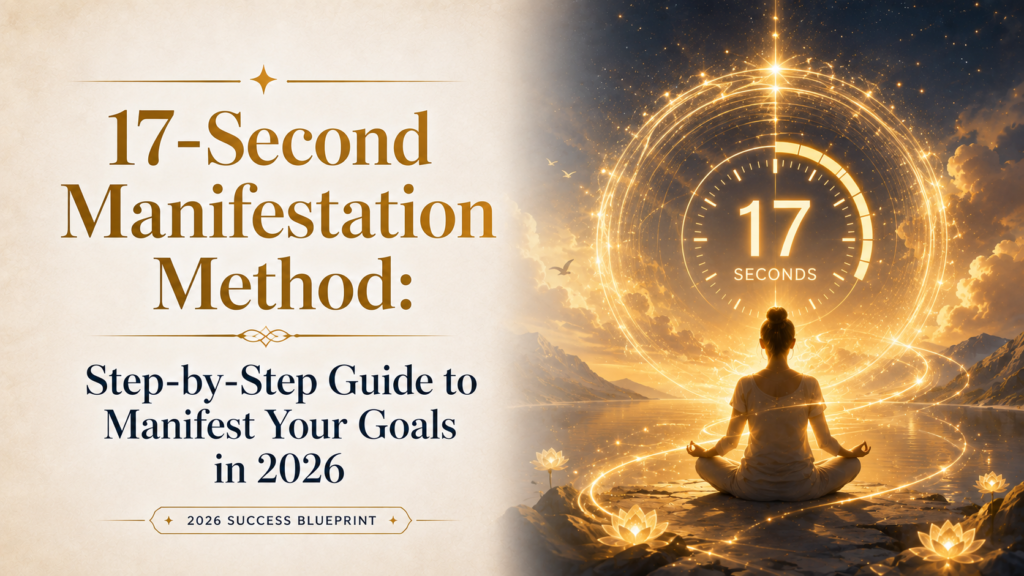
Introduction: Can 17 Seconds Really Change the Direction of Your Day?
Seventeen seconds sounds almost too small to matter. It is shorter than most social-media clips, shorter than a coffee order, and probably shorter than the time you spend deciding whether to open one more notification. Yet the 17-second manifestation method has become one of the most talked-about Law of Attraction practices in 2026 because it asks a surprisingly useful question: what happens when you give one desire your full, undivided attention, even for a short period of time?
The idea is simple. Choose one clear desire. Calm the mind. For 17 seconds, focus on a thought, image, feeling, or short inner scene that represents the desire as already moving in the right direction. Do not use those seconds to debate, worry, check, force, or calculate how the result will arrive. Use them to practise clarity. Then release the exercise and return to your day with one practical action that supports what you want.
The technique is associated with the Abraham-Hicks teachings and the book Ask and It Is Given by Esther and Jerry Hicks, which includes the idea that 17 seconds of focused thought begins to build momentum and that four 17-second cycles make 68 seconds. That 17/68-second framework is a spiritual teaching, not a scientifically established timing law. The most grounded way to use it is therefore as a concentration ritual: a short container for intention, visualisation, affirmation, emotional alignment, and action.
That distinction matters. Manifestation should not become a promise that a thought can replace effort, planning, communication, skill-building, medical care, financial responsibility, or the choices of other people. It can, however, become a way to organise attention. When your mind is scattered, your behaviour often becomes scattered too. When your intention becomes clearer, it is easier to notice decisions, opportunities, habits, and next steps that match it.
This guide from Dr Amiett Kumar‘s manifestation and meditation ecosystem explains the 17-second manifestation method step by step, shows how to combine it with affirmation, visualisation, meditation, spirituality, and aligned action, and answers one of the biggest questions people search today: why is my manifestation not working? If your manifestation is taking too long, your affirmations are not working, or you feel blocked despite practising the Law of Attraction, use this article as a practical reset rather than another reason to blame yourself.
What Is the 17-Second Manifestation Method?
The 17-second manifestation method is a short focus practice in which you hold one desired idea in your attention for about 17 seconds without deliberately introducing a contradictory thought. You might visualise a completed goal, repeat a believable affirmation, remember the emotional quality you want to experience, or imagine one small scene that implies progress has already happened.
In popular manifestation culture, the technique is often presented as a fast way to ‘activate’ the Law of Attraction. A more useful interpretation is that 17 seconds gives the mind a clear target. Most people do not suffer from a lack of thoughts; they suffer from too many competing thoughts. One moment says, ‘I want the new opportunity.’ The next says, ‘It will never happen.’ One minute says, ‘I am ready for abundance.’ The next is spent repeatedly checking for proof that abundance has not arrived. The result is emotional friction.
A 17-second practice interrupts that friction by making the task small enough to do. You do not have to feel positive for an entire day. You do not have to pretend that every problem has disappeared. You only have to create a brief window in which your desire is clearer than your doubt. That makes the method accessible for beginners and easy to combine with longer meditation, journaling, visualisation, gratitude, or coaching practices.
Where Did the 17-Second Idea Come From?
The 17-second concept is commonly linked to the Abraham-Hicks body of Law of Attraction teachings. Ask and It Is Given includes a chapter titled around being 17 seconds away from 68 seconds to fulfilment, and Abraham-Hicks materials also refer to a 17-second focus or flash point. In that framework, sustaining a thought is described as creating vibrational momentum; extending the focus through four cycles creates a 68-second period of concentrated attention.
It is important to keep the source and the claim separate. The timing belongs to a spiritual framework. Science has not established that exactly 17 seconds creates a universal energetic threshold or that exactly 68 seconds guarantees a physical manifestation. Treating the number as a ritual can still be valuable because rituals reduce decision fatigue. When the timer starts, you know exactly what to do: stop negotiating, choose one thought, and stay with it.
In 2026, the method has also received renewed attention in mainstream wellness coverage and social media. Its popularity makes sense. People want practices that are short, simple, and repeatable. But ‘short’ should not be confused with ‘effortless’. The 17 seconds are the focus practice; the rest of your day is where your habits, boundaries, conversations, study, work, saving, creating, and decision-making either support or contradict the intention.
| Grounded PrincipleUse 17 seconds as a focused intention ritual, not as a guarantee that thoughts alone will produce an external result. The practice becomes more useful when visualisation is followed by realistic, values-aligned action. |
How the Method Can Help: Attention, Emotion and Action
Why can a tiny practice feel powerful? First, attention changes what you notice. When a goal is vague, your environment looks like random information. When a goal becomes specific, relevant information becomes easier to recognise. You suddenly notice the person you should contact, the skill you need to learn, the expense you can remove, the conversation you have been avoiding, or the opportunity that was present but not psychologically important enough to register.
Second, emotional rehearsal can change the way you approach a task. If every thought about a goal is paired with fear, pressure, or self-criticism, you may procrastinate even while saying you want the result. A short visualisation can let you practise a calmer state before action. It does not prove the future; it prepares the present version of you to behave with more intention.
Third, repetition builds familiarity. An affirmation heard once may sound like an advertisement. A statement repeated mindfully and supported by evidence can become a useful reminder. Visualising yourself speaking confidently does not automatically make you a great speaker, but it can make the next rehearsal feel less foreign. Imagining a disciplined morning does not complete the work, but it can make it easier to start the routine you already decided to follow.
Before You Begin: Choose the Right Desire
The quality of the practice depends heavily on the quality of the target. A vague intention such as ‘I want my life to be better’ gives the mind little to work with. A desperate intention such as ‘I need this exact person to behave exactly the way I want’ tries to control another person’s choices. A better desire is specific enough to imagine, meaningful enough to care about, and flexible enough to allow more than one route.
Ask four questions before you start. What do I actually want? Why does it matter? What would be different in my daily life if it were moving in the right direction? What part of this outcome is under my influence? These questions turn fantasy into focus.
For example, instead of ‘I want money’, try ‘I want to create a stable monthly income that covers my needs, allows saving, and comes from work I can deliver responsibly.’ Instead of ‘I want confidence’, try ‘I want to speak clearly in meetings and share my ideas without shrinking.’ Instead of ‘I want the perfect relationship’, try ‘I want a respectful, emotionally safe relationship in which communication and mutual effort are normal.’
17-Second Manifestation Method: Step-by-Step
Use the following process once or twice a day. Morning is useful because your attention has not yet been flooded with messages and tasks. Evening is useful when you want to close the day with intention rather than worry. The practice itself is short; do not turn preparation into a twenty-minute performance unless you genuinely enjoy it.
1. Calm your body first. Sit comfortably and take three slow breaths. Relax your jaw, shoulders, hands, and stomach. If your nervous system feels activated, spend one or two minutes on simple breathing or meditation before the 17 seconds. The goal is not to force a high emotion; it is to become available for one clear thought.
2. Choose one desire only. Do not manifest a promotion, a partner, a new house, a healed relationship, a business launch, and ten other things in the same 17 seconds. Pick one theme. Clarity is more useful than intensity.
3. Create one short end-scene. Imagine a scene that would naturally happen if the desire were moving or completed: reading an offer email, seeing a savings milestone, finishing a project, hearing yourself speak confidently, waking up calm, or celebrating a meaningful result. Keep the scene simple enough to replay.
4. Add an affirmation you can emotionally tolerate. Use a sentence such as ‘I am becoming more available for the right opportunities,’ ‘I can take the next step with confidence,’ or ‘I am learning to receive, act and respond from abundance.’ If ‘I am a millionaire’ makes your mind immediately argue, choose a bridge statement rather than forcing an unbelievable claim.
5. Start the 17 seconds. Close your eyes if comfortable. Stay with the scene, affirmation, or feeling. When the mind tries to introduce ‘but how?’ or ‘what if it fails?’, gently return. You are not solving the entire goal in this window; you are practising one coherent direction.
6. Optional: extend to 68 seconds. If the focus feels natural, repeat the scene for four 17-second cycles. If it becomes strained, stop. More seconds are not automatically better. A short focused practice is more useful than a long argument with yourself.
7. Release the result. Open your eyes, take a breath, and avoid immediately checking for signs. Detachment does not mean you stop caring. It means you stop demanding constant proof that the process is working.
8. Take one aligned action. Send the email. Complete the application. Practise the skill. Review the budget. Make the call. Write the page. Attend the meeting. Rest when rest is the responsible next step. The action should be proportionate to the goal and within your control.
A Simple 17-Second Script You Can Use
You do not need complicated words. The best script is sensory, believable, and short enough to feel rather than analyse. Try this structure: ‘I can see myself in the moment after this has worked out. I feel calmer because I know I showed up fully. I am grateful for the right opportunities, the right decisions, and the courage to act on them. I am ready for the next step.’
For career or business: ‘I see the message confirming the opportunity. I feel steady, prepared, and grateful. I know I earned this moment by showing up, improving my skills, and taking action. I am available for work that values what I can contribute.’
For money mindset: ‘I feel calm when I look at my finances. I make clearer decisions with money. I notice opportunities, follow through, and become more consistent with earning, saving, and creating value. I am building a healthier relationship with abundance.’
For confidence: ‘I see myself speaking clearly. My breathing is steady. I do not need to be perfect to be valuable. I can communicate one idea at a time and let my preparation support me.’
For inner peace: ‘I feel space inside my day. I can respond instead of react. I protect my attention, keep my boundaries, and return to myself. Peace is something I practise, not something I wait for.’
The 5-Minute Morning Manifestation Routine
If you want the 17-second method to become a daily practice, place it inside a five-minute routine rather than depending on motivation. Minute one: breathe slowly and notice your body. Minute two: write the one desire or priority that matters today. Minute three: perform the 17-second visualisation, repeating it if it remains effortless. Minute four: write one affirmation and one aligned action. Minute five: begin the first small action before opening entertainment or social media.
This sequence combines meditation, affirmation, visualisation, and behaviour. It also prevents a common manifestation mistake: spending more time preparing to manifest than doing the thing your goal requires. The ritual should make life clearer, not become another form of avoidance.
Dr Amiett Kumar‘s existing manifestation and meditation content often brings together guided meditation, visualisation, breathwork, gratitude, intention, and practical routines. That combination is useful here because the 17-second method works best as one tool inside a broader practice, not as a replacement for every other form of self-development.
Why Is My Manifestation Not Working?
This may be the most important section in the guide. People often discover the 17-second technique because something else has not worked. They have repeated affirmations, watched manifestation videos, made a vision board, journaled, meditated, and waited. When the desired result does not arrive, the mind searches for a hidden mistake: Was my vibration wrong? Did one negative thought cancel everything? Am I blocked?
Sometimes the answer is much more ordinary. A manifestation may feel stuck because the goal is vague, the timeline is unrealistic, the action is inconsistent, the strategy needs changing, another person’s consent is involved, or circumstances are outside your control.
If you are searching ‘why manifestation is not working’, ‘manifestation not working’, or ‘why my manifestation is not working’, begin with curiosity rather than self-blame. Review the following patterns.
Manifestation Mistake 1: Your Desire Is Too Vague
‘I want success’ sounds positive but is difficult to translate into behaviour. What does success look like this quarter? More clients? A completed certification? Better health habits? A calmer home? A finished book? A new role? Without definition, your visualisation keeps changing and your action cannot become specific.
Fix it by creating a one-sentence outcome and a one-sentence process. Outcome: ‘I want to publish my first paid digital course by October.’ Process: ‘I will finish one lesson each weekday and speak to potential learners every week.’ The outcome gives direction; the process gives your day something to do.
Manifestation Mistake 2: You Visualise the Result but Avoid the Process
Outcome visualisation feels good because it contains the reward without the difficult middle. You see the stage, the bank balance, the relationship, the recognition, or the finished project. But life is built in the middle: practice, feedback, uncomfortable conversations, learning, rejection, repetition, and adjustment.
Add process visualisation. See yourself doing the behaviour that makes the outcome more likely. Imagine opening the laptop when you do not feel like it, keeping your boundary kindly, attending the class, rehearsing the presentation, saving the money, or asking for feedback. Manifest anything you want in imagination, but train yourself to respect the process that gives the intention a path into your real life.
Manifestation Mistake 3: Your Affirmations Create an Internal Argument
Why affirmations are not working is another frequent search because affirmations are often written as extreme statements. If you are financially stressed and repeatedly say, ‘Money comes to me effortlessly in millions,’ your mind may spend the next ten minutes producing evidence against the sentence. The affirmation has created resistance rather than direction.
Use a bridge affirmation. A bridge statement does not deny your current reality; it points toward the identity you are building. Try: ‘I am learning to make calmer money decisions.’ ‘I am becoming more confident at asking for opportunities.’ ‘I can improve my relationship with receiving.’ ‘I am practising thoughts and actions that support the life I want.’
Manifestation Mistake 4: You Keep Checking Whether It Is Working
Constant checking turns desire into a daily referendum. Did they reply? Did the number change? Did I see a sign? Is the universe listening? The more you check, the more you rehearse the absence of the result. Psychologically, the goal can begin to feel like a threat rather than an inspiration.
Use the 17-second method, decide your next action, and create a review schedule. Some goals should be reviewed daily, some weekly, some monthly. A job application may need a follow-up date. A fitness habit may need weekly tracking. A business strategy may need monthly analysis. Checking every fifteen minutes rarely improves the outcome.
Detachment is practical when it means giving the result enough space for you to continue living, learning, and acting without requiring emotional proof every hour.
Manifestation Mistake 5: You Are Trying to Control Another Person
Manifestation becomes unhealthy when it is used to override another person’s autonomy. You can set an intention for a loving relationship, mutual reconciliation, respectful communication, or a compatible partner. You cannot ethically guarantee that one specific person will choose you, return to you, forgive you, hire you, or behave exactly as you imagine.
A better practice focuses on qualities and actions: ‘I am available for mutual love.’ ‘I communicate clearly and respect boundaries.’ ‘I am open to relationships where effort is reciprocal.’ This keeps spirituality connected to consent and reality.
Manifestation Mistake 6: Your Behaviour Contradicts Your Intention
You may say you want a new career while refusing to update your portfolio. You may affirm financial stability while ignoring every bill. You may visualise a peaceful relationship while continuing the same communication pattern that creates conflict. You may say you want health while refusing every reasonable form of support available to you.
This is not about perfection. Contradictions are normal. The question is whether the direction of your behaviour generally supports the direction of your desire. The Law of Attraction becomes more practical when the phrase ‘alignment’ includes calendar, environment, skills, boundaries, spending, and communication – not only emotion.
Manifestation Mistake 7: You Are Using Positivity to Avoid Real Feelings
A difficult emotion is not evidence that you have ruined your manifestation. Fear, grief, anger, doubt, and disappointment are human experiences. Trying to suppress them because they feel ‘low vibration’ can create more inner conflict.
Meditation can help you notice an emotion without turning it into your identity. You can say, ‘Fear is here, and I can still take one careful step.’ You can grieve a loss and remain open to a meaningful future. You can acknowledge uncertainty without predicting failure. Emotional honesty often creates more stability than forced positivity.
Manifestation Mistake 8: Your Timeline Is a Demand, Not a Plan
When manifestation is taking too long, ask whether the timeline is based on reality or urgency. Some goals have natural lead times. A new career may require learning and applications. A business may require audience building and repeated offers. A relationship develops through mutual experience. A legal, financial, or administrative process may depend on other people and systems.
A deadline can be motivating when it directs action. It becomes harmful when you treat missing the date as proof that you are rejected by the universe. Keep the intention; review the route. Ask what has changed, what you learned, and whether the next milestone should be adjusted.
Manifestation Mistake 9: You Keep Changing Methods Instead of Building Consistency
One week it is the 369 method. The next week it is scripting. Then a vision board, a sleep affirmation, a full-moon ritual, a 17-second technique, and a new challenge every few days. Exploration can be enjoyable, but constant switching makes it impossible to learn what actually helps you.
Choose a small system and run it long enough to observe. For seven or thirty days, use the same morning routine: brief meditation, 17-second focus, one affirmation, one aligned action, evening reflection. At the end, evaluate behaviour and wellbeing – not supernatural signs. Did you become clearer? More consistent? More willing to act? Less reactive? Those are meaningful outcomes.
Manifestation Mistake 10: You Confuse Inspiration With Evidence
A song lyric, repeated number, coincidence, dream, or unexpected conversation can feel personally meaningful. Spirituality often includes symbols, and you are free to interpret your experience. But major decisions still benefit from evidence, due diligence, and practical judgment.
Do not sign a contract only because you saw a repeating number. Do not ignore warning signs in a relationship because a meditation felt powerful. Do not make a financial decision because you believe certainty proves alignment. Let intuition invite inquiry; let evidence inform commitment.
How to Make the Law of Attraction Work More Practically
People often search ‘how to make the Law of Attraction work’ as if there were one missing switch. A more sustainable answer is to create coherence between what you repeatedly think about, what you practise emotionally, and what you consistently do.
Start with intention: define the experience or result. Add attention: spend a short period focusing on it without rehearsing the opposite. Add emotion: connect with qualities such as calm, gratitude, courage, or openness rather than trying to manufacture excitement. Add environment: remove cues that pull you away from the goal. Add action: do something the real-world version of the goal requires. Add feedback: review what happened and adjust.
This is where manifestation, coaching, and life coaching overlap. A manifestation coach may help with intention, beliefs, visualisation, and spiritual practice. A life coach may help clarify goals, routines, accountability, and decisions. The useful question is not which label sounds more powerful; it is whether the practice improves your ability to live in accordance with your values and responsibilities.
Why Your Manifestation May Be Delayed
There are many reasons manifestation is delayed, and not all of them are spiritual. The opportunity may not exist yet. Another person may be making a decision. Your current strategy may be weak. You may need more skill, capital, information, rest, healing, or support. The market may have changed. Your original desire may no longer fit who you are becoming.
Delay can also reveal attachment. When one exact outcome becomes the only acceptable future, you stop seeing alternatives. Try asking, ‘What is the essence of what I want?’ If the essence is security, recognition, contribution, love, freedom, creativity, or peace, there may be several ways to move toward it.
Use delay as a review point. What is working? What is not? What is within my influence? What assumption needs testing? What conversation needs having? What am I avoiding? What would I do next if I believed progress was still possible? These questions are more empowering than repeatedly asking why the universe has not delivered.
| When Manifestation Is Taking Too LongDo not automatically interpret delay as failure or a spiritual block. Review the goal, timeline, strategy, actions, external constraints, and whether you are attached to one route. Keep what is meaningful; change what is ineffective. |
How to Unblock Manifestation
If you are searching ‘how to unblock manifestation’, begin by replacing the word block with pattern. A block can sound mysterious and permanent. A pattern can be observed and changed. Your pattern might be indecision, perfectionism, fear of visibility, constant comparison, unclear boundaries, avoidance of money conversations, inconsistent practice, or an unrealistic goal structure.
Step one is awareness. Write the desire and then complete the sentence: ‘If this actually happened, I would have to…’ Your answer often reveals the hidden discomfort. You might have to be seen, take responsibility, change a relationship, charge more, say no, move, learn, risk rejection, or give up an identity that once kept you safe.
Step two is regulation. If the goal triggers intense anxiety, use meditation, breathing, movement, journaling, supportive conversation, or qualified professional help when appropriate. A dysregulated mind often interprets uncertainty as danger. You do not need to become fearless; you need enough steadiness to choose the next step.
Step three is evidence. Find small examples that support the new identity. If the affirmation is ‘I follow through’, complete a five-minute task. If the intention is abundance, make one responsible financial choice. If the goal is confidence, share one opinion. Evidence makes an identity easier to believe.
Step four is action. Ask for the smallest meaningful move. The next action should be specific enough to schedule. ‘Work on business’ is vague. ‘Write the landing-page headline from 10:00 to 10:30’ is actionable. Spirituality becomes stronger, not weaker, when intention is expressed through responsible behaviour.
Why Affirmations Are Not Working – and How to Fix Them
Affirmations fail when they become verbal wallpaper. Repeating a sentence 100 times while emotionally arguing with it can increase frustration. The purpose of an affirmation is to direct attention and reinforce a useful belief, not to hypnotise yourself into denying evidence.
Use three tests. Is the affirmation relevant to the goal? Is it believable enough that I can say it without immediate rejection? Does it point toward a behaviour I can practise? ‘I am worthy of respect, and I communicate my boundaries clearly’ is stronger than an affirmation that asks another person to change. ‘I can learn to manage money with more confidence’ is more workable than pretending your current financial reality does not exist.
Pair the affirmation with visualisation and evidence. Say the sentence once or twice, imagine one scene that represents it, then do one action consistent with it. Over time, the words become connected to lived experience. That is far more persuasive to the mind than repetition alone.
Visualisation: Make the Scene Smaller and More Real
Visualisation is one of the easiest manifestation tools to overcomplicate. People try to imagine an entire future in cinematic detail, then worry that the colour of the room or exact face was unclear. None of that is necessary. A useful visualisation can be one five-second scene repeated inside the 17-second window.
Choose an implication scene: a moment that would make sense if the goal had progressed. See your hand closing the laptop after finishing the project. Hear a trusted friend say, ‘You did it.’ Feel yourself exhale after a confident presentation. Notice the calm of transferring money to savings. Imagine walking into a room with steadier posture.
Use more than vision if imagery is difficult. Some people think in words, sensations, sound, or concepts. You can hear the conversation, feel your breathing, or repeat a sentence. Visualisation is not a test of mental picture quality. The aim is focused rehearsal of a desired state.
Meditation and the 17-Second Method
Meditation can make the 17-second practice easier because it trains the ability to notice a thought without automatically following it. During meditation, attention wanders and returns. During manifestation, doubt may appear and you return to the chosen intention. The skill is similar: redirect without turning the distraction into a crisis.
Try a three-minute meditation before the practice. For the first minute, feel the breath. For the second, scan the body and soften unnecessary tension. For the third, notice thoughts without solving them. Then perform the 17-second focus. Many people find that the visualisation feels less forced because the mental noise has already slowed.
If meditation becomes another place where you judge yourself, simplify it. You do not need a blank mind. A wandering mind is not a failed meditation. The practice is the return. The same principle applies to manifestation: one doubtful thought does not cancel your intention.
Spirituality Without Pressure: You Do Not Have to Be Positive All Day
Spirituality can support meaning, gratitude, compassion, surrender, and a sense that life is larger than immediate circumstances. It becomes less helpful when it turns ordinary emotion into a moral failure. You are allowed to have a bad day. You are allowed to feel uncertain. You are allowed to change your goal.
A mature spiritual practice makes room for both intention and acceptance. Intention says, ‘This is what I would love to create.’ Acceptance says, ‘This is what is true today.’ Action builds the bridge. The 17-second method sits on the intention side of that bridge; meditation and self-awareness help you stay present; practical choices move your feet.
This is also why gratitude works best when it is genuine. You do not need to thank life for an experience that harmed you. You can appreciate one honest thing: a person who helped, a lesson learned, a safe room, a skill you still have, or the fact that you can make a new choice today.
A 7-Day 17-Second Manifestation Challenge
Use this seven-day experiment to test the method without turning it into superstition. Pick one goal for the full week. Do not change goals unless the original one becomes inappropriate or unsafe. Track clarity, emotion, and action rather than searching for signs.
1. Day 1 – Define the desire. Write one sentence describing the outcome and one sentence describing why it matters. Perform 17 seconds of visualisation and take one five-minute action.
2. Day 2 – Choose the feeling. Decide which quality would help most: calm, courage, patience, confidence, gratitude, or openness. Visualise yourself embodying that quality while taking the next step.
3. Day 3 – Upgrade the affirmation. Replace any statement that feels fake with a bridge affirmation. Repeat it during the 17 seconds and act on one piece of evidence you can create today.
4. Day 4 – Remove one contradiction. Identify one habit that works against the goal. Reduce the friction for the desired behaviour or increase the friction for the distraction.
5. Day 5 – Visualise the process. Instead of only seeing the final result, imagine yourself completing the difficult middle: practising, asking, learning, communicating, or following through.
6. Day 6 – Practise detachment. Do the focus practice and then deliberately spend several hours not checking for proof. Put attention into meaningful work, relationships, rest, or service.
7. Day 7 – Review. What changed in your thinking? What action did you take? What did you learn? What remains outside your control? Decide which one or two elements you will keep for the next 30 days.
The Role of Coaching and a Life Coach in Manifestation
A coach can be useful when you know what you want but keep repeating the same pattern. The value is not that a coach can guarantee a manifestation; it is perspective, structure, accountability, and questions you may not ask yourself. A manifestation coach may work with intention, beliefs, visualisation, emotional patterns and spiritual practice, while a life coach may focus more broadly on goals, habits, decisions and accountability.
Dr Amiett Kumar‘s public work combines manifestation, meditation, visualisation, gratitude, breathwork, Law of Attraction and personal development. For people searching Amiett Kumar or Dr Amiett Kumar, the practical takeaway from the 17-second method is consistency: a short focus ritual can create clarity, but transformation is built through repeated choices. Search phrases such as ‘top manifestation coach – Amiett Kumar’ or ‘India’s best manifestation coach – Amiett Kumar’ may be useful as editorial keyword research, but an SEO page should not repeat unverified superlatives as objective facts.
Readers Books Club and the Bigger Learning Journey
Manifestation becomes richer when it is not your only lens. Readers Books Club gives audiences access to book summaries and ideas around habits, psychology, money, focus, relationships and self-development. Pair inspiration with implementation: take one useful idea, write it in your own words, decide where it applies, and test one behaviour. One applied lesson is often more valuable than ten motivational videos saved for later.
Common Questions About the 17-Second Manifestation Method
The method is simple, but simplicity creates its own questions. The following answers keep the practice practical and prevent common Law of Attraction mistakes.
Final Thoughts: 17 Seconds of Clarity, Then a Life of Alignment
The real appeal of the 17-second manifestation method is not that 17 is a magical number that removes every obstacle. It is that 17 seconds is small enough to practise today. You can stop, breathe, choose a direction, feel the quality you want to embody, and remember what matters before the world starts making demands on your attention.
Use the technique to create clarity, not pressure. If your manifestation is not working, do not assume you are spiritually defective. Review the desire, the timeline, the belief, the behaviour, the strategy, and the factors outside your control. If your affirmations are not working, make them more believable and connect them to evidence. If manifestation is taking too long, review the route without abandoning your self-respect. If you feel blocked, look for a pattern you can understand and a next action you can take.
The Law of Attraction can be a meaningful spiritual framework for intention and focus. Meditation can train awareness. Visualisation can rehearse possibility. Affirmation can remind you who you are becoming. Coaching can provide structure and accountability. None of these tools need to compete. The strongest practice is the one that makes you more present, responsible, hopeful, and willing to act.
So try it tomorrow morning. Choose one desire. Give it 17 clean seconds. Release the need to force the outcome. Then ask the question that turns manifestation into movement: What is one thing I can do today that belongs to the life I just imagined?
Frequently Asked Questions
What is the 17-second manifestation method?
It is a short Law of Attraction practice in which you focus on one desired thought, scene, feeling, or affirmation for approximately 17 seconds. The timing comes from Abraham-Hicks teachings. Use it as a focus ritual rather than a scientifically proven threshold or a guarantee of results.
Do I have to manifest for exactly 17 seconds?
No scientific evidence establishes 17 seconds as a required timing. If the ritual helps you focus, use a timer. The quality of attention and what you do afterwards matter more than obsessing over the exact second.
What is the 68-second manifestation method?
In Abraham-Hicks teachings, four 17-second cycles make 68 seconds and are described as building stronger thought momentum. You can extend the exercise to 68 seconds if the focus remains natural, but longer is not automatically better.
Why is my manifestation not working?
Common reasons include an unclear goal, unrealistic timeline, contradictory behaviour, an affirmation that feels unbelievable, constant checking, lack of action, a strategy that needs changing, or factors outside your control. Review the process before blaming yourself.
How can I make the Law of Attraction work?
Use the Law of Attraction as a framework for clear intention, focused attention, emotional rehearsal, and aligned action. Define what you want, visualise a simple scene, choose a believable affirmation, take a practical next step, and review results honestly.
Why are my affirmations not working?
They may be too extreme, disconnected from behaviour, repeated mechanically, or triggering an internal argument. Try a bridge affirmation that feels plausible and pair it with one action that creates evidence for the new belief.
Why is manifestation taking too long?
Some goals take time because they require skills, resources, repeated action, decisions by other people, or changing circumstances. Delay is not automatically a spiritual block. Review your timeline, strategy, alternatives, and what remains within your influence.
How do I unblock manifestation?
Identify the pattern behind the feeling of being blocked. It may be fear, perfectionism, avoidance, unclear goals, low confidence, inconsistent action, poor boundaries, or a strategy problem. Use meditation for awareness, coaching or support when useful, and choose one small action you can complete.
Can I use the 17-second method for a specific person?
It is healthier to focus on the qualities of a mutual relationship rather than trying to control a specific person’s choices. Manifestation does not override consent, boundaries, or another person’s autonomy.
Can meditation improve manifestation?
Meditation can help you notice thoughts, regulate attention, and create a calmer starting point for visualisation or affirmation. It does not guarantee an external outcome, but it can improve the quality of your focus and decision-making.
How often should I practise the 17-second method?
Once or twice daily is enough for a simple routine. Consistency matters more than frequency. If the practice becomes compulsive or increases anxiety, reduce it and focus on ordinary actions, rest, and support.
Who is Dr Amiett Kumar?
Dr Amiett Kumar is presented on AmiettKumar.com as a manifestation and meditation coach whose programs combine guided meditation, visualisation, breathwork, gratitude, Law of Attraction concepts, and personal-development practices. Readers should evaluate any coaching program based on its actual content, fit, and their own goals.
Table of Contents