Introduction
By Dr Amiett Kumar | Law of Attraction and Manifestation Coach | Reading time: about 22 minutes
Have you ever looked at the life you truly want, with a calm mind, a thriving career, loving relationships and financial ease, and quietly wondered, “Why does that person feel like somebody else?”
Here is the truth that has changed thousands of lives inside our community: it feels like somebody else because you are still living as your old self. Your desires are not the problem. Your dreams are not too big. The gap between where you are and where you want to be is, very often, an identity gap.
That is exactly what future self manifestation is designed to close. It is the practice of becoming the person who already has what you desire, in thought, in feeling and in action, before the results arrive in your outer world. It is the heart of every effective identity shift manifestation method, and it is one of the most practical manifestation techniques you can learn.
In this guide, Dr Amiett Kumar and the Readers Books Club team walk you through how to manifest your future self in seven clear steps, using meditation, visualisation, affirmation and simple daily action. Whether you are a complete beginner or a long-time student of the law of attraction, you will find a method here that you can start today.
Quick takeaways: Your identity decides your results. Future self manifestation means defining your desired self, then thinking, feeling and acting like that person today. Meditation, visualisation and affirmations train your subconscious mind, and small daily actions make the new identity real.
What Is Future Self Manifestation?
Future self manifestation is a self-development and law of attraction practice in which you define the version of yourself who already lives your dream life and then deliberately think, feel and act like that person right now. You may also hear it called identity shifting or desired self manifestation. The names differ, but the idea is the same: you stop trying to get your desires from the outside and start becoming the person for whom those desires are natural.
Think about how most of us set goals. We say, “When I get the promotion, I will become confident.” Or, “When I have more money, I will feel secure.” Or, “When I find the right partner, I will be happy.” We place our identity at the end of the journey and wait for the world to hand it to us.
Future self manifestation reverses that order. It says: “I will begin to become that confident, secure, happy person now, and my life will reorganise itself around that identity.”
A complete identity shift works on three layers at the same time:
- Thoughts: the beliefs and mental pictures you hold about who you are. This is your self-concept.
- Feelings: the emotional state you live in most of the time. Your future self has a signature feeling, such as calm, gratitude, certainty or joy.
- Actions: the daily choices, habits and words that either confirm your old identity or build your new one.
When all three point in the same direction, change becomes surprisingly natural. When only one is working, say you are thinking positive thoughts while behaving like your old self, progress feels like a struggle.
It is also important to be clear about what this practice is not. It is not pretending that problems do not exist. It is not denial. And it is not sitting on the sofa waiting for the universe to deliver. It is a conscious decision about which version of yourself you will feed every day, combined with real, inspired action. Manifestation works alongside effort, never instead of it.
Why Your Identity Decides Your Results
Imagine a thermostat set to 24 degrees. You can open every window and let the cold air in, and within a short time the system works hard to bring the room back to 24. Your self-concept behaves in a similar way. It is the set of beliefs you hold about “who I am”, and it quietly regulates how much success, money, love, health and peace you allow yourself to experience.
If your inner thermostat says, “I am someone who struggles with money,” then a sudden bonus often disappears through unplanned spending, a bad investment or an unexpected expense. If it says, “I am not the kind of person who gets noticed,” you may unconsciously stay quiet in the very meeting where speaking up could change your career. The outer result is never random. It is usually a reflection of the identity running underneath.
The role of the subconscious mind
Most of what you do each day, how you react to criticism, how you handle money, what you eat, how you speak to yourself, runs on habit rather than fresh decision. These habits are stored in what we commonly call the subconscious mind. This is why subconscious mind manifestation is such a powerful idea: if you want a different life, you need to give your subconscious a different “default setting” to follow.
The subconscious learns through two main doors: repetition and emotion. Something you repeat often, and feel strongly while repeating, becomes familiar. And what becomes familiar starts to feel normal, and the mind moves you toward what feels normal. That is why the tools in this guide, meditation, visualisation and affirmation, are not decorations. They are the practical methods of rewriting your default settings.
Calm, relaxed states, such as those reached during meditation, also make the mind more receptive to new suggestions. This is one reason meditation for manifestation has been a cornerstone of spirituality and personal growth traditions for centuries.
What psychology says
Modern psychology supports the heart of this approach. Researchers Hazel Markus and Paula Nurius introduced the idea of “possible selves” in the 1980s, suggesting that the future versions of ourselves we imagine act as powerful motivators for present behaviour. Later research on future self-continuity, including work by psychologist Hal Hershfield, has found that people who feel more connected to their future selves tend to make better long-term decisions, such as saving more and taking better care of their health.
In simple words: the more real and familiar your future self feels to you, the more naturally you act in ways that create that future.
Law of Attraction vs the Law of Assumption
If you have studied the law of attraction, you know the core principle: like attracts like. Your dominant thoughts and emotional state shape the experiences, people and opportunities that move toward you. Most students of the law of attraction learn to focus on what they want, feel grateful, and keep their energy high.
The law of assumption, popularised by the 20th-century teacher Neville Goddard, goes one step further. It says that whatever you assume to be true about yourself, and persist in assuming, eventually shows up in your reality. Instead of asking, “How do I attract this?” it asks, “Who would I have to be for this to be normal?”
Here is how the two ideas work together:
- Law of attraction: shows you that your inner state influences your outer world.
- Law of assumption: shows you that you can choose that inner state by choosing your assumptions about who you are.
- Identity shifting: is the practical bridge between them, a step-by-step way to live from the assumption of your desired self.
You do not have to pick one philosophy over the other. Use the law of attraction as your map and the law of assumption as your vehicle. The seven steps below combine both into one simple system you can practise daily.
Step 1: Get Crystal Clear on Your Desired Self
Every journey begins with a destination. Yet most people never define their desired self. They know what they want, a better job, more income, a happy relationship, but they have never described who they would need to be to live that life comfortably.
This is where mental clarity becomes your first superpower. A vague desire creates vague thoughts, vague emotions and vague actions. A clear picture of your future self gives your mind something specific to move toward.
The five-domain clarity exercise
Take a quiet half hour with a notebook. Choose a time horizon, ideally one year from today. Then describe your future self in five areas of life, writing in the present tense as if it is already true:
- Mind: How do you think? How do you handle stress, setbacks and criticism? What do you believe about yourself?
- Body: How do you look after your health and energy? How do you move, sleep and eat?
- Relationships: How do you treat people? How do they treat you? What kind of partner, parent, friend or leader are you?
- Work and wealth: What work do you do? How do you earn, save, invest and give? What is your relationship with money?
- Spirit: What does your inner life look like? How do you meditate, reflect and stay connected to something greater than yourself?
Choose identity before outcome
Notice the difference between these two statements:
- Outcome: “I want to earn ten lakh rupees a month.”
- Identity: “I am a financially confident person who creates great value, makes decisions calmly, and saves and invests with ease.”
The outcome may or may not happen on your timeline. The identity, however, is something you can begin to live today. And when you live the identity, outcomes follow far more naturally.
Journal prompt: If I woke up tomorrow as my highest self, what are the first three things I would notice about my thoughts, my choices and my mood?
Do not rush this step. The clearer your picture, the easier the next six steps become.
Step 2: Write Your Future Self Profile and Identity Statements
Now that you have clarity, turn it into something you can read, hear and repeat. Think of this step as creating the “character sheet” for your future self.
Create your Future Self Profile
On one page, give your future self a simple title, such as “Future Me” or “The Calm, Confident Me”. Then write short notes under these headings:
- Core values: What matters most to this person? (For example: integrity, freedom, service, growth.)
- Daily habits: What does a normal morning, afternoon and evening look like?
- Beliefs: What does this person believe about money, love, success and their own worth?
- Emotional signature: Which feelings do they live in most of the time? Choose three, such as peace, gratitude and certainty.
- Speech and body language: How do they speak? How do they walk into a room?
- Environment: What kind of home, workspace and company do they keep?
Turn the profile into identity statements
Next, convert your notes into short, powerful “I am” statements. These are the foundation of self concept manifestation. A good identity statement follows four rules:
- Present tense. Say “I am” or “I choose”, not “I will be”.
- Positive wording. Say what you are, not what you are no longer.
- Emotionally believable. It should stretch you without making your mind scream “liar!”.
- Specific. “I am disciplined with my morning routine” is stronger than “I am great”.
For example:
- “I am a calm and clear-minded person who responds, not reacts.”
- “I am someone who makes confident decisions about money.”
- “I am healthy, energetic and consistent with my daily practice.”
- “I am a loving, present partner and parent.”
Use bridge statements when belief is low
If “I am” feels too far from your current reality, use a bridge statement to make the leap easier:
- “I am becoming someone who trusts herself more every day.”
- “I am learning to see myself as a confident speaker.”
- “I am open to the idea that I am worthy of a better life.”
Bridge statements are not a weakness. They are a clever way of keeping your mind cooperative while the new identity takes root. Over time, move from “I am becoming” to “I am”.
Step 3: Practise Future Self Meditation
If clarity is the map, meditation is the doorway. Future self meditation is a simple practice in which you sit quietly, relax deeply, and imagine meeting the person you are becoming. It brings together stillness, spirituality and imagination in a way that feels deeply personal.
Why does it work so well? Because daily life is noisy. Doubts, to-do lists and old stories fill your mind from morning to night. Meditation lowers that noise and brings the mental clarity you need to feel your future self rather than just think about them. A calm mind is also a more receptive mind, which is exactly what you want for meditation for manifestation.
A simple 10-minute future self meditation
Find a quiet place, sit comfortably and keep your back relaxed but upright. Then follow these steps:
- Settle. Close your eyes. Take five slow breaths, inhaling through the nose for a count of four and exhaling gently for a count of six.
- Relax the body. Move your attention from the top of your head down to your toes, softening each part as you go.
- Set the scene. Imagine a peaceful place, perhaps a garden, a riverbank or a quiet hall. Feel the air, hear the sounds, notice the light.
- Invite your future self. Picture a door or a path. Your future self, the person from your Future Self Profile, slowly walks toward you.
- Observe. Notice how they walk, how they look, the expression on their face. Notice what they radiate: peace, strength, joy.
- Ask one question. Silently ask, “What do I most need to know or do today to become you?” Listen without forcing an answer. A word, a picture or a feeling may come.
- Step in. Imagine stepping into your future self’s body, as if wearing a perfectly fitted coat. Breathe as they breathe. Feel what they feel. Stay here for a few minutes.
- Anchor the feeling. Gently press your thumb and forefinger together. This creates a physical “anchor” you can use during the day to return to this state.
- Return with gratitude. Take three deep breaths, say thank you, and open your eyes slowly.
Tips for a better practice
- Same time, same place. Early morning, before the phone and the world, is ideal.
- Do not judge your meditation. A wandering mind is normal. Simply return to the breath and the scene.
- Keep a notebook nearby. Write down any insight in one or two lines right after you finish.
- Be consistent before being long. Ten minutes every day is far more effective than one hour once a week.
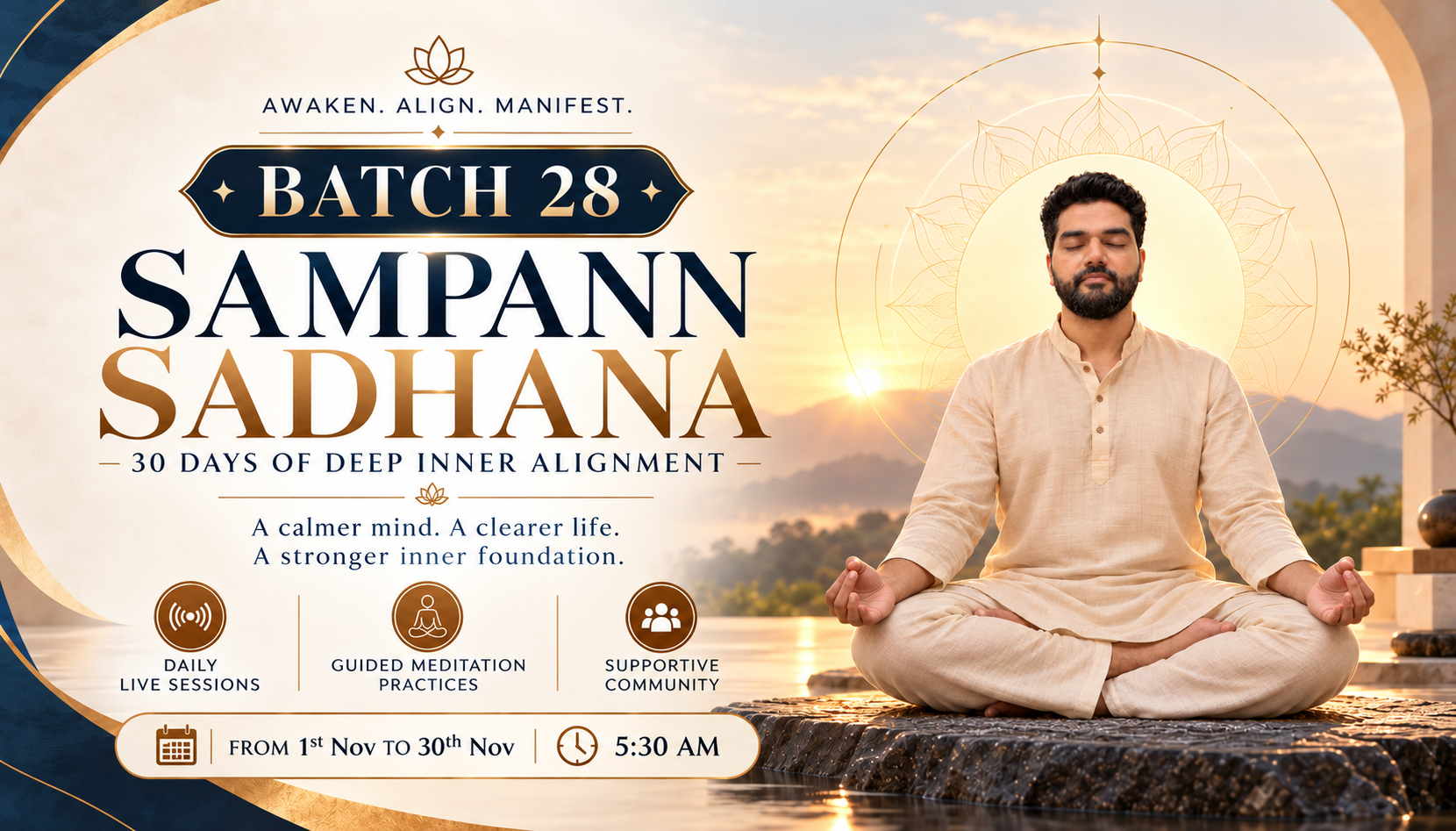
If you find it easier to meditate in a group, our daily live meditation classes in the Sampann Sadhana programme are designed to guide you step by step, with a community practising alongside you.
Step 4: Use Future Self Visualisation to Make It Feel Real
Meditation prepares the mind. Visualisation gives it a vivid experience to remember. Future self visualization is the art of mentally living a scene from your desired life so clearly that your brain and body respond as though it is happening.
Athletes, performers and speakers have used mental rehearsal for years to prepare for important moments. The same principle applies to identity: the more often you rehearse being your future self, the more familiar and natural that identity becomes.
Visualisation is not daydreaming
A daydream is passive and floaty. A powerful visualisation is specific, sensory and emotional. Use these four principles:
- Be inside the scene. See through your own eyes, not as if watching yourself on a screen. Notice your hands, your breath, your posture.
- Use all five senses. What do you see, hear, smell, touch and taste in this moment?
- Add the feeling. Emotion is the glue. Feel gratitude, pride, relief or joy as strongly as you can.
- Choose the end, not the means. Do not worry about how it happens. Visualise being the person for whom it has already happened.
The “day in the life” technique
Walk through one full day of your future self, from waking to sleeping. Spend a few moments on each part:
- Morning: Where do you wake up? What is the first thought that crosses your mind? How do you begin your day?
- Work: What do you do? How do you speak in meetings? How do others respond to you?
- Midday: How do you take care of yourself? What do you eat? Whom do you meet?
- Evening: How do you spend time with loved ones? What do you feel as you look back on the day?
- Night: What do you think about as you fall asleep? Which feeling do you carry into dreams?
The “wish fulfilled” scene
If you are short on time, choose a single 60-second scene that proves your desire has become real. It could be a phone call sharing good news, a moment of walking into your new office, or a quiet moment of gratitude in your own home. Replay the same short scene every day until it feels natural, and end it with a sense of “Of course, this is how my life is.”
Best times to visualise
The calm minutes after waking and just before sleeping are particularly good, because the mind is naturally relaxed and open. You can also pair visualisation directly with the meditation in Step 3. Many students visualise right after step 7 of the meditation, while still feeling the energy of their future self.
Step 5: Speak Your Identity With Future Self Affirmations
Your words are instructions to your subconscious. Future self affirmations are short, positive statements, spoken or written, that describe your desired self as already real. Used well, affirmation is one of the simplest and most portable manifestation techniques there is.
Why many affirmations fail
Plenty of people say, “I have already tried affirmations, and nothing happened.” There are usually four reasons:
- They do not believe the statement, and their inner voice argues loudly.
- They repeat words mechanically without any feeling.
- They affirm but do not act, so their behaviour contradicts the words.
- They give up too early, before repetition has had time to work.
How to make affirmations work
Use the Say it, Feel it, Prove it method:
- Say it. Speak your affirmation aloud, slowly, ideally in front of a mirror, looking into your own eyes.
- Feel it. Pause after each statement and let the emotion rise in your body. If there is no feeling, slow down and imagine the scene again.
- Prove it. Take one small action during the day that matches the statement. This gives your mind real evidence.
21 future self affirmations to begin with
Choose three to five that resonate and repeat them daily. Edit the words so they sound like you.
Identity and confidence
- I am becoming the person I have always wanted to be, and I begin today.
- I trust myself to make good decisions.
- I am worthy of the life I am creating.
- I release my old story and choose a new identity.
Mind and clarity
- My mind is calm, clear and focused.
- I respond to challenges with wisdom, not fear.
- I give my attention to what truly matters.
Money and career
- I am a magnet for opportunities that match my talents.
- I create value, and value flows back to me.
- I handle money with confidence and gratitude.
- I am ready for the next level of my career.
Relationships
- I attract and nurture loving, supportive relationships.
- I speak honestly and listen with an open heart.
- I am surrounded by people who believe in me.
Health and energy
- I treat my body with love and respect.
- I wake up each day with energy and enthusiasm.
- I choose habits that support my highest self.
Spirituality and peace
- I am deeply connected to my inner wisdom.
- I am grateful for everything that is on its way to me.
- I am at peace with where I am and excited about where I am going.
- My future self is already guiding me, and I am following with trust.
Practical ways to use them
- Morning mirror time: two minutes, spoken aloud.
- Voice notes: record your affirmations in your own voice and listen on your commute or before sleep.
- Written affirmations: write your top three ten times each in the evening.
- Phone wallpaper and sticky notes: let your environment remind you throughout the day.
Step 6: Act, Decide and Dress Like Your Future Self
This is the step where manifestation becomes real life. Thoughts, meditation and visualisation prepare the ground, but identity is ultimately confirmed by what you do. Every action is a vote for the person you are becoming.
Writer James Clear popularised this idea in the book Atomic Habits: lasting change comes from identity-based habits, not just goals. Readers of our Readers Books Club book summaries will recognise the principle immediately. You do not rise to the level of your goals; you become the person who naturally does the things that lead there.
Ask the “future self question”
Several times a day, especially at decision points, pause and ask:
“What would my future self do right now?”
Your future self would perhaps go for the morning walk rather than hit snooze. They would pause before reacting angrily. They would send the proposal rather than wait for perfection. They would choose to read twenty pages rather than scroll for an hour.
Think small, think daily
You do not need dramatic changes. Choose one tiny action in each area of life that your future self would do and do it consistently:
- Mind: five minutes of silence or journaling every morning.
- Body: a ten-minute walk or stretching routine after waking.
- Relationships: one sincere message of appreciation to someone each day.
- Work and wealth: thirty minutes of skill-building or one step toward your goal.
- Spirit: gratitude practice and a few minutes of meditation.
Dress, speak and carry yourself accordingly
Your external world sends signals back to your inner world. Small details matter:
- Dress in a way that matches the person you are becoming, even when working from home.
- Speak with the tone, pace and language of your future self. Replace “I’ll try” with “I will”.
- Stand and sit with the posture of someone confident and at ease.
- Tidy your space, because a clear environment supports a clear mind.
Keep a “proof journal”
Every night, write down three small things you did that your future self would be proud of. Over weeks, this journal becomes undeniable evidence that you are changing. When doubt appears, open it and read. Evidence is the fastest way to turn “I am becoming” into “I am”.
Step 7: Release the Old Identity and Protect the New One
Here is a truth few people talk about: changing your identity can feel uncomfortable. Even positive change can trigger fear, because the old self was familiar and, in its own way, safe. You may notice resistance, self-doubt or an urge to return to old habits. This is normal. It is not a sign that the method is failing. It is a sign that something is shifting.
Notice and rewrite the old stories
Spend a few minutes writing down the beliefs your old identity held, such as “I am not good enough”, “Money is hard to earn”, or “People like me do not succeed”. Then, next to each one, write a new belief that your future self holds. When the old thought returns, say calmly, “That was my old story. My new story is…” and repeat the new one.
Forgive and let go
Many identities are built on old hurts, comparisons and disappointments. Releasing them is not about pretending the past did not happen. It is about refusing to let it define who you are becoming. Gentle forgiveness, of others and of yourself, frees a great deal of energy.
Guard your environment
Your new identity needs protection while it is young. Be mindful of three things:
- Inputs: The videos, news, social media and conversations you consume shape your thoughts. Choose content that feeds your future self, such as books, podcasts and teachings on law of attraction, spirituality and personal growth.
- People: Spend more time with those who encourage your growth. Share your dreams selectively, especially in the early days.
- Routines: Build small rituals, morning meditation, evening gratitude, weekly review, that keep you anchored.
Practise patient detachment
Do not check every hour whether your manifestation has arrived. Constant checking sends a message of doubt. Instead, focus on being your future self today, and trust that the results will appear in the right time and the right way. Detachment does not mean you stop caring. It means you stop clinging.
Return, do not restart
You will have off days. You may skip your meditation, snap at someone, or fall into an old pattern. Do not decide that you have “failed”. Simply return to your practice at the very next opportunity. A shift in identity is not a straight line; it is a pattern of returning, again and again, to the person you have chosen to become.
Your 15-Minute Daily Future Self Routine
Here is a simple routine that combines every step above. You can complete it in under fifteen minutes, and you can expand it as you grow.
Morning (about 13 minutes)
- Breathe and give thanks (2 minutes). Take slow breaths and name three things you are grateful for.
- Future self meditation (5 minutes). Meet your future self, ask your one question and step into their energy.
- Visualisation (4 minutes). Replay one scene or “day in the life” moment with full emotion.
- Affirmations (2 minutes). Say your top three to five affirmations aloud, with feeling.
During the day
- Ask, “What would my future self do?” at every important decision.
- Take one aligned action in each area of life.
- Use your thumb-and-finger anchor whenever you want to return to your future self’s state.
Evening (about 3 minutes)
- Write three entries in your proof journal.
- Thank your future self and close the day with a calm breath.
Commit to this routine for at least thirty days. Treat it like a training programme for your mind: the benefits accumulate with consistent practice.
7 Mistakes That Block an Identity Shift
Even sincere practitioners fall into a few common traps. Watch out for these:
- Waiting to feel ready. You will never feel completely ready. Begin as you are, and let confidence grow through practice.
- Affirming one thing and believing another. If your inner dialogue says “this is impossible” all day, a two-minute affirmation will not win. Address the doubts using bridge statements and the proof journal.
- Obsessing over the outcome. Constantly asking “When will it happen?” keeps you in lack. Focus on who you are being today.
- Copying someone else’s future self. Your desired self must reflect your values and your dreams, not what social media says success should look like.
- Skipping action. Manifestation without inspired action is just wishful thinking. Take the next small, practical step.
- Quitting in the dip. Progress often feels slow just before a breakthrough. Stay with the practice.
- Staying in an unsupportive environment. If every voice around you reinforces your old identity, change becomes harder. Make space for people and inputs that support your growth.
Table of Contents