Introduction: Your Dream Life Has an Identity Before It Has an Address
Most people approach manifestation by asking one question: “How do I get what I want?” They think about the job, the relationship, the money, the home, the confidence, the health routine, the audience, the business, or the sense of peace they hope to create. Then they search for a technique that will make the result arrive faster.
Future self-actualisation begins with a different question: Who would I need to become to create, receive, and sustain that life?
That shift sounds small, but it changes the entire practice. Instead of treating manifestation as a repeated attempt to pull a distant future toward you, you begin building a bridge between the person you are today and the person who can live that future naturally. Your future self stops being a fantasy character. It becomes a direction for your identity, attention, habits, decisions, relationships, and daily actions.
This is why future self meditation, future self manifestation, and future self visualisation are useful themes for anyone interested in meditation, affirmation, visualisation, spirituality, the Law of Attraction, coaching, or personal growth. A calm meditation can help you step out of today’s noise. Visualisation can make a future identity more vivid. Affirmation can help you choose the language you want to reinforce. Reflection can reveal what is currently inconsistent. Action turns the inner picture into evidence.
Psychology gives this idea a useful parallel called future self-continuity: the degree to which you feel connected to the person you will be in the future. Research links stronger future-self continuity with more future-orientated choices, and a 2026 randomised research programme tested a writing exercise designed to strengthen that connection. [1][2][3] This does not prove that visualisation can command external events; it suggests something more practical: when the future feels psychologically closer, it may be easier to make choices on its behalf.
This guide takes that grounded approach. You will learn how to use future self meditation, visualisation for manifestation, affirmation, identity shift manifestation, subconscious-pattern awareness, and aligned action without turning your dream life into an anxious obsession. You will also learn what to do when manifestation feels delayed, when affirmations feel fake, when old habits keep returning, and when you are asking, “Why is my manifestation not working?”
The goal is not to escape your present self. The goal is to build a relationship between your present self and your future self that is strong enough to change how you live today.
What Is Future Self Manifestation?
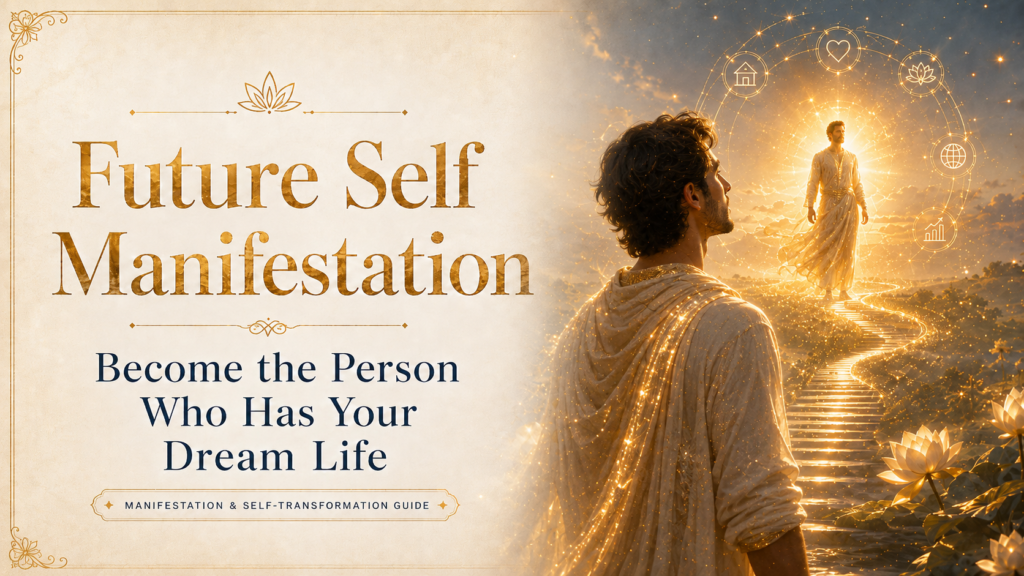
Future Self Manifestation is a self-development and spiritual practice in which you imagine a future version of yourself who is already living with the qualities, habits, relationships, skills, environment, or achievements you desire. You then use that future identity as a reference point for present-day choices.
In a simple practice, you might close your eyes and imagine yourself one year from now. Instead of focusing only on a trophy moment, you see an ordinary day. What time do you wake up? How do you speak to yourself? How do you treat your body? What work do you do? How do you handle stress? What boundaries have become normal? What do you no longer tolerate? What habits look boring now because you have repeated them so often? What responsibilities came with the success you wanted?
This is different from outcome-only fantasy. Outcome-only fantasy shows you receiving the award, seeing the bank balance, getting the message, stepping into the new house, or hearing applause. Future self-manifestation goes deeper. It asks what kind of person exists before, during, and after the result.
For example, if you want to manifest a successful coaching business, the future self is not only the person receiving payments. That person may also be someone who studies deeply, communicates clearly, publishes consistently, follows up with clients, manages money responsibly, keeps promises, protects their energy, and can tolerate being visible.
If you want a peaceful relationship, your future self is not merely someone who has found “the right person”. That self may communicate needs honestly, notice red flags sooner, stop chasing emotional unavailability, repair conflict with maturity, and maintain a life outside the relationship.
If you want to manifest anything meaningful, the result and the identity that sustains it are connected.
This is why future self work fits naturally with the broader manifestation approach found across Dr Amiett Kumar’s content: meditation for inner stillness, affirmation for intentional self-talk, visualisation for mental rehearsal, spirituality for meaning, and practical action for real-world movement. AmiettKumar.com already emphasises that manifestation should not become a replacement for action; future-self work makes that principle especially clear.
Why Future Self Meditation Can Be More Powerful Than Constant Goal – Chasing
Goal-chasing can create a strange psychological problem. The more you repeat “I need to get there,” the more attention you may place on the fact that you are not there yet. Your dream becomes a permanent distance. You compare today with the ideal future, feel behind, then add more techniques because you think the gap means you are failing.
Future self meditation changes the emphasis from chasing to relating.
For a few quiet minutes, you stop asking the future to prove itself and begin listening to it as a perspective. You imagine the person you are becoming and ask what that person would notice about your current life. This can make meditation practical rather than passive.
A future self meditation might reveal that your biggest obstacle is not “low vibration” but an uncomfortable conversation you keep postponing. It may show you that your goal is too vague. It may reveal that your future business needs a skill you have avoided learning. It may show that you are trying to manifest confidence while building a life around avoiding situations that require courage.
Meditation can support this work because it creates a pause between stimulus and response. The National Center for Complementary and Integrative Health notes that meditation and mindfulness practices have been studied across areas such as stress, anxiety, sleep, and attention, though evidence varies by outcome and practice. It is more responsible to treat meditation as a supportive practice than as a guaranteed cure or supernatural shortcut. [6]
The purpose of future self meditation is not to become unconscious of present reality. It is to become calm enough to see present reality more clearly.
The Psychology Behind Future Self-Continuity
The phrase future self-continuity describes how connected you feel to your future self. Some people experience their future self almost like a stranger. They know intellectually that tomorrow’s consequences belong to them, but emotionally those consequences feel distant. Other people experience a stronger sense of continuity: “That future person is still me, so what I do today matters to them.”
Research has linked stronger future-self continuity with long-term decision-making. Early work found that people who felt more connected with their future selves tended to discount future rewards less and showed stronger saving behaviour. Later experimental work found that writing to a distant future self could influence subsequent exercise behaviour. A 2022 review describes self-continuity as a broad construct connected with motivation, intentions, decisions, behaviour, and psychological health.
The most recent evidence is especially relevant to a future self manifestation practice. A 2026 randomised controlled research programme tested a “day preconstruction method”, in which people deliberately constructed a future day. Across four preregistered experiments involving more than 1,600 participants, the method was designed to strengthen future-self continuity and examine effects on real choices and valued living.
The lesson for manifestation is not “science proves the Law of Attraction”. That would overstate the evidence. The lesson is more useful: making your future self vivid and psychologically close can be a meaningful self-regulation tool.
If the future version of you feels real, you may find it easier to ask questions such as:
- Would my future self thank me for this choice?
- Am I protecting tomorrow’s energy or borrowing from it?
- Does this purchase support my future or only soothe my present mood?
- Does this relationship pattern belong in the life I keep visualising?
- What small action would make the future less abstract today?
These questions turn future self-actualisation from a mood into a decision system.
Future Self Manifestation Is Not About Rejecting Who You Are Today
One of the biggest manifestation mistakes is using the future self as a weapon against the present self.
You imagine a confident, wealthy, disciplined, peaceful version of yourself and then look at today’s version with disappointment. You call your current self lazy, weak, blocked, negative, or “not aligned”. The practice becomes self-rejection dressed as personal growth.
That approach usually creates more resistance, not less.
Your present self is the only person who can build the future. If you constantly shame that person, you damage the relationship required for change. Future self-work should create direction and compassion at the same time.
A healthier statement is “I am learning to become someone who handles this differently.” This leaves room for growth without pretending the growth is complete.
Instead of saying, “My future self never procrastinates,” ask, “How does my future self respond when procrastination appears?” Maybe that future self still feels resistance but has a five-minute starting rule. Maybe they still get anxious before important conversations but no longer wait for anxiety to disappear before speaking.
The future self is not perfect. The future self is practised.
That distinction is essential if you want identity shift manifestation to remain sustainable.
Identity Shift Manifestation: Become Before You Receive
The phrase identity shift manifestation is popular because it describes an intuitive truth: many goals require you to change more than circumstances. They require changes in how you see yourself and how you behave repeatedly.
Identity is the collection of stories, roles, values, memories, expectations, and patterns through which you answer the question, “Who am I?” If you repeatedly describe yourself as “someone who always quits,” that identity influences what you notice and what you expect. If you begin gathering evidence that you are “someone who keeps small promises”, a different identity becomes available.
The key word is evidence.
You do not create a stable identity only by repeating a sentence. You strengthen identity when your behaviour gives the sentence credibility.
Suppose your future-self affirmation is: “I am a calm and confident speaker.” If you avoid every opportunity to speak, the affirmation has little behavioural support. A better pathway may be:
1. “I am learning to speak clearly even when I feel nervous.”
2. Volunteer to ask one question in a meeting.
3. Record one two-minute video.
4. Speak to a small group.
5. Review what improved.
6. Repeat.
Each action becomes evidence for the identity.
This is where affirmation research is worth understanding carefully. In psychology, self-affirmation usually means reflecting on personally important values, not simply repeating positive slogans. Meta-analytic research has found small but meaningful effects of self-affirmation interventions on behaviour and well-being in certain contexts. [8][9] That is not the same as proving that “I am a millionaire” repeated 100 times will create money. It does support the broader idea that how we connect goals with values and self-concept can influence behaviour.
For future self-actualisation, use affirmations as identity cues, then give them evidence.
The Role of the Subconscious Mind
Manifestation content often talks about “reprogramming the subconscious mind.” The phrase can sound mysterious, but part of what people mean is familiar: repeated experiences become habits, expectations become automatic, and learned emotional associations can influence behaviour before you consciously analyse them.
Your subconscious mind is not a magic vault where any sentence becomes reality if repeated often enough. But much of human behaviour does become automatic through learning. You may reach for your phone when uncomfortable, apologise when you have done nothing wrong, avoid opportunities where you could be judged, or spend money immediately after feeling stressed. These patterns can operate with very little conscious deliberation.
Future self-work becomes useful when it helps you identify those automatic loops.
Ask your future self:
- Which automatic habit did I have to interrupt?
- What trigger used to control me?
- What emotion did I learn to tolerate instead of escaping?
- What belief stopped being useful?
- What new routine eventually became normal?
Then work on one loop at a time.
For example: “When I feel overwhelmed, I scroll” can become “When I feel overwhelmed, I stand up, take five breaths, write the smallest next action, and work for five minutes.” That is less glamorous than a manifestation ritual, but it is exactly how a future identity becomes visible in daily life.
Future Self Visualisation: See an Ordinary Day, Not Only the Grand Finale
Many people practise visualisation by watching the emotional highlight reel of their desired life. There is nothing wrong with imagining the result. The problem appears when the entire practice becomes outcome-only.
If you visualise only the applause, you may never rehearse the preparation. If you visualise only the money, you may never see the budgeting, selling, studying, negotiating, creating, or serving that helped generate it. If you visualise only the relationship, you may ignore the boundaries and communication that make the relationship healthy.
Research on mental contrasting and goal pursuit provides a useful caution. Positive fantasies alone can sometimes reduce effort, while combining a desired future with the obstacles in current reality can support goal commitment and action. A meta-analysis of mental contrasting with implementation intentions found a small-to-moderate positive effect on goal attainment. [10]
So build two scenes.
Scene One: The Future Outcome. See a vivid but realistic moment that represents the life you want. Maybe you are opening your office, receiving your degree, walking into your home, reviewing your business dashboard, speaking calmly with your partner, or waking with enough time to meditate before the day begins.
Scene Two: The Future Process. Now see yourself doing something ordinary that made the result possible: studying, exercising, making a difficult call, publishing, following up, practising, saving, going to therapy or coaching, turning down a distraction, or going to bed on time.
The first scene gives emotion. The second gives direction.
That combination is stronger than fantasy alone.
How to Do Future Self Manifestation: A 10-Step Method
Step 1: Choose One Life Area
Do not begin by trying to redesign your entire life in one session. Choose one area: career, money, health habits, relationship patterns, confidence, creativity, spiritual practice, or emotional peace.
A focused intention creates a clearer future self.
Instead of “I want my dream life,” try: “Over the next year, I want to become the kind of person who can build a stable creative business,” or “I want to become someone who handles relationships with self-respect and calm communication.”
Step 2: Define the Outcome Without Making It Your Identity
Write what you want, but do not make your worth depend on it.
“I want to grow my business to X revenue” is a goal. “If I do not reach X revenue, I am a failure” is an identity threat.
Future self manifestation works better when the goal gives direction but does not become proof that you deserve love, respect, or belonging.
Step 3: Enter Future Self Meditation
Sit comfortably for five to ten minutes. Let your breathing become natural. Notice where your body is supported. Relax your jaw, shoulders, hands, and belly.
Do not force your mind to become blank. If thoughts appear, notice them and return to the breath.
Then say silently: “I am meeting the version of me who has practised this path.”
That wording matters. You are not meeting a magical version who received everything effortlessly. You are meeting a version shaped by repetition.
Step 4: Move One Year Into the Future
Imagine waking up one year from now. Keep the date symbolic if exact dates make you anxious.
Look around the room. What is different? What has stayed the same? What time is it? What does your morning look like? How do you use your phone? What do you do before work? What feels normal now that once felt difficult?
Do not chase cinematic perfection. Some people see images. Others sense ideas, words, or emotions. All are valid ways to practise mental imagery.
Step 5: Interview Your Future Self
Ask five questions:
1. What did you stop doing?
2. What did you start doing consistently?
3. What did you learn to tolerate?
4. What did you stop believing about yourself?
5. What is the next step you want me to take this week?
Write the answers immediately after meditation. Treat them as reflective prompts, not prophecy.
Step 6: Create One Future Self Affirmation
Choose an affirmation that feels directional and believable enough to practise.
Examples:
- “I am becoming someone who keeps promises to myself.”
- “I can be visible without abandoning myself.”
- “I make financial decisions that protect my future.”
- “I communicate clearly and choose relationships that respect me.”
- “I create before I consume.”
- “I can feel uncertainty and still take the next step.”
If an affirmation creates immediate internal rejection, use a bridge statement: “I am learning…”, “I am practising…”, or “I am becoming…”.
Step 7: Identify the Present Obstacle
This is the step many manifestation practices skip.
Ask: “What in my current reality most clearly conflicts with this future?”
Maybe it is a habit. Maybe it is a skill gap. Maybe it is debt. Maybe it is fear of rejection. Maybe you have no calendar time for the goal. Maybe you keep choosing emotionally unavailable people. Maybe you are waiting for motivation.
Name the obstacle without turning it into shame.
Step 8: Create an If-Then Plan
Turn the future identity into a practical behavioural rule.
- If I feel the urge to skip my workout, then I will do ten minutes before deciding.
- If I start doomscrolling during a work block, then I will put the phone in another room.
- If I receive criticism, then I will wait ten minutes before replying.
- If I want to impulse-buy, then I will wait twenty-four hours.
- If I feel afraid to publish, then I will post the smallest useful version.
Implementation-intention research supports the value of linking a specific cue with a specific action. Mental imagery can also be used to rehearse these if-then plans. [11]
Step 9: Take One Aligned Action Within 24 Hours
Do not finish future self meditation with a beautiful feeling and no movement.
Send the email. Update the résumé. Transfer the savings. Book the appointment. Draft the page. Record the video. Have the conversation. Buy the book. Practise the skill. Walk for twenty minutes. Remove the distracting app.
The action does not need to be dramatic. It needs to be real.
Step 10: Release the Timeline, Keep the Practice
Detachment does not mean you stop caring. It means you stop using constant checking as evidence of faith.
Review your goals at sensible intervals, not every hour. Continue the identity practice. Adjust the plan when reality gives you new information.
You can be committed to the direction without demanding that life follow your exact script.
A 15-Minute Future Self Meditation
Use this practice in the morning, before sleep, or before an important decision.
Minutes 0–3: Settle. Sit comfortably. Feel the floor or chair supporting you. Take slow breaths. Let the day become slightly quieter.
Minutes 3–5: Name the intention. Choose one area of life. Say: “I am here to understand who I am becoming.”
Minutes 5–9: Enter the future day. Imagine an ordinary day one year from now. Notice your environment, routines, posture, conversations, work, and energy. Include one meaningful outcome, but spend more time on the way you live.
Minutes 9–11: Ask the future self. What did you practise? What did you release? What did you stop postponing? What should I do next?
Minutes 11–13: Rehearse the next action. Visualise yourself taking one concrete step in the next twenty-four hours. See the beginning, not just the finish.
Minutes 13–15: Return. Repeat one affirmation. Take a breath. Open your eyes. Write down the next action and when you will do it.
If meditation makes you feel unusually distressed, disconnected, or overwhelmed, stop and use a simpler grounding practice. Meditation is a tool, not a test of spiritual worth.
Future Self Affirmations That Do Not Require You to Lie to Yourself
Many people ask why affirmations are not working. One reason is that the statement is so far from their current experience that repeating it becomes an argument.
A person with deep financial fear may repeat, “I am infinitely wealthy,” while every repetition activates the thought, “No, I am not.” Instead of building an identity, the affirmation rehearses contradiction.
Try bridge affirmations:
- “I am learning to handle money with clarity and confidence.”
- “I am becoming more comfortable receiving opportunities.”
- “I am building the skills that make my future career possible.”
- “I can create a healthy relationship without chasing or controlling.”
- “I am allowed to grow at a sustainable pace.”
- “I notice opportunities and take thoughtful action.”
- “I can be disciplined without being cruel to myself.”
- “I protect the attention my future requires.”
- “I am becoming the person who can sustain what I desire.”
- “I trust myself to take the next useful step.”
The purpose is not to hypnotise yourself into denying reality. The purpose is to choose language that supports a direction you can practise.
How to Manifest Your Dream Life Without Turning It Into a Full-Time Ritual
A dream life is usually built from repeated ordinary days. That means your manifestation routine should leave enough time and energy for living.
A sustainable daily structure can be simple:
Morning – 10 minutes: future self meditation and one affirmation.
During the day – one aligned action: something measurable that moves the goal.
Evening – 5 minutes: ask, “What did I do today that my future self would recognise?” Then note one adjustment for tomorrow.
That is enough.
You do not need to stack the 369 method, Whisper Method, scripting, water manifestation, vision boards, tarot, repeated checking, multiple guided meditations, and fifty affirmations into one day. If techniques create clarity, use them. If techniques become a way to avoid action or manage anxiety, simplify.
The best manifestation practice is not the one that keeps you thinking about manifestation all day. It is the one that helps you live differently.
Applying Future Self Manifestation to Career, Money, Love, and Confidence
Future self work becomes useful when it changes the questions you ask in real situations.
Career and business: Do not visualise only the promotion, clients, audience, or revenue. Meet the professional who prepares, learns, follows up, publishes, communicates clearly, and handles rejection without disappearing. Then create one piece of evidence today: Improve the portfolio, make the call, record the episode, apply for the role, or practise the skill.
Money: Instead of focusing only on a bank-balance number, imagine the person who can manage that money responsibly. Do they track expenses, save automatically, ask for fair compensation, learn financial basics, and pause before impulse purchases? Connect abundance language with financial literacy and behaviour.
Love and relationships: Visualise the quality of the relationship rather than trying to control a specific person’s choices. How do you communicate? What boundaries are normal? What inconsistency do you no longer chase? A grounded affirmation is “I choose relationships where care, respect, consistency, and freedom can exist together.”
Confidence: Ask what your future self learned to do while still nervous. Confidence is often built after action, not before it. Rehearse the next courageous behaviour – speaking, publishing, applying, asking, or setting a boundary – rather than imagining a future in which fear never appears.
Across all four areas, the principle is the same: visualise the identity, name the behaviour, then create evidence.
Law of Attraction and Future Self Manifestation: A Grounded Connection
Within the Law of Attraction, people often describe manifestation as aligning thoughts, feelings, beliefs, and energy with a desired reality. Future self manifestation fits that philosophy because it gives alignment a concrete question: Does the way I live today match the future I keep asking for?
You may say you want peace while structuring every day around urgency. You may say you want abundance while refusing to look at your finances. You may say you want visibility while hiding every piece of your work. You may say you want love while repeatedly abandoning your own boundaries.
The useful role of the Law of Attraction here is reflective: your repeated focus influences what you notice, how you interpret opportunities, and what actions feel congruent with your identity. The spiritual interpretation – that energy or consciousness also influences external events – is a matter of belief rather than something established by scientific evidence.
Keeping those categories clear strengthens the practice. You do not need to attack spirituality to respect evidence, and you do not need to misuse science to make spirituality meaningful.
For people who search top manifestation coach, top manifestation coach – Amiett Kumar, or India’s best manifestation coach – Amiett Kumar, the more important question is what kind of practice helps you become clearer, calmer, more responsible, and more capable of taking aligned action. A title may attract attention; a useful framework should improve behaviour.
Why Manifestation Is Not Working: 10 Future Self Mistakes
1. You Visualise the Reward but Not the Responsibility
You want the promotion but do not imagine leadership pressure. You want the business but not customer service. You want the relationship but not communication. Add the responsibility to the future scene.
2. Your Future Self Is Too Perfect
If your imagined self never gets tired, never doubts, never has conflict, and never makes mistakes, you are visualising a character, not a human being. Build resilience into the identity.
3. You Use Affirmations That Trigger Constant Rejection
If the statement feels absurd, move one step closer to belief. “I am becoming…” can be more useful than forcing a claim your mind rejects.
4. You Keep Changing the Goal
A new technique every week can create excitement without depth. Give a meaningful direction and enough time to generate evidence.
5. You Confuse Manifestation Taking Too Long With Failure
Complex goals involve skills, other people, market conditions, health, timing, money, and uncertainty. A slow result is not automatically a blocked manifestation.
6. You Ignore the Present Obstacle
Future self-work must include current reality. Name the habit, fear, skill gap, resource constraint, or relationship pattern that needs attention.
7. You Use Meditation to Avoid Decisions
Meditation should make reality clearer. If you meditate repeatedly instead of making the call, setting the boundary, or starting the work, the practice has become avoidance.
8. You Ask for Signs More Than You Create Evidence
Repeatedly checking numbers, messages, horoscopes, or social media can turn manifestation into anxious monitoring. Create behavioural evidence instead.
9. You Try to Control Other People
No manifestation method gives you ethical ownership of another person’s choices. Focus on the relationship quality you want and the choices available to you.
10. You Do Not Review and Adjust
A future self is a hypothesis about where you want to go. Life gives feedback. Review the plan monthly and update it when reality changes.
How to Unblock Manifestation With the Future Self Reset
When you feel stuck, do not automatically add another technique. Use this five-question reset:
1. Is the future clear? Write one concrete outcome and one identity quality.
2. Is the present honest? Name the biggest current contradiction.
3. Is the affirmation believable enough to practise? If not, create a bridge statement.
4. Is there a next action? Define something you can do within twenty-four hours.
5. Am I overchecking? Choose a review date and stop monitoring constantly.
This approach helps answer searches such as why manifestation is not working, why my manifestation is not working, reasons manifestation is delayed, why affirmations are not working, and how to unblock manifestation without reducing every difficulty to a spiritual flaw.
Sometimes the unblock is rest. Sometimes it is skill-building. Sometimes it is a boundary. Sometimes it is changing the goal. Sometimes it is accepting that another person has a choice. Sometimes it is doing the uncomfortable thing you already know you need to do.
A 7-Day Future Self Manifestation Challenge
Day 1: Meet the Future Self
Do the 15-minute future self meditation. Write the five answers from your future-self interview.
Day 2: Identify the Identity
Choose three qualities the future self has. Convert each into a behaviour. “Disciplined” might become “works for thirty minutes before checking social media”.
Day 3: Find the Contradiction
Identify one habit that conflicts with the future. Do not choose five. Create one replacement rule.
Day 4: Visualise the Process
Spend five minutes seeing the desired outcome, then five minutes seeing yourself doing the work that supports it.
Day 5: Use One Affirmation
Repeat one future self affirmation slowly during a short meditation. Take one action that gives the statement evidence.
Day 6: Practise Detachment
Do not check for signs. Spend the day living normally. Put your attention into work, relationships, movement, creativity, reading, service, or rest.
Day 7: Review Like a Coach
Ask: What changed in my attention? What action did I actually take? What was difficult? What needs to continue for thirty days?
Keep two practices, not ten.
Meditation, Spirituality, and the Future Self
Spirituality can add depth to future self-work because it asks what your goals are for.
If your future self has more money, what does that money allow you to contribute? If your future self has more influence, how do you use it responsibly? If your future self is calmer, who benefits from your calm? If you achieve the dream but become less kind, less present, and less connected, was that the future you actually wanted?
Meditation helps you ask these questions without the noise of performance.
You may discover that some desires are borrowed. They came from comparison, family pressure, social media, fear, or status. Other desires feel quieter but more deeply yours.
Future self-manifestation becomes mature when it includes both ambition and discernment.
Spirituality does not have to mean believing that every event was “manifested” by your thoughts. It can mean living with intention, humility, gratitude, service, and awareness of what is larger than immediate ego gratification.
How Coaching and a Life Coach Can Support Future Self-Work
Future self exercises can create insight, but insight does not always become behaviour.
This is where coaching can be useful. A responsible life coach, performance coach, manifestation coach, or mentor can help you translate a vision into priorities, routines, milestones, and accountability. They can also ask the uncomfortable questions your future-self meditation may reveal but you keep avoiding.
Good coaching should increase your agency, not make you dependent on the coach for every decision. It should help you identify what you can control, distinguish belief from evidence, and build systems that continue working when motivation is low.
For the Dr Amiett Kumar audience, the most useful integration is simple: meditation for clarity, affirmation for identity language, visualisation for direction, spirituality for meaning, coaching for structure, and action for evidence.
That is a practical way to manifest anything without making manifestation an escape from reality.
Readers Books Club: What Books Can Teach Your Future Self
Readers Books Club fits naturally into future-self work because your future identity will often require ideas you do not yet have.
Books can function as conversations with possible selves. A finance book can introduce the future version of you who understands money. A communication book can show the future you who handles conflict better. A psychology book can help you recognise an automatic pattern. A biography can show how another person tolerated years of uncertainty before a visible result appeared.
Do not only ask, “What book should I read?” Ask, “What does my future self need to learn next?”
Then select books around that gap.
Reading becomes a manifestation tool in the most grounded sense: you deliberately expose your mind to better models, language, strategies, and questions, then apply what matters.
Frequently Asked Questions
What is future self manifestation?
It is the practice of imagining a future version of yourself and using that identity to guide present-day habits, decisions, and actions.
What is future self meditation?
It is a meditation in which you imagine a future version of yourself to clarify values, identity, habits, and next steps rather than predict the future.
Does future self visualization really work?
Visualisation can be useful for mental rehearsal, clarity, and planning, and future-self continuity research suggests that feeling connected to your future self is associated with more future-oriented behaviour. This does not prove that visualisation alone can guarantee external outcomes.
How often and how long should I do future self meditation?
Two to four sessions per week of about 10 to 15 minutes is enough for many people. If the practice becomes obsessive, reduce the frequency and focus on action.
What should I visualise when trying to manifest my dream life?
Visualise both an outcome and an ordinary process. See the future life, but also see the habits, conversations, work, boundaries, learning, and responsibilities that helped create it.
What is identity shift manifestation?
Identity shift manifestation focuses on becoming the kind of person who can create and sustain a desired life. It connects manifestation with self-concept, habits, values, and repeated behaviour.
Why are my affirmations not working?
Your affirmation may be too unbelievable, too vague, disconnected from behaviour, or used mechanically. Try a bridge affirmation such as “I am learning…” or “I am becoming…” and take an action that gives the statement evidence.
Why is my manifestation taking too long?
Manifestation taking too long does not automatically mean you are blocked. Goals can depend on skill, money, health, other people, market conditions, timing, and uncertainty. Review what you can influence and adjust the plan.
How do I make the Law of Attraction work?
A grounded approach is to use the Law of Attraction as a framework for intentional focus, emotional awareness, gratitude, visualisation, and aligned action. Do not rely on thought alone to replace communication, planning, skill, boundaries, or professional support.
How do I unblock manifestation?
Clarify the goal, identify the present obstacle, choose a believable affirmation, define one next action, and stop excessive checking. Sometimes “unblocking” means addressing a practical problem rather than adding another spiritual technique.
Final Thoughts: Do Not Wait for Your Future Self to Rescue You
The future self is powerful because it changes the direction of attention. It gives you a way to step outside today’s mood and ask what kind of life your repeated choices are building.
But your future self cannot come backward through time and save you.
You are the person who saves that future by what you practise now.
Future self manifestation is most useful when it combines imagination with honesty. Visualise the life, but also visualise the work. Use affirmation, but choose words you can support with evidence. Meditate, but let stillness lead to clearer decisions. Explore spirituality, but do not use it to deny reality. Learn from coaching, a life coach, Amiett Kumar content, Dr Amiett Kumar’s meditation and manifestation frameworks, and Readers Books Club, but keep responsibility for your choices in your own hands.
The future is not only something you attract. It is also something you rehearse, prepare for, protect, and repeatedly vote for with your behaviour.
So close your eyes for a moment and meet the person you want to become.
Then open them.
And do one thing that person would recognise.
Table of Contents