A practical guide to identity shift, visualisation, meditation, self-concept and aligned action
Introduction: What If the Biggest Shift Is the Version of You Making the Decision?
There is a reason “quantum jumping manifestation” has become such a magnetic phrase in manifestation, meditation and self-development spaces. It speaks to a feeling almost everyone has experienced: the sense that your current life is being repeated by the same thoughts, habits, expectations and reactions and that real change may require more than simply wanting a different result.
You can want a new career while still thinking like the version of you who is afraid to apply. You can want a healthier relationship while continuing to tolerate the patterns that created the old one. You can visualise financial abundance while making choices from fear, avoidance or impulsivity. You can repeat affirmations every morning and still spend the rest of the day acting from the identity you are trying to leave behind.
That is the real psychological appeal of quantum jumping: the idea that instead of waiting for the outside world to change first, you deliberately step into the mindset, emotional posture, standards and actions of the person who would naturally create a different life.
In spiritual and Law of Attraction communities, quantum jumping is often described as moving into a parallel timeline or desired reality where your goal already exists. In 2026, fresh manifestation content continues to describe it through visualisation, identity shifting, subconscious reprogramming, emotional embodiment and detachment. At the same time, grounded mindfulness sources make an important distinction: there is no scientific evidence that a person can literally move between alternate universes through meditation. The practical exercise is better understood as guided imagery and future-self rehearsal.
That distinction does not make the practice less useful. It makes it more usable.
This guide explains how to quantum jump in a grounded way: as a structured manifestation practice that combines meditation, visualisation, self-concept, subconscious mind work, the Law of Attraction, the Law of Assumption, emotional regulation and aligned action. It is designed for readers who follow Dr Amiett Kumar for manifestation, meditation, affirmation, visualisation, spirituality and personal growth and who want a method that feels inspiring without asking them to abandon reality.
If you are searching for quantum jumping manifestation, how to quantum jump, quantum manifestation, reality shifting manifestation, desired reality manifestation, identity shift manifestation, future self manifestation, subconscious mind manifestation or meditation for manifestation, this article gives you a complete framework.
What Is Quantum Jumping Manifestation?
Quantum jumping manifestation is a modern self-development practice in which you imagine moving from your current identity into a version of yourself who already embodies the qualities, choices and lifestyle connected with your desired outcome.
The language often includes terms such as “parallel reality,” “timeline,” “quantum field,” “frequency” and “alternate self.” Those words come from spiritual and metaphysical interpretations, not from established evidence that human consciousness can literally switch universes.
In practical terms, the method usually contains five ingredients:
- deep relaxation or meditation;
- vivid mental imagery;
- future-self or identity rehearsal;
- emotional embodiment of the desired state;
- action that matches the new identity.
Think of it as an imaginative bridge between the person you have been and the person you are trying to become.
The Core Question
The most useful question in quantum jumping is not:
“Which universe do I need to enter?”
It is:
“What would the version of me who can hold this reality think, choose, tolerate, practise and stop doing?”
That question changes manifestation from passive wishing into identity-based personal growth.
Suppose you want a successful business. The future version of you may be more comfortable selling, more consistent with follow-up, more willing to publish imperfect work and less emotionally destroyed by rejection.
Suppose you want a peaceful relationship. The future version may communicate needs directly, stop chasing unavailable people, regulate anxiety and maintain boundaries.
Suppose you want better health. The future version may sleep more consistently, move regularly, eat more deliberately and ask for professional support when needed.
The “jump” is therefore not one magical moment. It is the decision to stop practising the identity that produces the old pattern and begin rehearsing the one that supports the new one.
Quantum Jumping vs. Quantum Physics: Keep the Language Clear
This is one of the most important sections of the article.
Quantum mechanics is a branch of physics describing matter and energy at extremely small scales. The word “quantum” has precise scientific meanings in physics. Manifestation content frequently borrows that language as a metaphor for sudden transformation, multiple possibilities or non-linear change.
That metaphor should not be confused with scientific proof that visualisation causes a person to travel to another physical universe.
A responsible way to use quantum jumping is:
- spiritual frame: “I am shifting into a more aligned reality.”
- psychological frame: “I am rehearsing a different identity and response.”
- behavioural frame: “I am changing the actions that make a different outcome more likely.”
You can hold a spiritual belief and still stay intellectually honest about where evidence ends.
The practice becomes stronger when you do not need exaggerated claims to justify it.
Why Identity Matters More Than the Technique
Many manifestation methods focus on what you want. Quantum jumping focuses more deeply on who you are being while you want it.
Two people can repeat the same affirmation and create completely different behaviour.
“I am successful.”
Person A says the sentence but avoids difficult work, postpones decisions and treats every setback as proof that success is not meant for them.
Person B says the sentence, then asks: “What does a successful person do today?” They prepare, communicate, learn, recover and continue.
The difference is identity expressed through behaviour.
This is why self-concept is central to quantum manifestation.
Self-concept is the collection of ideas you hold about yourself: what you believe you are capable of, what you deserve, how you expect others to treat you, how disciplined you think you are, and what kinds of outcomes feel “normal” for someone like you.
A desired reality becomes easier to approach when the actions required for it no longer feel foreign to your identity.
You do not need to say, “I already have everything.”
You can begin with:
“I am becoming someone who can create, receive and sustain this kind of life.”
That statement leaves room for both belief and growth.
Step 1: Define Your Desired Reality With Precision
Quantum jumping becomes vague when the goal is vague.
“I want a better life.”
“I want abundance.”
“I want to be successful.”
“I want love.”
These are directions, not realities you can meaningfully rehearse.
Start by making the desired reality concrete.
Use the Five-Part Reality Map
Write one sentence for each category.
1. Result
What outcome do you want?
Example: “I want to build a profitable consulting business.”
2. Identity
Who do you need to become to participate in that result?
Example: “A clear communicator who can sell expertise without apologising for it.”
3. Standards
What does that version of you no longer tolerate?
Example: endless procrastination, vague pricing, inconsistent follow-up and hiding behind preparation.
4. Daily behaviours
What does the desired version repeatedly do?
Example: prospecting, improving the offer, publishing useful content, following up and reviewing numbers.
5. Emotional skill
What feeling must you learn to handle?
Example: uncertainty, rejection, visibility or delayed results.
This exercise immediately reveals whether you are trying to manifest an outcome without becoming capable of its process.
Desired Reality vs. Fantasy
A useful desired reality contains elements under your influence.
Unhelpful:
“Everyone admires me.”
Better:
“I communicate confidently and stop organising my life around universal approval.”
Unhelpful:
“This specific person must love me.”
Better:
“I create relationships based on mutual respect, availability and honest communication.”
Manifestation becomes healthier when it expands agency rather than attempts to control other people.
Your One-Line Quantum Intention
Complete this sentence:
“I am stepping into the version of myself who…”
Examples:
- “…follows through even when motivation changes.”
- “…handles money with clarity and patience.”
- “…communicates needs without abandoning self-respect.”
- “…creates visible work instead of waiting for perfect confidence.”
- “…protects peace without avoiding necessary conversations.”
Keep this sentence. You will use it throughout the practice.
Step 2: Enter a Calm, Receptive State Through Meditation
Trying to visualise a desired reality while the mind is racing often turns manifestation into another form of mental pressure.
Meditation creates space.
The goal is not to enter a supernatural trance. It is to reduce noise enough that you can pay attention deliberately.
A 7-Minute Preparation Meditation
Minute 1: Arrive
Sit comfortably. Close your eyes if that feels safe. Notice your body touching the chair, floor or bed.
Minutes 2-3: Breathe
Let the breath become slightly slower. Do not force huge breaths. Relax your shoulders and jaw.
Minutes 4-5: Observe
Notice the thoughts already present. Do not try to eliminate them. Label them gently: planning, fear, memory, comparison, doubt.
Minute 6: Release performance
Say silently:
“I do not need to visualise perfectly. I only need to become present.”
Minute 7: Set intention
Repeat your quantum intention once.
“I am stepping into the version of myself who…”
Then begin the visualisation.
Why Meditation Helps
Research on mindfulness and emotion regulation is more modest than social-media claims often suggest, but systematic reviews indicate that mindfulness-based strategies can support aspects of emotional regulation and reduce reactivity in some contexts.
The manifestation takeaway is simple: a less reactive state can make it easier to observe old patterns without automatically obeying them.
That is valuable because identity change requires choice at exactly the moment the old identity wants to take over.
Meditation Is Not Avoidance
If your desired reality requires a difficult conversation, meditation should help you have the conversation more clearly not replace it.
If your desired reality requires job applications, meditation should help you tolerate uncertainty not become a substitute for applying.
If your desired reality requires medical care, meditation should support coping not replace professional treatment.
A useful spiritual practice sends you back into life with more clarity.
Step 3: Meet the Future Version of You
This is the central visualisation in quantum jumping manifestation.
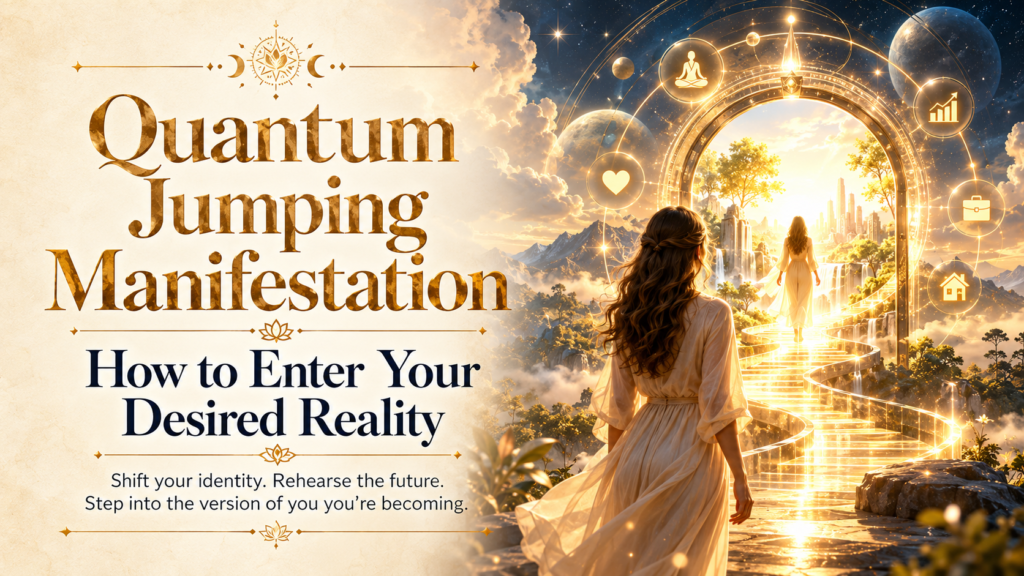
Imagine a symbolic doorway, bridge, staircase, light, room or path. The object itself is not important. It simply gives the mind a transition cue.
On the other side is the version of you living closer to the desired reality.
Do not begin by asking what they own.
Ask how they operate.
The Future-Self Interview
Visualise the future version of you and ask:
- What did you stop believing?
- What did you stop tolerating?
- What did you start doing consistently?
- How do you respond when things go wrong?
- What do you do when nobody is watching?
- How do you use your phone?
- How do you speak to yourself after mistakes?
- Which skill changed everything?
- Which boundary became non-negotiable?
- What did you have to become comfortable feeling?
Write the answers immediately after meditation.
Do not treat the answers as supernatural messages. Treat them as reflective material generated by your own mind.
First-Person Visualisation
Many people watch their future self like a movie.
Try switching to first person.
See through their eyes.
If the goal is public speaking, feel your feet on the stage.
If the goal is financial order, see yourself opening the spreadsheet calmly.
If the goal is a healthier relationship, hear yourself communicating a boundary without shouting or collapsing.
If the goal is writing a book, feel your hands typing on the ordinary day when inspiration is low.
The more the visualisation includes process rather than only reward, the more useful it becomes.
Why Process Imagery Matters
Outcome imagery can motivate. But outcome imagery alone can become fantasy.
Mental contrasting offers a better structure: imagine the desired future, then identify the real obstacle standing between you and it.
A meta-analysis of mental contrasting combined with implementation intentions found a small-to-moderate positive effect on goal attainment across 21 studies and more than 15,000 participants, while also noting possible publication bias and the need for more research.
The practical lesson is strong:
Dream clearly.
Then face the obstacle clearly.
Step 4: Identify the Old Timeline You Keep Recreating
Every desired reality has an old pattern competing with it.
This is where manifestation becomes uncomfortable and useful.
Ask:
“What keeps recreating the current reality?”
It may be a belief:
“I always fail.”
A behaviour:
“I stop after one rejection.”
An environment:
“I cannot focus because my phone is beside me all day.”
A relationship pattern:
“I over-explain every boundary because I am afraid of disapproval.”
A money pattern:
“I avoid numbers until there is a crisis.”
A self-concept:
“I am someone who never finishes.”
Quantum jumping is not powerful because you deny this old pattern. It is powerful because you finally stop romanticising it as fate.
Use the Old-Timeline Audit
Create four columns:
Trigger | Old response | Short-term reward | Long-term cost
Example:
Trigger: I receive criticism.
Old response: I stop sharing my work.
Short-term reward: relief from exposure.
Long-term cost: invisibility and slower growth.
Trigger: I feel lonely.
Old response: I message someone who repeatedly treats me poorly.
Short-term reward: temporary connection.
Long-term cost: self-respect and emotional stability.
Trigger: I feel overwhelmed.
Old response: I scroll for an hour.
Short-term reward: escape.
Long-term cost: unfinished work and more stress.
This reveals why old patterns survive: they usually provide an immediate benefit even when they create a long-term problem.
Do Not Shame the Old Self
The old identity often developed for a reason.
Avoidance may once have protected you from criticism.
People-pleasing may have protected belonging.
Perfectionism may have protected you from feeling inadequate.
Over-control may have reduced uncertainty.
You do not have to hate the previous version of yourself to outgrow it.
The goal is:
“Thank you for protecting me. I need a different strategy now.”
That is a more sustainable identity shift than self-attack.
Step 5: Create the Bridge Belief
One of the biggest mistakes in manifestation is trying to leap emotionally from complete disbelief to total certainty.
Old belief:
“I am not good enough.”
New affirmation:
“I am the most successful person in the world.”
The mind often rejects the jump.
A bridge belief creates movement without requiring denial.
Examples of Bridge Beliefs
Old:
“I never follow through.”
Bridge:
“I am learning to restart quickly instead of giving up completely.”
Old:
“Money never stays with me.”
Bridge:
“I am learning to handle money before I spend it.”
Old:
“I am bad at relationships.”
Bridge:
“I can learn healthier communication and choose differently.”
Old:
“I am not confident.”
Bridge:
“I can act before confidence feels complete.”
Old:
“I always overthink.”
Bridge:
“I am practising making smaller decisions faster.”
Affirmation + Evidence
A future-self affirmation becomes stronger when paired with evidence.
Affirmation:
“I am becoming disciplined.”
Evidence:
Complete the scheduled 15-minute task.
Affirmation:
“I respect myself.”
Evidence:
Do not send the message that violates your own boundary.
Affirmation:
“I create opportunities.”
Evidence:
Send the application, pitch, follow-up or invitation.
The evidence is not proof that the universe must deliver the final outcome. It is proof that your identity is no longer only language.
Law of Assumption Connection
The Law of Assumption is often summarised as living from the state in which the desire is already fulfilled.
A grounded interpretation is to ask:
“If I assumed I was capable of building this life, what would I do differently today?”
That question keeps the practice behavioural.
Step 6: Turn the Quantum Jump Into If-Then Action
This step separates a powerful visualisation from a temporary emotional high.
The future self must have a plan for the moment the old self returns.
Use implementation intentions:
If X happens, then I will do Y.
Examples:
If I feel the urge to abandon the workout, then I will complete the ten-minute minimum version.
If I receive rejection, then I will wait until my emotions settle, write one lesson and send the next application within 24 hours.
If I begin comparing myself on social media, then I will close the app and work on my own output for ten minutes.
If I feel anxious about a delayed reply, then I will regulate before sending another message.
If I miss one day of meditation, then I restart tomorrow instead of calling the week a failure.
If I want to buy something impulsively, then I wait 24 hours before purchasing.
Implementation intentions have a strong research history in self-regulation. They work by linking a predictable cue with a predetermined response, reducing the need to make a fresh decision under pressure.
The WOOP-Style Quantum Jump
You can combine the manifestation theme with mental contrasting:
Wish: What do I want?
Outcome: What would improve if it happened?
Obstacle: What internal pattern is most likely to stop me?
Plan: If that obstacle appears, what will I do?
Example:
Wish: grow my YouTube channel.
Outcome: larger reach and a stronger creative career.
Obstacle: perfectionism delays publishing.
Plan: If I start rewriting the same video endlessly, then I publish when it meets my pre-defined quality checklist.
That is a quantum jump with operational instructions.
Aligned Action Does Not Mean Constant Action
Some manifestation content turns “aligned action” into another form of hustle.
Not every moment requires doing more.
Aligned action may be:
- resting because exhaustion is damaging your judgment;
- asking for help;
- learning before launching;
- waiting for more information;
- leaving an unhealthy opportunity;
- having a difficult conversation;
- going to therapy;
- seeing a doctor;
- saying no;
- doing less, more consistently.
The test is not “Am I busy?”
It is “Does this action match the reality I say I want?”
Step 7: Repeat Until the Desired Self Feels Normal
A single meditation can be emotionally powerful.
Identity changes through repetition.
The new version of you may initially feel artificial because unfamiliarity often feels like falseness.
You are used to the old internal script.
You may be used to overthinking.
You may be used to chaos.
You may be used to undercharging.
You may be used to relationships that require chasing.
You may be used to breaking promises to yourself.
Calm can feel strange.
Consistency can feel boring.
Healthy boundaries can feel “mean.”
Visibility can feel dangerous.
Receiving can feel undeserved.
The goal is to practise the new response until unfamiliar becomes familiar.
The 21-Day Identity Rehearsal
For the next 21 days, use four anchors.
Morning: Identity
Read your one-line quantum intention.
Ask: “What would this version of me do first today?”
Midday: Reset
Pause for one minute.
Ask: “Which timeline am I rehearsing with my current behaviour?”
Evening: Evidence
Write one piece of evidence that you acted differently.
Before sleep: Rehearsal
Visualise one challenge you are likely to face tomorrow and see yourself handling it from the desired identity.
This keeps future-self work connected to daily life.
Do Not Count Days as Magic
Twenty-one days is a useful practice period, not a scientific guarantee that every identity changes in exactly three weeks.
Some patterns shift quickly.
Others take months.
Some require professional support.
The goal is consistent practice, not a mystical countdown.
A Complete Quantum Jumping Meditation: 15 Minutes
Use this once or twice a week as a deeper practice.
Minutes 1-3: Ground
Sit or lie comfortably.
Notice five physical sensations.
Let the exhale become slightly longer.
Say:
“I am here. I am safe enough to observe.”
Minutes 4-5: Name the Current Reality
Without drama, state what is true now.
“My current pattern is…”
“My biggest obstacle is…”
“The emotion I avoid is…”
Do not judge.
Minutes 6-8: Open the Symbolic Door
Imagine a doorway, bridge, staircase or field of light.
On the other side is your future self.
Notice posture, pace, expression and environment.
Minutes 9-11: Merge With the Identity
Step into first-person perspective.
Ask:
“What do I believe now?”
“What do I do differently?”
“What do I no longer tolerate?”
“What is my next action?”
Let one answer become clear.
Minutes 12-13: Rehearse the Obstacle
Now imagine the real obstacle appearing.
Rejection.
Distraction.
Fear.
Old contact.
Impulse spending.
Criticism.
Fatigue.
See yourself responding differently.
This part matters more than perfect golden-light imagery.
Minutes 14-15: Return With a Plan
Open your eyes.
Write:
“When ___ happens, I will ___.”
Then do one action within 24 hours.
That is how the meditation enters reality.
Quantum Jumping for Money
Money manifestation often focuses on receiving, abundance and energetic alignment.
A useful quantum-jumping practice also examines financial behaviour.
Old Timeline
- avoiding balances;
- emotional spending;
- underpricing;
- no savings system;
- not learning money basics;
- assuming wealth belongs to “other people.”
Desired-Self Identity
“I am someone who handles money with attention, patience and self-respect.”
Visualisation
Do not only imagine the bank balance.
Imagine yourself:
- reviewing numbers calmly;
- asking for fair compensation;
- learning a financial skill;
- pausing before impulse purchases;
- saving automatically;
- making thoughtful decisions when emotions are high.
Aligned Action
Choose one:
- automate a transfer;
- create a simple budget;
- negotiate one expense;
- increase a useful skill;
- send a proposal;
- review debt with a qualified adviser if needed.
Abundance becomes more meaningful when you become better at holding what you want to receive.
Quantum Jumping for Love and Relationships
The most important ethical rule is simple:
Quantum jumping is not a tool for controlling another person.
Your desired reality should focus on the relationship you are capable of creating and choosing not on overriding someone else’s autonomy.
Old Timeline
- chasing inconsistent attention;
- abandoning boundaries;
- hiding needs;
- interpreting anxiety as chemistry;
- trying to earn basic respect.
Desired-Self Identity
“I choose mutual, available and respectful love.”
Visualisation
Imagine yourself:
- communicating clearly;
- listening without mind-reading;
- tolerating temporary uncertainty;
- saying no when necessary;
- leaving repeated disrespect;
- receiving care without suspicion.
This is more powerful than visualising a specific person behaving exactly as you want.
Quantum Jumping for Career and Success
Career manifestation becomes much stronger when “future self” is defined by skills and behaviours.
Old Timeline
“I need to feel ready before I apply.”
Desired Identity
“I prepare and participate at the same time.”
Process Visualisation
See yourself:
- submitting the application;
- asking for feedback;
- preparing for the interview;
- speaking concisely;
- surviving rejection;
- learning one new skill;
- following up professionally.
Implementation Plan
If I see a role that meets 70-80% of my criteria, then I evaluate it and apply rather than waiting for perfection.
The future self is not the one who never feels doubt.
It is the one who has a better response to doubt.
Quantum Jumping for Confidence
Confidence is one of the most misunderstood manifestation goals.
People wait to feel confident before acting.
But confidence is often an outcome of action.
Old Identity
“I cannot do this until I feel ready.”
Bridge Identity
“I can take the next step while still feeling nervous.”
Exposure Ladder
Create five levels.
- easiest uncomfortable action;
- slightly harder action;
- moderate challenge;
- difficult challenge;
- major desired behaviour.
Move gradually.
The desired reality becomes less imaginary each time you survive an experience your old identity considered impossible.
Quantum Jumping, the Subconscious Mind and Repetition
Manifestation communities often say the subconscious mind accepts what is repeated with emotion.
Psychology uses more cautious language: repeated thoughts, cues, behaviours and emotional associations can become more accessible and automatic over time.
The practical overlap is repetition.
If every day you rehearse:
“I am powerless,”
and behave accordingly, that pattern becomes familiar.
If you begin rehearsing:
“I can influence my next response,”
and repeatedly prove it through action, the new pattern gains evidence.
This is why the subconscious mind manifestation angle should not focus only on listening to affirmations.
Use four forms of repetition:
- language;
- imagery;
- environment;
- behaviour.
A new identity becomes believable when all four begin telling the same story.
Quantum Jumping vs. 369 Method vs. Pillow Method vs. Future-Self Visualisation
These practices overlap, but they emphasize different things.
| Method | Main Tool | Best Use |
| Quantum Jumping | identity-based visualisation | rehearsing a new self and response |
| 369 Method | written repetition | reinforcing a concise intention or affirmation |
| Pillow Method | bedtime cue + affirmation | creating a simple nightly intention ritual |
| Future-Self Visualisation | mental imagery | clarifying process, standards and identity |
| Meditation | attention + regulation | reducing reactivity and improving awareness |
You do not need to use all of them.
Choose one or two practices that increase clarity and follow-through.
Do not build a manifestation routine so complicated that practising it becomes the new form of procrastination.
Common Quantum Jumping Mistakes
Mistake 1: Treating the Metaphor as Proven Physics
Quantum language can be inspiring, but manifestation claims should not be presented as established quantum mechanics.
Use the metaphor if it helps. Keep the evidence honest.
Mistake 2: Visualising Only the Reward
If your visualisation contains applause but no practice, wealth but no financial behaviour, love but no boundaries, or success but no risk, you are rehearsing fantasy more than identity.
Visualise the process.
Mistake 3: Trying to Control Specific People
A healthy desired reality respects autonomy.
Manifest the qualities of the relationship and your own standards, not domination of another person’s choices.
Mistake 4: Checking Constantly for Signs
If you spend the entire day asking whether the “timeline shifted,” anxiety becomes the practice.
Meditate.
Choose the action.
Return to life.
Mistake 5: Ignoring Real Constraints
Manifestation does not remove economics, health conditions, legal realities, other people’s decisions or random events.
Use the practice to increase agency not to blame yourself for everything.
Mistake 6: Changing Identity Without Changing Environment
If your phone, relationships, schedule and routines constantly reward the old version of you, identity work becomes harder.
Change cues where possible.
Mistake 7: Forcing Emotion
You do not need to “feel the frequency” perfectly.
Some days the visualisation will feel vivid.
Some days it will feel ordinary.
Consistency matters more than emotional theatre.
A 7-Day Quantum Jumping Practice
Day 1: Define the Reality
Complete the five-part Reality Map.
Write your one-line quantum intention.
Day 2: Identify the Old Timeline
Complete the Trigger → Old Response → Short-Term Reward → Long-Term Cost table.
Day 3: Meet the Future Self
Do the 15-minute visualisation.
Write three lessons from the future-self interview.
Day 4: Create Bridge Beliefs
Write three beliefs that feel both hopeful and believable.
Pair each with one action.
Day 5: Build If-Then Plans
Create three responses for your most predictable obstacles.
Day 6: Change the Environment
Remove one cue that supports the old identity.
Add one cue that supports the new identity.
Examples:
- phone out of the bedroom;
- book on the desk;
- gym clothes prepared;
- budget visible;
- meditation cushion ready;
- calendar block scheduled.
Day 7: Review the Evidence
Ask:
What did I do differently?
What still triggers the old identity?
What behaviour gave me the strongest evidence?
What will I continue for 30 days?
Do not ask only, “Did my manifestation arrive?”
Ask, “Am I becoming more capable of living the reality I say I want?”
How Quantum Jumping Fits With Dr Amiett Kumar’s Broader Manifestation Framework
Dr Amiett Kumar’s current website content repeatedly connects manifestation with meditation, affirmation, visualisation, gratitude, subconscious patterns and practical daily routines. Recent articles on the Pillow Method, 369 Method and gratitude all use an integrated approach rather than treating manifestation as a single isolated technique.
Quantum jumping can fit that same ecosystem when used responsibly.
A simple sequence is:
Meditation become present.
Affirmation choose the identity language.
Visualisation rehearse the desired self and process.
Gratitude recognise what is already available.
Aligned action make the next decision match the identity.
Detachment stop compulsively checking whether the result has arrived.
That structure also avoids a common trap: collecting manifestation techniques without applying any of them deeply.
You do not need more methods.
You need a method that changes the quality of your decisions.
Table of Contents